
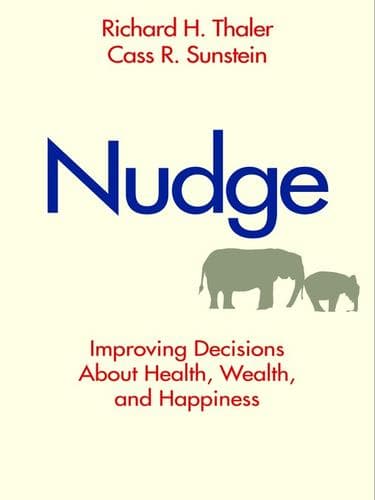
Nudge
Richard H. Thaler, Cass R. Sunstein
Takes Kahneman's insights about predictable biases and shows how choice architecture can steer people toward better decisions, from pensions to organ donation, in a more applied and policy-focused way.
Reader-supported: when you buy through links on our site, we may earn an affiliate commission. Learn more
We earn a commission if you buy through these links. Learn more
Find Similar BooksGuide by the Books of the Day editors · Updated · How we write our guides
Kahneman's tour of the two systems behind your judgments shows how intuition misleads us and when slow reasoning helps, drawn from decades of his research.
2 creators reviewed Thinking, Fast and Slow on YouTube between 2015 and 2018, with 3M views between them. Their opinions are their own; we picked these reviews, we didn't write them.
Thinking, Fast and Slow is Daniel Kahneman's long, wide-ranging account of how the human mind makes judgments and choices. Published in 2011, it pulls together the research he carried out, much of it with the late Amos Tversky, on the mistakes people make when they rely on quick impressions. Kahneman organizes the material around a simple framing: a fast, automatic mode of thought that runs without effort, and a slower, effortful mode that we switch on when we notice a problem. Much of the book concerns how fast intuition produces answers that feel right but aren't.
The approach is conversational and example-driven. Kahneman poses small puzzles, asks readers to answer them before reading on, and then shows where most people, including trained experts, go wrong. The chapters move from attention and heuristics to statistics, risk, and well-being, so the book builds up gradually rather than reading as a set of separate essays. Expect many experiments described in detail, a lot of worked reasoning, and a willingness to admit that the author fell for some of the same traps.
The experience is less like a self-help manual than a long seminar with a patient, slightly wry guide. It is dense in places, and the later sections on economic choice and well-being are more technical than the opening. Readers should come away with a vocabulary for their own mistakes rather than a set of rules that will fix them.
Kahneman treats the fast, automatic mode and the slow, deliberate mode as useful characters rather than literal brain regions. The fast system handles most of daily life and supplies a constant stream of impressions. The slow system is capable but lazy, and it often endorses whatever the fast system offers without checking it. Much of the book's value comes from learning to notice when that handoff is going wrong.
The book catalogues the mental shortcuts we use to judge probability and value, such as judging by how easily examples come to mind or being pulled toward a number we have just seen. These shortcuts are often efficient and accurate. Kahneman's point is that they can also lead us to answer an easier question than the one we were asked, without our noticing the substitution.
Kahneman's work with Tversky challenged the standard picture of a perfectly rational decision maker. People judge outcomes relative to a reference point, feel losses more sharply than equal gains, and make different choices depending on how the same options are framed. The chapters on risk explain why these patterns matter for investing, negotiation, and everyday trade-offs.
Kahneman distinguishes between living through an experience and remembering it afterward, and shows that memory tends to be shaped by peaks and endings rather than by total duration. This distinction complicates common assumptions about happiness and about how we should measure well-being. It is one of the book's more original threads, and it is worth reading slowly.
The book examines why confident forecasts, planning estimates, and expert judgments are so often off target. Kahneman explains that intuition is trustworthy when the environment is regular and the person has had good feedback, and unreliable when those conditions are missing. This gives readers a practical test for when to trust a gut feeling and when to slow down and check.
The book is long, and some readers find its repetition and detailed experimental descriptions wearing. Several findings it presents confidently, particularly in social priming research, have since failed to replicate, and Kahneman himself later acknowledged that some of those claims were overstated. The participants in most studies are drawn from Western, educated populations, which limits how far the conclusions generalize. The two-system framing is a simplifying metaphor, and critics argue it can be taken more literally than the evidence supports. The book offers insight more than concrete remedies.
Book details and cover from Google Books.
Ready to read Thinking, Fast and Slow?
Get your copy on Amazon, or listen to it on Audible. We earn a commission if you buy through these links.
Richard H. Thaler, Cass R. Sunstein
Takes Kahneman's insights about predictable biases and shows how choice architecture can steer people toward better decisions, from pensions to organ donation, in a more applied and policy-focused way.
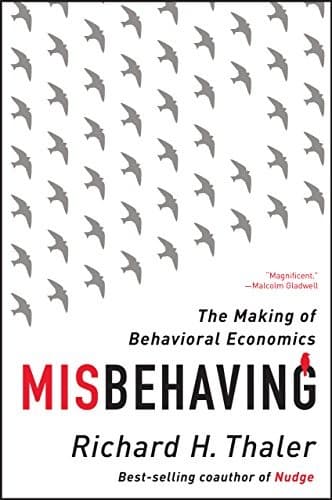
Richard H. Thaler
A lively insider history of how behavioral economics challenged the rational-agent model, featuring Kahneman and Tversky's work and told with humor that lightens the density of Thinking, Fast and Slow.
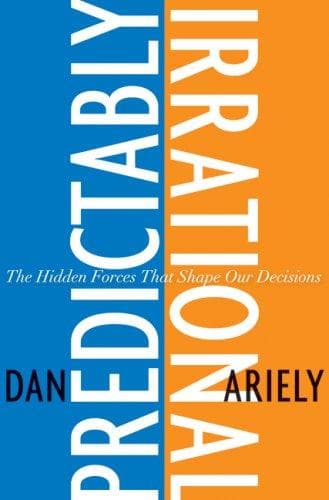
Dan Ariely
Ariely's playful experiments on pricing, free offers and social norms illustrate the same irrational patterns Kahneman describes, in shorter, more anecdotal chapters that make an easy companion read.
Michael Lewis
Tells the story of Kahneman's partnership with Amos Tversky, showing the friendship and arguments that produced the heuristics and biases research at the heart of Thinking, Fast and Slow.