
We earn a commission if you buy through these links. Learn more
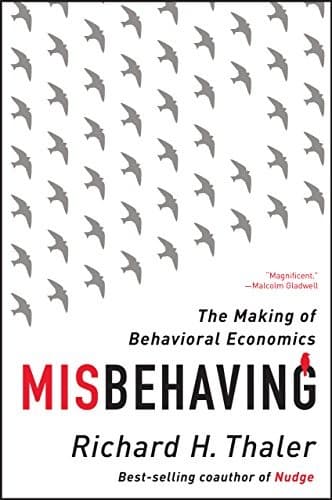
Misbehaving
Guide by the Books of the Day editors · Updated · How we write our guides
Richard Thaler's insider account of how behavioral economics went from a fringe idea to a mainstream field, told through his own career and the arguments he had along the way.
What Creators Say About Misbehaving
2 creators reviewed Misbehaving on YouTube between 2017 and 2025, with 1K views between them. Their opinions are their own; we picked these reviews, we didn't write them.
What It's About
Misbehaving is Richard Thaler's account of how behavioral economics grew from a marginal, often mocked idea into a respected part of the discipline. Much of the book follows his own career, from the early observations he made as a young economist who noticed that people did not behave the way standard models predicted, to the slow and sometimes hostile reception those observations received from colleagues. It is as much a story about academic politics and persistence as it is about psychology.
The approach is part memoir, part intellectual history, and part wry commentary on how economists argue with each other. Thaler writes in a conversational voice, with plenty of self-deprecating humor and clear affection for the collaborators who shaped his work, including Daniel Kahneman and Amos Tversky. You get a feel for how ideas were tested, argued over, and turned into research programs, and how a few well-chosen examples could change minds more effectively than abstract theory.
Reading it feels less like studying a textbook and more like sitting in on a long conversation with a seasoned economist who enjoys telling the story. The technical material is kept light, and most of the examples come from everyday choices about saving, spending, and markets rather than from equations. It works well as a companion to the research it describes, and it is an easy, enjoyable read even if you come to it without a background in economics.
Read this if you…
- want an insider's view of how economic research actually changes, including the politics and personalities involved
- are curious about why people save, spend, and choose the way they do, and want real examples rather than equations
- enjoy memoirs of ideas and like following a researcher's career through its wrong turns and breakthroughs
Skip it if you…
- want a rigorous, self-contained textbook on behavioral economics or its formal models
- are looking for a neutral survey of the field, since the account is shaped by the author's own experiences and views
Key Ideas
- 1
Standard models assume people act rationally
Mainstream economics has long relied on the idea that people are consistent, calculating decision-makers. Thaler argues that this simplification breaks down in patterned ways rather than random noise. The book shows why the anomalies he collected mattered: they were systematic departures that existing theory had no room for, and documenting them was the first step toward building more realistic models.
- 2
Why people treat money differently by label
Thaler's concept of mental accounting describes how people sort money into mental categories, such as savings, gifts, or a vacation fund, and then make choices that a purely rational model would not predict. The book traces how this idea took shape and why it challenged the assumption that a dollar is always a dollar.
- 3
The struggle between present and future selves
Much of the book's interest lies in how self-control problems affect saving and spending. Thaler shows how recognizing that people want to save but often fail to follow through led to practical design ideas, including the savings plan known as Save More Tomorrow, which he developed with Shlomo Benartzi.
- 4
Small design choices shape big decisions
The book explains how the idea of choice architecture, arranging options so that the default path helps people, moved from academic papers into policy discussions. Thaler describes the work he did with Cass Sunstein on nudging and the debates that followed, including the criticisms it attracted from different directions.
Limitations
Because the book is so personal, it leans toward the author's perspective and can read as self-congratulatory in places, with credit disputes told mostly from his side. It is not a complete history of the field, and it covers the research that later drew scrutiny only lightly. Readers who want a full treatment of the replication debates or critiques of nudge policies will need to look elsewhere. Some of the anecdotes are more entertaining than they are detailed.
Questions Readers Ask
- Do I need a background in economics to read Misbehaving?
- No. The book is written for general readers and keeps technical material to a minimum. The ideas are explained through everyday examples about saving, spending, and decision-making. A basic curiosity about how people make choices is enough to follow along and enjoy it.
- How does Misbehaving compare to Thinking, Fast and Slow?
- Kahneman's book is a broad tour of how the mind makes judgments, drawing on psychology throughout. Thaler's book is narrower in scope and focuses on how economists received these ideas and how his own work developed. Reading Kahneman first gives useful background, but Misbehaving stands on its own.
- Published
- 2015
- ISBN
- 9780393352795
- Difficulty
- beginner
- Category
- Business
Book details and cover from Google Books.
Ready to read Misbehaving?
Get your copy on Amazon, or listen to it on Audible. We earn a commission if you buy through these links.