
We earn a commission if you buy through these links. Learn more
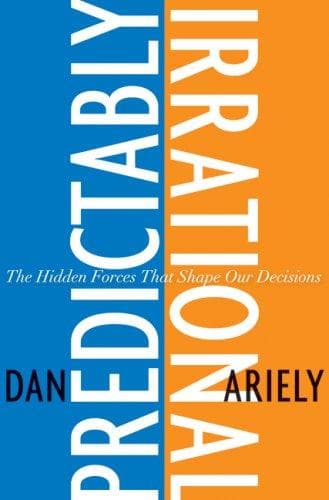
Predictably Irrational
by Dan Ariely
Guide by the Books of the Day editors · Updated · How we write our guides
A readable, example-driven tour of the quirks that bend everyday choices, from the pull of 'free' to the sway of irrelevant numbers, and a useful first encounter with behavioral economics.
What Creators Say About Predictably Irrational
2 creators reviewed Predictably Irrational on YouTube between 2012 and 2015, with 1M views between them. Their opinions are their own; we picked these reviews, we didn't write them.
What It's About
Predictably Irrational is Dan Ariely's popular introduction to behavioral economics, the field that tests how people actually decide rather than how classical economic models say they should. Ariely builds each chapter around a simple experiment or everyday puzzle, such as why a free candy can beat a better-value one, or why a magazine's confusing three-option price list nudges you toward a particular plan. The result reads more like a series of curious stories than a textbook.
The tone is friendly and conversational, with the author often describing his own experiments step by step and inviting you to guess the result before revealing it. The book rarely gets dense, and it is organized around recurring themes such as anchoring, the cost of zero, social versus market norms, and the way emotions cloud judgment. Most readers finish it in a few evenings and come away with a sharper eye for marketing, pricing and their own habits.
It is best approached as a set of thought-provoking examples rather than a final verdict on human nature. The studies are small, the lessons are often generalized quickly, and the pleasure lies in testing your own reactions against the results. Think of it as a guided set of demonstrations you can carry into shops, offices and your own decision-making.
Read this if you…
- are curious about why marketing and pricing work on you
- want an accessible first book on behavioral economics
- enjoy learning through small experiments and everyday examples
Skip it if you…
- want a rigorous academic treatment with full statistical detail
- are looking for a practical self-help plan with step-by-step tools
Key Ideas
- 1
Our judgments are relative, not absolute
Ariely argues that we rarely know what something is worth on its own terms. We judge prices and options against whatever reference point is nearby, which is why a deliberately unattractive option can make another look like a bargain. Seeing this pattern makes it easier to notice when a choice is being framed for you.
- 2
Zero price changes how we weigh things
The book's most memorable idea is that 'free' carries an emotional charge out of proportion to its economic value. A small cost reduction can be less persuasive than removing the price entirely. Ariely uses simple candy and chocolate comparisons to show how this distorts ordinary buying decisions.
- 3
Money and social relationships follow different rules
People behave differently when a favor is governed by social norms, such as helping a friend, than when it is governed by a market transaction. Adding a payment can sometimes weaken good behavior rather than strengthen it. The idea has practical implications for workplaces, schools and policy design.
- 4
Emotions and temptation distort our judgment
Ariely examines how hunger, arousal and other momentary states change what we think we will want or do. People often underestimate how much a current feeling will shape their choices. The lesson is less about willpower in the abstract and more about recognizing when your present state is making decisions for you.
Limitations
Many of the experiments are small, and the book sometimes moves from a single study to broad claims about human nature. Behavioral economics as a whole has faced replication problems, and some of Ariely's own later work has been challenged; a 2012 honesty study he co-wrote was retracted in 2021 after data concerns. The book is also a product of its time and does not reflect later research or debates. Read it as a starting point and verify important claims before relying on them.
Questions Readers Ask
- Is Predictably Irrational still worth reading?
- Yes, as an accessible introduction to how people actually make decisions. Some specific findings have since been questioned, and the field has grown considerably. Treat the examples as illustrations of ideas worth exploring further rather than settled facts, and check specific studies before citing them.
- How does it compare to Thinking, Fast and Slow?
- Kahneman's book is broader, deeper and more rigorous, and it covers the psychology behind decision-making in much more detail. Ariely's book is lighter, more playful and more focused on everyday examples. Many readers start with Ariely and move to Kahneman for a fuller foundation.
- Published
- 2008
- ISBN
- 9780062018205
- Difficulty
- beginner
- Category
- Business
Book details and cover from Google Books.
Ready to read Predictably Irrational?
Get your copy on Amazon, or listen to it on Audible. We earn a commission if you buy through these links.