
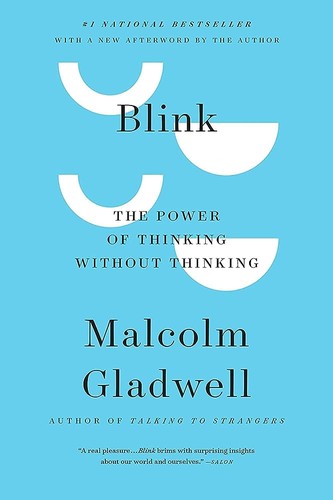
Blink
Malcolm Gladwell
Like Brooks, Gladwell argues that fast, unconscious judgments often beat deliberate reasoning. His examples of split-second decisions show the creative, pattern-spotting mind The Social Animal describes.
Reader-supported: when you buy through links on our site, we may earn an affiliate commission. Learn more
We earn a commission if you buy through these links. Learn more
Find Similar Booksby David Brooks
Brooks uses one composite couple's whole life to argue that emotion, the unconscious, and social bonds matter more than IQ and willpower in building a good life.
The Social Animal, published in 2011, is a nonfiction book by New York Times columnist David Brooks. Rather than offering a checklist of self-help rules, it is built around a narrative. A composite American couple, Harold and Erica, is followed from infancy toward old age, and at each stage Brooks pauses to explain what neuroscience, psychology, economics, and related fields have found about how people develop, decide, and flourish.
The approach is essayistic and synthetic. Brooks mostly draws on existing research rather than original experiments, and he shapes it into a single argument: that much of human life runs beneath conscious awareness, that our minds are shaped by relationships, and that our culture overrates raw intelligence, rational calculation, and self-reliance. The writing is conversational and clear, and the story gives abstract claims a human face.
Reading it feels like being walked through a large body of recent research by a guide with strong opinions and a warm, hopeful temperament. It is absorbing and often humane. Readers who expected a practical manual may find the novelistic device charming, or they may find the characters a little thin as vehicles for the ideas.
Brooks argues that emotion and intuition do much of the work before conscious reasoning arrives, and that deliberate thought often serves to justify choices already made. He treats feelings not as noise to be overcome but as the foundation that makes good judgment possible in the first place.
Much of the mind's processing happens outside awareness, and Brooks suggests this is where character forms and where major life decisions are quietly shaped. The implication is that well-trained intuition deserves more trust than the culture usually gives it, though he is less precise about when that trust is warranted.
The book's central thread is that minds are social from the start. We learn our values, emotional habits, and sense of self through relationships with others. Brooks presents the isolated, purely rational individual as a myth that distorts how people understand their own success and happiness.
Brooks criticizes a culture that equates success with intelligence test scores and self-made independence. In their place he proposes a standard built on trust, humility, and contribution to others. This is the most explicitly moral part of the book, and it is where readers are most likely to agree or push back.
The composite couple is a device rather than evidence, and the narrative can feel contrived. Brooks leans on a range of studies, and some of the psychology he relies on, including certain priming and willpower findings, has faced serious replication problems since publication. He is also selective in what he presents as settled. Critics note that the book says less about structural inequality, unequal opportunity, and economic conditions than about individual character and social bonds. Its sweeping claims about culture can sound more confident than the evidence allows.
Book details and cover from Google Books.
Ready to read The Social Animal?
Get your copy on Amazon, or listen to it on Audible. We earn a commission if you buy through these links.
Malcolm Gladwell
Like Brooks, Gladwell argues that fast, unconscious judgments often beat deliberate reasoning. His examples of split-second decisions show the creative, pattern-spotting mind The Social Animal describes.
Daniel Kahneman
Kahneman maps the two systems of thought that Brooks also puts at the centre of human decision-making. Readers who appreciated his challenge to overrated rationalism will find the research behind it here.
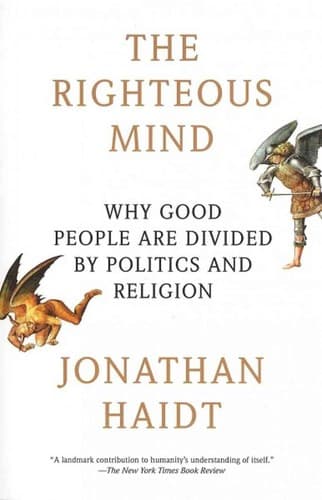
Jonathan Haidt
Haidt shows that moral judgments are driven by intuition and then justified by reason, a point Brooks makes about the social, unconscious mind. It extends his case into politics and morality.
Angela Duckworth
Duckworth examines what separates people who achieve over the long term, focusing on character rather than talent. Readers drawn to Brooks's view of success as built through character will find a complementary case.