
We earn a commission if you buy through these links. Learn more
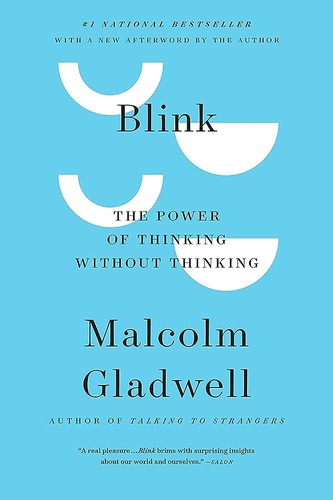
Blink
Guide by the Books of the Day editors · Updated · How we write our guides
Gladwell's most persuasive case for trusting first impressions, packed with vivid stories about experts who read a situation in seconds and why that instinct sometimes fails.
What Creators Say About Blink
2 creators reviewed Blink on YouTube between 2016 and 2019, with 110.8K views between them. Their opinions are their own; we picked these reviews, we didn't write them.
What It's About
Blink is a popular science book about the thinking we do before we are aware of thinking. Gladwell's central claim is that people, especially experts, often reach accurate conclusions within seconds, drawing on patterns they have absorbed but cannot easily explain. He calls the skill of reading a situation from a small slice of information thin-slicing, a term he borrows from research on how quickly people form judgments that match far longer observation.
The approach is storytelling first. Each chapter opens with a case, such as a museum's purchase of a statue that experts sensed was wrong, a famous American presidential election shaped by appearance, or a laboratory study of couples whose arguments predicted their future. Gladwell then moves between anecdote, psychology research, and interviews, building toward a broader point. The tone is confident and conversational, and the pacing is quick. You will finish it in an evening or two without feeling lectured.
Reading it feels like being walked through a set of puzzles, each with a surprising answer. The book rewards curiosity about how minds work and makes an intuitive case that snap judgment deserves more respect than many people give it. It is less interested in offering a rulebook, so expect to come away with ideas to test in your own life rather than a method to follow.
Read this if you…
- enjoy narrative nonfiction that turns research into stories
- want to understand why first impressions are sometimes more accurate than they seem
- are curious about how experts make decisions without visible effort
Skip it if you…
- want a rigorous, citation-heavy examination of cognitive science
- expect practical step-by-step methods for improving your judgment
Key Ideas
- 1
Thin-slicing: judging well from very little
Gladwell argues that the mind can extract a reliable verdict from a brief sample of behaviour or evidence. He uses this to explain why some quick reactions turn out to be right, and why experts often sense the answer before they can justify it. The idea is that experience compresses large amounts of information into fast, usually accurate pattern recognition.
- 2
Adaptive unconscious and the limits of reasoning
The book describes a part of the mind that processes information outside conscious awareness and sends conclusions upward as feelings or hunches. Gladwell suggests that deliberate analysis is not always superior, and that overthinking can drown out the signal that a trained person already has. The case is made through examples where reflection made outcomes worse.
- 3
When snap judgments fail under pressure
Gladwell is equally interested in how rapid cognition goes wrong. Stereotypes, fear, and unfamiliar settings can distort a first reaction, and the book examines how this shaped high-stakes incidents. The argument is not that instinct is infallible but that it is shaped by conditions, and that those conditions can be learned and managed.
- 4
Expertise, bias, and the value of rapid reading
A recurring theme is that real expertise lets people notice what matters at a glance, while outsiders struggle with information overload. Gladwell suggests that the best decision-makers learn to filter what they see, and that organisations can either support or undermine this skill through how they gather and present information.
Limitations
Critics have argued that Gladwell's examples are selected to support his thesis, and that the book can make snap judgment sound more reliable than the evidence allows. Many of the studies he draws on are summarised briefly, so readers cannot easily check how strong they are. The book also says less about the many situations where quick judgments are simply wrong, and about how biases can hide inside confident intuition. Since its 2005 publication, research on decision-making and implicit bias has developed considerably, and newer work may sharpen or qualify several claims.
Questions Readers Ask
- Is Blink still worth reading today?
- Yes, as an accessible introduction to ideas about intuition and rapid judgment. Its best chapters remain engaging. However, because the research has moved on, treat its claims as starting points for further reading rather than settled science, and consider pairing it with more recent work on decision-making and bias.
- How does Blink compare with Daniel Kahneman's Thinking, Fast and Slow?
- Kahneman's book is more systematic and more cautious about intuition, cataloguing the errors that fast thinking produces. Blink is looser and more celebratory of snap judgment. If you want a balanced account of when to trust your gut, read Kahneman. If you want an entertaining case for why instinct deserves more respect, Blink fits well.
- Published
- 2004
- ISBN
- 9780316172325
- Difficulty
- beginner
- Category
- Education
Book details and cover from Google Books.
Ready to read Blink?
Get your copy on Amazon, or listen to it on Audible. We earn a commission if you buy through these links.