
We earn a commission if you buy through these links. Learn more
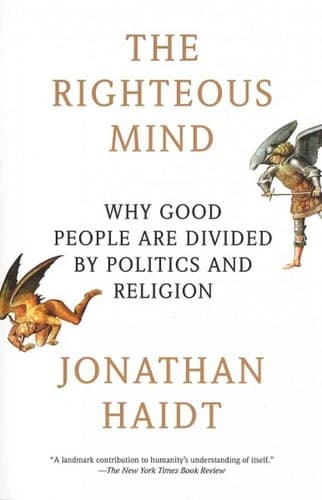
The Righteous Mind
Guide by the Books of the Day editors · Updated · How we write our guides
Haidt explains why moral judgments come from gut intuition before reasoning, and why that makes political opponents so hard to persuade. It is a useful lens for anyone baffled by polarization.
What Creators Say About The Righteous Mind
2 creators reviewed The Righteous Mind on YouTube between 2012 and 2022, with 200.7K views between them. Their opinions are their own; we picked these reviews, we didn't write them.
What It's About
The Righteous Mind is Jonathan Haidt's attempt to explain why people disagree so stubbornly about morality and politics. His central claim is that moral judgments usually arrive as fast, emotional intuitions, and that the reasoning we offer afterward is more often a defense of those feelings than a path to them. Haidt uses the image of an elephant and its rider to make this concrete: the rider is our verbal reasoning, and the elephant is the intuitive mind that mostly steers.
The book is part research summary, part personal argument, and part travelogue of ideas. Haidt draws on his experimental work on moral psychology, on evolutionary accounts of group living, and on his own changing views about political conservatives. He sketches several moral foundations, such as care, fairness, loyalty, authority, and sanctity, that he thinks different cultures and political camps weight differently. Much of the book is written in a conversational, self-questioning voice, and it often stops to test its own claims.
Reading it feels less like absorbing a set of tips and more like being walked through an argument you may end up disagreeing with in places. It rewards patience with long passages, and it is most valuable when you read it as a prompt to examine your own reactions to people you disagree with.
Read this if you…
- want a clear framework for why moral arguments rarely convert people
- are curious about how evolutionary thinking applies to politics and religion
- find yourself baffled or angry at people who see the same issues differently
Skip it if you…
- want a short, punchy read with lots of practical takeaways
- expect a neutral survey of political science rather than the author's own argument
Key Ideas
- 1
Intuition comes first, reasoning follows
Haidt argues that people reach moral verdicts quickly and then search for justifications. Reasoning is often used to persuade others or to defend a position already taken, which explains why arguing facts rarely changes minds. The idea reframes disagreement as a difference in initial feelings rather than in logic alone.
- 2
Moral foundations shape different political views
He describes a small set of intuitive moral concerns, including care, fairness, loyalty, authority, and sanctity. Liberal and conservative moralities, in his account, weight these foundations differently rather than one side being simply more or less moral. This gives readers a vocabulary for why the other side's values feel alien.
- 3
Humans are built for groups as well as individuals
Haidt draws on evolutionary ideas about group living to argue that people have a strong capacity for team loyalty and shared ritual. He frames this as a double-edged trait that makes cooperation possible while also fueling tribalism. The point helps explain why moral communities can be both generous and hostile to outsiders.
- 4
Understanding the other side without agreeing
A practical thread of the book is that open-minded engagement starts with grasping why opponents hold their views. Haidt suggests this understanding can reduce contempt even when it does not change the conclusion. It is a more modest goal than winning arguments, and the book makes a reasonable case that it is also more productive.
Limitations
Critics have questioned how firmly the moral foundations framework is supported and whether its measures capture what people actually care about. Some readers feel the book's examples lean toward explaining conservatives more sympathetically than liberals, and Haidt's group-selection ideas remain contested among scientists. The book is also dated in its specific political examples and predates much later research on polarization. It offers less guidance on concrete policy or on how to change institutions.
Questions Readers Ask
- Who is The Righteous Mind best suited for?
- It suits readers interested in psychology, politics, or religion who are willing to engage with long arguments and some academic research. It is especially useful for people who feel stuck in political arguments and want to understand why. Readers wanting a quick, practical guide will likely find it slow going.
- Is The Righteous Mind still relevant?
- Its core ideas about intuition and moral foundations remain widely discussed, so it still shapes conversations about polarization. Some specific examples and empirical claims have been challenged or refined by later research. Reading it alongside newer work helps separate the durable insights from the details that have aged.
- How does it compare to Thinking, Fast and Slow?
- Kahneman's book focuses on cognitive biases in judgment and decision-making generally, while Haidt focuses specifically on morality and group identity. Both argue that fast, intuitive processes shape our conclusions more than we admit. Haidt's book is narrower in scope but more directly relevant to political disagreement.
- Published
- 2012
- ISBN
- 9789025908362
- Difficulty
- intermediate
- Category
- Psychology
Book details and cover from Google Books.
Ready to read The Righteous Mind?
Get your copy on Amazon, or listen to it on Audible. We earn a commission if you buy through these links.