
The Selfish Gene
Richard Dawkins
Like The Blank Slate, it uses evolutionary logic to explain behaviour that seems to have no obvious cause. Dawkins writes with the same clarity and boldness about why organisms act as they do.
Reader-supported: when you buy through links on our site, we may earn an affiliate commission. Learn more
We earn a commission if you buy through these links. Learn more
Find Similar BooksGuide by the Books of the Day editors · Updated · How we write our guides
An accessible tour through the history and science of the idea that the mind starts empty, and why Pinker thinks that belief warps debates on parenting, violence, politics, and art.
2 creators reviewed The Blank Slate on YouTube between 2008 and 2023, with 574.4K views between them. Their opinions are their own; we picked these reviews, we didn't write them.
The Blank Slate is Steven Pinker's 2002 case against the view that the human mind is a largely blank surface shaped mainly by culture, upbringing, and society. He calls this view the blank slate doctrine and traces its roots from Locke and other Enlightenment thinkers through twentieth-century behaviorism and cultural anthropology. He argues it was embraced for reasons that had as much to do with politics as with evidence. Pinker is a cognitive scientist, so the book leans on research from genetics, evolutionary biology, and developmental psychology, and he writes in a brisk, argumentative voice with plenty of wit.
The book is less a single experiment than a long argument built from several strands: historical case studies, reviews of twin and adoption research, discussions of how children learn language and social rules, and a close look at how the doctrine has shaped debates about violence and sex differences. Pinker takes care to separate claims about innate traits from claims about destiny, and that distinction recurs throughout.
Reading it feels like sitting in on a debate where the author has prepared thoroughly and is quick to name his opponents' moves. Some chapters are dense with data; others read more like essays. The tone can be combative, and the book rewards readers willing to follow a sustained argument rather than a list of takeaways.
Pinker argues that the idea that minds are shaped entirely by environment came to be treated as a moral necessity, so questioning it seemed to threaten equality or decency. He tracks how this belief shaped mid-century social science and public debate, and he claims it made empirical questions feel like threats rather than problems to be studied.
A central move in the book is separating a trait being built in by genes from that trait being unchangeable. Heritability figures describe variation across a population, not destiny for an individual. Pinker argues that people who blur these ideas end up both dismissing genetic evidence and treating it with fatalism.
Pinker reviews behavioral genetics findings suggesting that many personality differences among siblings come from experiences outside the shared home, and that parenting style has smaller measured effects on adult personality than many people expect. He uses this to challenge the assumption that good parenting can reliably shape children into any chosen form.
Pinker argues that rejecting a shared human nature invites utopian engineering and undervalues universal emotions and motives. He contends that an honest account of human nature, based on science and common sense, leads to more realistic and humane approaches to violence, crime, and equality.
Critics argue that Pinker sometimes caricatures his opponents, especially social scientists and anthropologists, and that the book is more one-sided than its even-handed tone suggests. Some reviewers felt he underplayed how much culture and environment shape behavior, and that he overstated how settled the science was in areas like behavioral genetics and evolutionary psychology. Because the book is more than two decades old, some empirical claims reflect the research of its time, and the newer afterword addresses some debates but not all.
Book details and cover from Google Books.
Ready to read The Blank Slate?
Get your copy on Amazon, or listen to it on Audible. We earn a commission if you buy through these links.
Richard Dawkins
Like The Blank Slate, it uses evolutionary logic to explain behaviour that seems to have no obvious cause. Dawkins writes with the same clarity and boldness about why organisms act as they do.
Robert Wright
Wright applies evolutionary psychology to jealousy, status, and cooperation, the kind of everyday human traits Pinker says the blank slate view ignores. It is accessible and well argued.
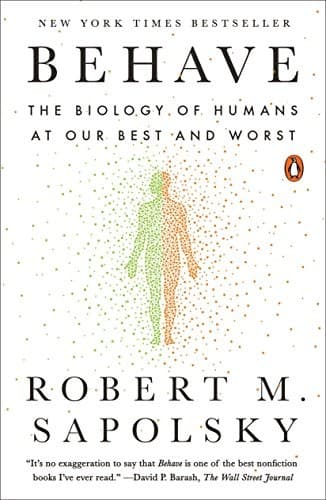
Robert M. Sapolsky
Sapolsky traces human behaviour through genes, hormones, and environment, showing that biology and experience interact. Readers who liked Pinker's refusal to pick one cause will find that balance here.

Judith Rich Harris
Harris argues that parents matter less to how children turn out than we assume, a claim Pinker discusses in his chapter on parenting. It is a provocative, direct challenge to conventional wisdom.