
We earn a commission if you buy through these links. Learn more
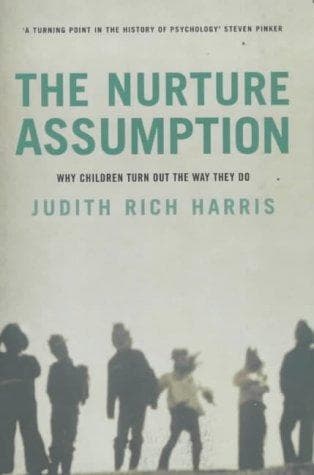
The nurture assumption
A provocative argument that parents shape their children's lives less than we assume, and that peers and outside environments do much of the shaping.
What It's About
The Nurture Assumption is Judith Rich Harris's case against one of the most widely held beliefs in modern parenting: that the way parents raise their children is the main force shaping who those children become. Harris, who wrote from outside the academic mainstream, pulls together research from behavioral genetics, adoption and twin studies, and developmental psychology to argue that the effect of home environment on personality and adult outcomes is smaller than most people assume. She separates the shared environment of the family from the nonshared environment each child experiences outside it.
Her approach is that of a patient, somewhat combative explainer. She works through studies one at a time, comments on how their findings have been interpreted, and is willing to say that a popular claim does not survive the data. The tone is confident and often witty, with an edge aimed at researchers and parenting advisers she thinks have overreached. Much of the book reads like an argument with the reader's own assumptions, which makes it engaging but also means it is more persuasive in some places than in others.
Reading it is less like following a self-help manual and more like sitting through a long, carefully built case. You will come away with new questions about what parents can and cannot control, and a sharper sense of how much of a child's social world is built with peers. It asks you to revise a belief rather than change a routine.
Read this if you…
- want a rigorous, evidence-driven challenge to popular parenting advice
- are curious how genes and environment combine to shape children
- are a parent or teacher willing to have a comfortable belief questioned
Skip it if you…
- want practical parenting tips or step-by-step guidance
- prefer a balanced survey that gives every position equal weight
Key Ideas
- 1
Behavioral genetics suggests a smaller family effect
Twin and adoption studies suggest that children raised in the same household are not much more alike in personality than children who share a home only by chance. Much of the remaining variation tracks genes, and much of the rest seems to come from experiences children have outside the family. Harris treats this pattern as the central puzzle that the nurture assumption fails to explain.
- 2
Peers shape behavior more than parents
Children spend much of their time with peers and absorb their norms, slang, and status rules. Harris argues that identity forms largely within groups, and that learning to fit in with peers matters more for adult personality than what happens at home. She calls this process group socialization.
- 3
Children adapt to the groups they join
Harris uses the example of accents to show how children pick up the speech patterns of their friends rather than their parents. The broader point is that children are highly adaptive to the social groups they enter, and that they store what they learn for use outside the home, not only inside it.
- 4
Where parents still matter, and where they do not
Harris does not argue that parents are irrelevant. She notes that they supply genes, shape the home, and influence matters such as language at home and general wellbeing. Her narrower claim concerns personality and long-term outcomes, and she asks readers to separate those effects from the everyday work of raising children.
Limitations
Critics argue that Harris leans on the cases that support her and downplays evidence that parenting does matter, especially in cases of abuse, neglect, and emotional insecurity. Her reliance on twin and adoption correlations is open to debate, since such designs cannot cleanly separate every mechanism. The book also draws mostly on Western, middle-class research samples, and its polemical tone can feel one-sided. Later research has refined several of her claims, but it has not dismissed her central challenge.
Questions Readers Ask
- Is The Nurture Assumption still relevant to parents?
- Yes, mainly as a corrective. Its central argument has been debated for decades since publication, and researchers still argue about how much family environment matters. Read it to question the idea that every outcome is your doing, not as a guide to what to change tomorrow. Its main value is in changing how you think about cause.
- How does it compare to Pinker's The Blank Slate?
- Pinker's The Blank Slate covers wider territory, including innate features of the mind and the history of the nature-nurture debate. Harris is narrower and focuses on childhood development, peers, and the family. If you want the big picture, start with Pinker. If you want a detailed argument about parents and peers, Harris goes deeper.
- Published
- 1998
- ISBN
- 9780747548942
- Difficulty
- intermediate
- Category
- Science
Book details and cover from Google Books.
Ready to read The nurture assumption?
Get your copy on Amazon, or listen to it on Audible. We earn a commission if you buy through these links.