
We earn a commission if you buy through these links. Learn more
Behave
Guide by the Books of the Day editors · Updated · How we write our guides
Sapolsky's sweeping tour of why people act as they do, from the brain's last-second decisions back through hormones, childhood, evolution, and culture, makes a hard case for compassion over blame.
What Creators Say About Behave
2 creators reviewed Behave on YouTube between 2017 and 2020, with 72.4K views between them. Their opinions are their own; we picked these reviews, we didn't write them.
What It's About
Behave is a long, wide-ranging attempt to explain why people do what they do, from a violent act to a moment of generosity. Sapolsky, a Stanford neuroendocrinologist who has spent decades studying baboons in Kenya, organizes the book around timescales. He starts with what happens in the brain and body in the seconds before an action, then works backward through hormones, childhood experience, evolutionary history, and culture. The result is less a single argument than a method: every behavior has many causes operating at once, and most of them sit outside the person's awareness.
The style is conversational and often funny, with sharp digressions and a fondness for vivid animal examples. It also carries a lot of real science and does not shy from technical detail. Expect long chapters, frequent detours into neurochemistry, and plenty of careful hedging about what is known and what is speculation. It rewards patient reading more than skimming.
Reading it feels less like absorbing a thesis than being walked through a very large set of puzzle pieces by someone who keeps stopping to show how each one fits. Many readers come away with a changed sense of blame and responsibility, which is the book's main ambition, and with a reminder that our categories of good and bad people are shakier than they feel.
Read this if you…
- want a broad, science-driven account of why people act as they do
- are comfortable with long chapters and some dense biology
- are curious about free will and responsibility without a philosophy background
Skip it if you…
- want a short, tight book built around a single clear thesis
- are looking for practical self-help advice on changing your own habits
Key Ideas
- 1
Behavior has layers of causes
Sapolsky separates the immediate triggers of an action from the longer chains that produced them, such as hormones, early development, and evolutionary pressures. The book's central habit is asking which timescale an explanation belongs to. Seeing these layers at once makes simple verdicts about why someone acted look incomplete, and it gives readers a practical framework for thinking about any behavior, not just the ones covered here.
- 2
Stress and social rank shape health
Drawing heavily on his long field work with baboons, Sapolsky shows how position in a social hierarchy can change stress hormones, immune function, and behavior. The argument extends to humans, where status, uncertainty, and chronic pressure affect bodies in ways that are easy to dismiss. The animal evidence is the most engaging part of the book and makes the human implications feel concrete rather than abstract.
- 3
Free will looks thinner under scrutiny
Because every choice rests on a chain of earlier causes, Sapolsky argues that the sense of acting freely is far less complete than people assume. He does not conclude that choices are meaningless, but he pushes toward a more forgiving view of wrongdoing and a more serious look at how society punishes. Readers interested in moral responsibility will find this the most debated thread in the book.
- 4
Tribalism and empathy are biologically tangled
The book examines why humans bond intensely with their own groups and treat outsiders with suspicion, sometimes with violence. Sapolsky looks at how these instincts arise and how they can be loosened, though he is candid that the mechanisms are messy. The discussion is especially relevant to readers thinking about polarization and prejudice, where the book offers explanation more than easy fixes.
- 5
Culture and biology constantly feed each other
Sapolsky rejects the idea that nature and nurture are separate contests. Cultural norms, economic conditions, and beliefs change the biology of individuals, and biology in turn shapes what cultures can become. This interplay runs through the later chapters and is the thread that ties the book's scientific material to questions about society and policy.
Limitations
Critics note that the book is long and repetitive in places, and that its reach across neuroscience, psychology, genetics, and social policy means some topics get thinner treatment than specialists would like. Its free-will argument has been debated by philosophers who find it less novel than the book presents it. Some of the science, especially in fast-moving areas like genetics and brain imaging, has been revised since publication. Readers who want a clear line on personal accountability may find the deterministic framing unsatisfying.
Questions Readers Ask
- Is Behave still worth reading given newer neuroscience books?
- Yes, mostly. Its framework of layered causes, running from the last few seconds back to evolution, still organizes the subject well, even though specific findings in genetics and brain imaging have moved on. Read it as a map for thinking about behavior, and check specialist sources for current details.
- How does Behave compare with Thinking, Fast and Slow?
- The books differ in aim. Kahneman explains how the mind's fast and slow systems produce predictable errors in judgment. Sapolsky covers a far wider range, including hormones, childhood, evolution, and culture, and is more interested in what this means for blame and compassion. Choose Kahneman for decision-making and Sapolsky for the full biological picture.
- Do I need a background in biology to read Behave?
- No, though patience helps. Sapolsky explains terms as he goes and relies on many stories and examples, but chapters on neurons and hormones can be dense. Readers without a science background usually manage well when they slow down and reread the more technical sections.
- Published
- 2017
- ISBN
- 9781847924711
- Difficulty
- intermediate
- Category
- Science
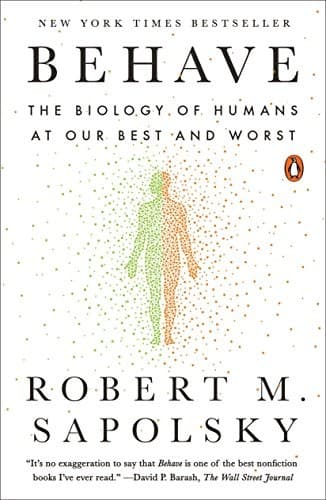
Book details and cover from Google Books.
Ready to read Behave?
Get your copy on Amazon, or listen to it on Audible. We earn a commission if you buy through these links.