
A Discovery of Witches
Deborah E. Harkness
A scholarly heroine, a brooding centuries-old love interest and rich historical layers make this a natural next step for Outlander fans who loved the blend of romance, danger and the past.
Reader-supported: when you buy through links on our site, we may earn an affiliate commission. Learn more
We earn a commission if you buy through these links. Learn more
Find Similar BooksGuide by the Books of the Day editors · Updated · How we write our guides
A time-travel romance that works as a sweeping historical adventure: a postwar nurse lands in 1740s Scotland, and the period detail is as absorbing as the love story.
2 creators reviewed Outlander on YouTube between 2014 and 2020, with 124.8K views between them. Their opinions are their own; we picked these reviews, we didn't write them.
Outlander follows Claire Randall, a former wartime nurse who is spending a second honeymoon in the Scottish Highlands with her husband, Frank, a historian. On a walk near ancient standing stones, she is pulled back roughly two centuries into a country of clan rivalries, English garrisons, and political unrest. Everything she knows about medicine, money, and social rules suddenly matters in ways she never expected, and the book keeps her practical, improvising, and often in danger.
Gabaldon writes in close first person, so the story is filtered through Claire's sharp, wry, unsentimental voice. She is a trained nurse, and much of the pleasure lies in watching her apply modern skill to 18th-century illness, injury, and herbal remedies. The prose is immersive and detailed, with Scots and French phrases woven into the dialogue. The romance develops slowly under pressure rather than arriving all at once, and the sexual content is frank.
Reading it is a commitment. The book runs long, the middle stretches can feel slow as the setting is built, and violence, including sexual violence against women, is shown directly rather than softened. Readers who settle into its rhythm get a vivid, emotionally demanding story that ends by setting up much more to come.
Claire's value comes from what she knows, not from heroics. Her training in nursing, her frankness, and her understanding of how power works give her leverage, but they also make her conspicuous and vulnerable. The tension between what she can do and what the period allows drives much of the plot and keeps her choices feeling costly.
Gabaldon builds daily life in detail: food, clothing, medicine, clan law, and the uneasy politics of a Highlands on the edge of larger rebellion. The setting is not decoration. It shapes what people can say, who can be trusted, and what a single decision risks. Readers who enjoy history for its textures will find this the strongest part of the book.
The central romance is more than attraction. Claire is caught between two men and two incompatible futures, and the book takes seriously the question of what it means to belong somewhere. Loyalty, duty, and self-definition matter as much as desire, which gives the emotional arc more weight than a typical historical romance.
The book does not treat cruelty as background noise. Captivity, coercion, and brutality, especially toward women, are depicted with unsettling directness. This is central to the story's stakes, but it is also the element most likely to shape whether a reader finds the book gripping or hard to stay with.
Claire's first-person narration is dry, observant, and often funny about her own situation, which lightens a long and sometimes grim story. Her voice is the main reason many readers keep going through the slower passages, and it is the thread that ties the historical material and the emotional drama together.
The book is long, and many readers find the middle section slow as Gabaldon builds the setting and secondary characters. Its treatment of sexual violence is direct, and some critics argue the romance leans on dominance dynamics that feel dated. Gender roles in parts of the story reflect the period but can read as conventional by modern standards. The book also begins a long series, and its ending is designed to leave major questions open.
Book details and cover from Google Books.
Ready to read Outlander?
Get your copy on Amazon, or listen to it on Audible. We earn a commission if you buy through these links.
Deborah E. Harkness
A scholarly heroine, a brooding centuries-old love interest and rich historical layers make this a natural next step for Outlander fans who loved the blend of romance, danger and the past.
Audrey Niffenegger
Like Claire and Jamie's story, this is a love affair shaped and strained by time itself, told with emotional depth and a focus on devotion across impossible circumstances.
Octavia Butler
A modern woman is pulled into the past and must survive its brutal realities. It shares Outlander's premise but delivers a sharper, harrowing look at history and power.
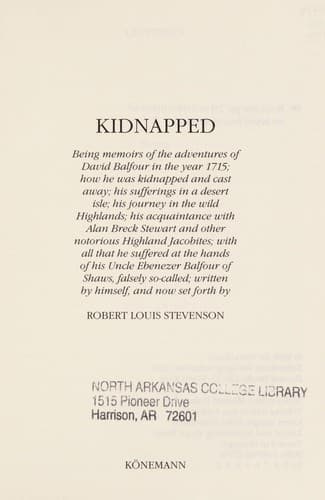
Robert Louis Stevenson
Set just after the Jacobite rising, this classic adventure across the Highlands offers the clan loyalties, redcoats and rugged landscapes that make Outlander's Scotland so vivid.