
We earn a commission if you buy through these links. Learn more
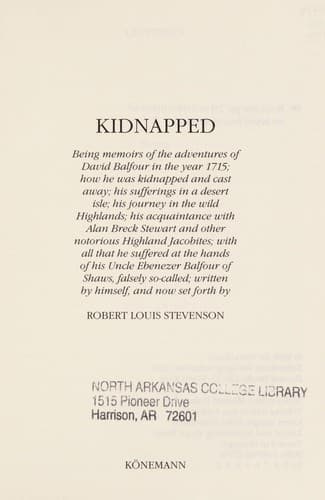
Kidnapped
Guide by the Books of the Day editors · Updated · How we write our guides
Stevenson's 1886 adventure follows an orphan across 18th-century Scotland with a fugitive Jacobite. Here is what reading it is like and who will enjoy it.
What Creators Say About Kidnapped
2 creators reviewed Kidnapped on YouTube between 2021 and 2025, with 3.4K views between them. Their opinions are their own; we picked these reviews, we didn't write them.
What It's About
Kidnapped follows David Balfour, a young man from a modest rural background who is left alone after his father's death and sent to live with a suspicious uncle who has little interest in his welfare. The early chapters establish a sense of unease and a fast-moving plot that soon takes David well beyond his home district. The story is set in Scotland in the years after the failed Jacobite rising of 1745, when the country was still divided, watchful, and often hostile to strangers.
The book is narrated in the first person by David, looking back on his younger self with a dry, earnest, sometimes comic voice. That voice does a lot of the work. David is brave but inexperienced, honest to a fault, and often baffled by the people and politics around him, and his bewilderment makes the reader feel the strangeness of the world he is entering. Stevenson also writes Scots dialogue and idiom, which gives the speech of many characters a distinct texture.
Reading Kidnapped feels like following a serial. It moves through a series of set pieces, journeys, chases, and encounters, with coastlines, moors, and cities each playing a part. Stevenson is a superb pacer, and the book rarely sits still, though it is more episodic than a tightly built modern thriller. It is often shelved as children's fiction, but it rewards adult readers who enjoy old-fashioned storytelling done with real craft.
Read this if you…
- Enjoy historical adventure with a road-trip structure and a strong sense of place
- Want a young narrator with a dry, self-deprecating voice
- Liked Treasure Island and want something similar from the same author
Skip it if you…
- Want a dense, psychologically intricate novel with modern pacing
- Find older Scots dialect and 18th-century phrasing a constant obstacle to enjoyment
Key Ideas
- 1
An unlikely partnership across class and creed
The core of the book is the uneasy alliance between David, a naive lowland youth, and Alan Breck, a flamboyant and quarrelsome Highland fugitive. Their friendship is built on mutual suspicion and grudging respect, and it gives the story its emotional spine. Stevenson uses their differences in temperament, background, and loyalty to explore how strangers from opposite sides of a divided country learn to trust each other.
- 2
Scotland in the aftermath of rebellion
Stevenson sets the story in a country still scarred by the 1745 rising and its suppression. Soldiers, informers, and rumours shape daily life, and to be from the wrong region or hold the wrong opinions can be dangerous. The book gives a vivid sense of a society under occupation-like pressure, though it views the Highland cause largely through outsiders' eyes.
- 3
A narrator whose innocence is the lens
David's voice is the book's most distinctive feature. He is earnest, slightly pompous, and eager to do right, and he often misreads what is happening around him. That gap between his understanding and the reader's gives the story irony and warmth, and it turns his coming-of-age into a question of how far principle can survive contact with a rough world.
- 4
Adventure as a test of character
Each danger and reversal in the story pushes David to decide what kind of person he is willing to be. Honesty, loyalty, and courage are tested rather than simply displayed. The episodes are not just thrills; they are moments where a young man learns, sometimes painfully, what he owes to others and what he will not compromise.
Limitations
The Scots dialogue and period diction can slow readers who are not used to them, and some older attitudes toward Highland people and Catholicism show through the narration. The politics of the Jacobite rising are seen mostly from a Lowland, outsider perspective, so the Highland cause is less fully understood than it might be. Some coincidences and convenient escapes strain plausibility, and the female characters have limited roles. These are common complaints, and they are not disqualifying for most readers, but they are worth knowing before you start.
Questions Readers Ask
- Is Kidnapped really a children's book?
- It is often shelved that way and is widely taught to young readers, so it is accessible to them. Its vocabulary, dialect, and historical background, however, make it more satisfying for teenagers and adults who enjoy older prose. Many adult readers come back to it for its voice and atmosphere rather than its plot alone.
- How does it compare with Treasure Island?
- Both are adventure stories by Stevenson with young narrators and memorable rogues. Treasure Island is tighter and more openly thrilling, while Kidnapped is more historical, more episodic, and more interested in politics and the landscape of Scotland. If you loved the pirate story for its momentum, expect a slower, more reflective book here.
- Is it still worth reading today?
- Yes, especially if you enjoy historical fiction or travel-driven adventure. Its portrait of a divided country after rebellion still feels rich, and Stevenson's prose remains lively. Readers who want modern pacing or a fully balanced view of the historical conflict may want to pair it with a more recent account.
- Published
- 1886
- ISBN
- 9789390001118
- Difficulty
- intermediate
- Category
- Children's Books
Book details and cover from Google Books.
Ready to read Kidnapped?
Get your copy on Amazon, or listen to it on Audible. We earn a commission if you buy through these links.