
Thinking, Fast and Slow
Daniel Kahneman
The earlier book by Noise's lead author lays out the cognitive biases and two-system thinking that Noise builds on, so readers can see where the ideas on judgement error come from.
Reader-supported: when you buy through links on our site, we may earn an affiliate commission. Learn more
We earn a commission if you buy through these links. Learn more
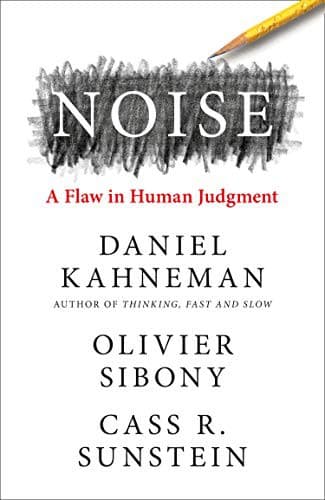
Find Similar Booksby Daniel Kahneman, Olivier Sibony
Guide by the Books of the Day editors · Updated · How we write our guides
Noise shows that inconsistent judgment, not just biased judgment, quietly undermines hiring, medicine, justice, and insurance, and it offers practical ways to reduce it.
2 creators reviewed Noise on YouTube in 2021, with 30.8K views between them. Their opinions are their own; we picked these reviews, we didn't write them.
Noise is about one specific kind of error: the scatter in judgments that should agree. Daniel Kahneman, Olivier Sibony, and Cass Sunstein argue that we spend most of our attention on bias, the consistent lean in one direction, and overlook noise, the unwanted variability when different people, or the same person on different days, reach different conclusions about the same case. The authors build their case mainly through examples from insurance, hiring, medicine, criminal sentencing, and forecasting.
The style is deliberate and somewhat repetitive. Much of the book is workmanlike, with case studies, diagrams, and frequent signposting, and it asks readers to follow a framework rather than be carried along by anecdotes. The middle section moves from diagnosis to measurement, and the later chapters focus on practical process more than theory, so it reads partly like a consultant's report and partly like a behavioral science text.
The experience is less a page-turner than a working manual for anyone who makes or reviews decisions. You are likely to finish with a new habit: asking how consistent a process is, not only whether its outputs seem reasonable. Readers who know Thinking, Fast and Slow will recognize the authors' voice, but this book stands apart by focusing on variability rather than cognitive shortcuts.
Bias is a systematic error that pushes results in one direction, like a scale that always reads high. Noise is random scatter, like a set of shots that land all over the target. Both make judgments inaccurate, but noise is easier to overlook because it produces no obvious pattern. The authors argue that organizations focus on bias while assuming their people agree with one another, which is often false.
Level noise appears when some evaluators are consistently harsher or more lenient than others. Pattern noise is subtler: different people react to the same case in idiosyncratic ways that do not average out. The book also discusses occasion noise, where a single person's judgment shifts with mood, fatigue, or timing. Separating these types helps a reader see where variability is coming from.
The authors suggest that organizations can measure their own inconsistency by having several people judge the same set of cases independently and then comparing the spread of their answers. This turns an abstract worry into something a team can count. The idea is practical and easy to borrow, even if your organization never runs a formal study.
Decision hygiene is the book's name for simple steps that make judgment more reliable. Examples include breaking a decision into separate, assessable components, having people form views independently before any group discussion, and combining several independent estimates. None of these steps requires special expertise, which is why the authors present them as broadly usable.
Simple rules and statistical models tend to be more consistent than human judges, and the authors make a strong case for using them where the task allows. They also acknowledge that rules can miss context and that people still need to set goals, check outcomes, and handle unusual cases. The book treats algorithms as a tool within a process, not a full replacement for judgment.
The book leans heavily on repetition, and some readers will find the structure tiring, especially once the core argument has been made. Several remedies are sensible but abstract, and the authors do not always show how hard they are to implement inside real bureaucracies. Consistency is also not the same as accuracy: a process can be uniform and still be wrong, and the book's focus on reducing variability can sometimes underplay that point. Its examples are mostly from before the recent wave of AI tools, so readers interested in current machine learning debates will need additional sources.
Book details and cover from Google Books.
Ready to read Noise?
Get your copy on Amazon, or listen to it on Audible. We earn a commission if you buy through these links.
Daniel Kahneman
The earlier book by Noise's lead author lays out the cognitive biases and two-system thinking that Noise builds on, so readers can see where the ideas on judgement error come from.
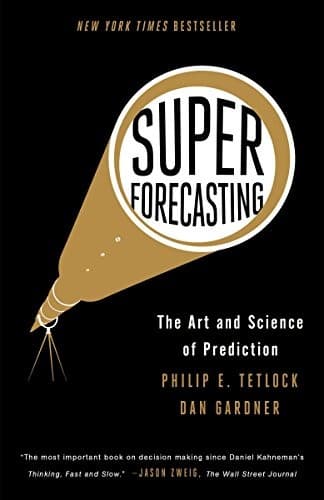
Philip E. Tetlock, Dan Gardner
Like Noise, it asks how judgement can be made more accurate and consistent, showing how disciplined forecasters track their reasoning and update on evidence.
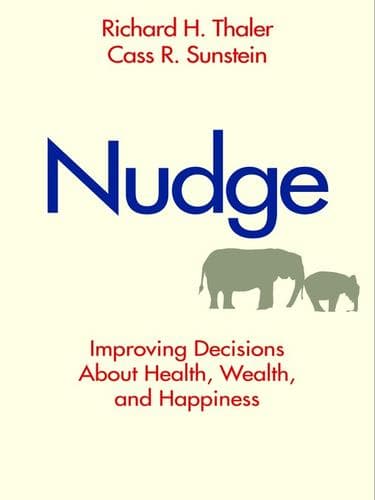
Richard H. Thaler, Cass R. Sunstein
It shares Noise's interest in how choice architecture and small design changes steer everyday decisions, with a similarly accessible, example-driven style.
Atul Gawande
Gawande shows how simple, standardised checklists reduce errors in surgery and other complex work, mirroring Noise's case for rules and structured procedures over case-by-case intuition.