
We earn a commission if you buy through these links. Learn more
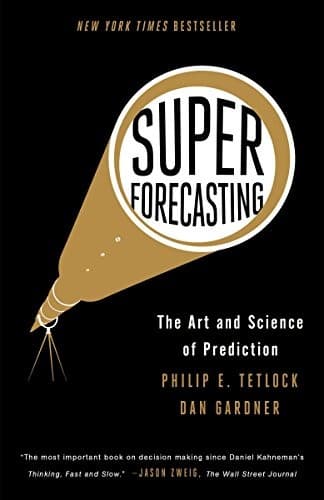
Superforecasting
by Philip E. Tetlock, Dan Gardner
Guide by the Books of the Day editors · Updated · How we write our guides
A rare look at how a forecasting contest found specific thinking habits that measurably improve predictions, written for readers who want practical tools rather than theory.
What Creators Say About Superforecasting
2 creators reviewed Superforecasting on YouTube between 2017 and 2025, with 6.5K views between them. Their opinions are their own; we picked these reviews, we didn't write them.
What It's About
Superforecasting is Philip Tetlock and Dan Gardner's account of the Good Judgment Project, a multi-year forecasting tournament run for the US intelligence community's research arm. Thousands of volunteers answered specific questions about world events, from elections to economic moves, and their answers were scored for accuracy once outcomes became known. Tetlock, a psychologist, had earlier shown that many confident pundits did little better than chance on questions like these. The tournament let him ask a more useful question: can forecasting skill be measured, and can it be taught?
The book's answer is yes, and its most interesting finding concerns who did best. The top performers, called superforecasters, were rarely famous experts. They were ordinary people with a particular way of thinking: they broke big questions into smaller ones, started from how often similar things happen, adjusted their views in small steps as new evidence arrived, and were willing to change their minds. Working in teams and combining different viewpoints also helped.
The style mixes research narrative, anecdotes from the tournament and from history, and practical advice. It reads quickly and is upbeat, with a clear sense that the authors want to persuade. The experience is less like a theory of human judgment and more like being handed a set of habits you can test on your own predictions.
Read this if you…
- want a practical way to think more clearly about uncertainty in work or personal decisions
- are curious how forecasting contests and prediction markets actually work
- follow news and policy debates and want to judge pundits' confident claims more carefully
Skip it if you…
- want a rigorous statistical textbook, since this is written for general readers and leans on anecdote
- expect a method for predicting long-range futures or rare shocks, because the approach is built for near-term, checkable questions
Key Ideas
- 1
Forecasting skill can be measured and taught
The tournament scored every prediction against what actually happened, so accuracy could be tracked across hundreds of questions rather than judged by reputation or confidence. The authors show that the gap between good and poor forecasters was persistent, not random, and that brief training in reasoning habits raised average accuracy. The idea that prediction is a learnable craft, with feedback, is the book's central claim.
- 2
Foxes beat hedgehogs at predicting
Borrowing Isaiah Berlin's image, the authors contrast hedgehogs, who organize everything around one big theory, with foxes, who draw on many small pieces of evidence and accept complexity. Hedgehogs tended to be more confidently wrong. Foxes were more likely to hedge, revise, and admit uncertainty, which the book argues is exactly what good forecasting requires.
- 3
Start with base rates, then adjust
Before examining the details of a specific case, superforecasters first asked how often this kind of event usually happens. This outside view anchors the estimate. Only then did they bring in the particulars of the situation, the inside view, and adjust carefully. The book also shows how splitting a question into estimable parts makes vague worries into numbers you can check.
- 4
Update in small steps, aggregate views
Strong forecasters revised their probabilities in modest increments when new information arrived, rather than swinging to extremes. They also valued diverse perspectives, and the book describes how averaging or combining independent judgments tends to beat a single expert's view. Being wrong becomes a signal to learn from rather than a verdict on your intelligence.
Limitations
The method works best on questions with clear resolution dates and outcomes that can be checked, which limits how far its lessons reach into slow-moving or unprecedented situations. Critics such as Nassim Taleb have argued that rare, high-impact events resist forecasting altogether. The book's evidence rests largely on one tournament, and its narrative sometimes reads as a celebration of the authors' own project. Some readers also find the prose repetitive in places.
Questions Readers Ask
- Do I need a math or statistics background to read Superforecasting?
- No. The book explains concepts such as base rates, probability updating, and scoring accuracy in plain language, with examples from the tournament. Readers comfortable with basic percentages will follow the argument easily. Some sections go into more detail about how forecasts were scored, but you can skim those without losing the main ideas.
- How does Superforecasting compare to Thinking, Fast and Slow?
- Kahneman's book is broader, covering many cognitive biases across everyday judgment and decision-making. Superforecasting is narrower and more practical, focused on how to make better predictions and what habits produce them. Many readers find the two complement each other, with Kahneman explaining why our judgment goes wrong and Tetlock and Gardner showing what to do about it.
- Is the advice still relevant?
- The core habits, such as starting with base rates, separating questions into parts, and updating gradually, do not depend on any particular era. Some examples are dated, and recent debates about the limits of forecasting in areas like elections and pandemics show where the approach is still being tested. It remains a useful starting point rather than a complete guide.
- Published
- 2015
- ISBN
- 9781101905562
- Difficulty
- intermediate
- Category
- Psychology
Book details and cover from Google Books.
Ready to read Superforecasting?
Get your copy on Amazon, or listen to it on Audible. We earn a commission if you buy through these links.