
A Brief History of Time
Stephen Hawking
Hawking takes on the same puzzle of what time is and where its arrow comes from, written for general readers. Like Rovelli, he makes cosmology feel vivid and personal without requiring advanced maths.
Reader-supported: when you buy through links on our site, we may earn an affiliate commission. Learn more
We earn a commission if you buy through these links. Learn more
Find Similar BooksGuide by the Books of the Day editors · Updated · How we write our guides
A short, lucid tour of why time seems to flow, why we remember the past, and whether time is fundamental at all, written for curious readers rather than specialists.
2 creators reviewed The Order of Time on YouTube in 2018, with 18.4K views between them. Their opinions are their own; we picked these reviews, we didn't write them.
The Order of Time is a short book in which Carlo Rovelli, a theoretical physicist who works on loop quantum gravity, asks what time actually is. He starts from the experiences most of us take for granted: a shared present, a steady march from past to future, clocks that tick uniformly. Then he shows how physics and philosophy complicate each of those assumptions, one at a time, until the familiar picture looks more like a convenient approximation than a description of reality.
The style is essayistic rather than textbook-like. Rovelli moves in short sections between physics, the history of ideas, and literature, and he uses almost no equations. The aim is to build intuition for ideas that are usually hidden behind mathematics, so you come away with a sense of the debates rather than the technical machinery needed to settle them.
Reading it is a brisk, slightly disorienting experience. Some arguments are sketched more than proven, and the more speculative passages on quantum gravity are presented as work in progress. The payoff is less a set of facts than a shift in how you think about the present moment, memory, and the direction of time.
Rovelli argues that the basic laws of physics mostly do not distinguish past from future, and that the idea of a single universal now breaks down once you take relativity seriously. The sense that time flows everywhere at once looks more like a feature of our particular vantage point than a property of the universe as a whole.
The one-way character of time is tied to thermodynamics. The universe seems to have begun in a highly ordered state, and disorder has been increasing since. Rovelli connects this asymmetry to why we have memories of the past and records of it, but not of the future.
In the most fundamental descriptions that physicists are developing, the equations of quantum gravity do not contain a time variable in the usual sense. Rovelli explores how time might emerge from relationships among physical systems, while being candid that this is an open and contested research programme.
Rovelli suggests that the experience of time flowing, along with memory and emotion, is better understood by looking at the structure of our brains and our limited, coarse-grained perspective on the world than by looking at physics alone. The feeling of time is partly a fact about us.
The book is short, so many of its arguments are compressed and some readers will want more evidence and detail. Its quantum gravity material is speculative and unsettled, and Rovelli's framing that time may be illusory can sound more certain than the science supports. Critics also find the discussion of the mind and emotion less developed than the physics, and the poetic tone can feel loose to readers who want precise definitions. Because it is a translation of an Italian original, some of the phrasing may feel less sharp than in the author's own writing.
Book details and cover from Google Books.
Ready to read The Order of Time?
Get your copy on Amazon, or listen to it on Audible. We earn a commission if you buy through these links.
Stephen Hawking
Hawking takes on the same puzzle of what time is and where its arrow comes from, written for general readers. Like Rovelli, he makes cosmology feel vivid and personal without requiring advanced maths.
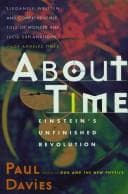
Paul Davies
Davies examines why time seems to flow and why we remember only the past, the same puzzles Rovelli raises. It is a thoughtful, well-argued tour of the physics and philosophy behind the arrow of time.
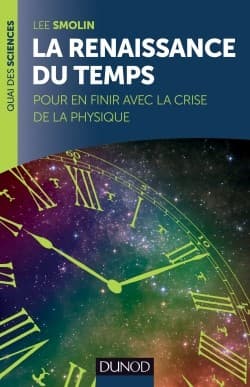
Lee Smolin
Smolin argues that time is real and fundamental, challenging the timeless picture that Rovelli explores. Readers who enjoyed the debate in The Order of Time will find a sharp, opinionated counterpoint.
Sean Carroll
Carroll explains why the past differs from the future and how the arrow of time connects to the quantum world. His clear, engaging prose suits readers who liked the physics in The Order of Time.