
We earn a commission if you buy through these links. Learn more
About time
by Paul Davies
A physicist's clear, opinionated tour of why time remains one of science's open puzzles, from relativity and entropy to quantum theory, for readers who want more than a textbook overview.
What It's About
About Time is a popular science book by the physicist Paul Davies that asks a question most of us never stop to examine: what time actually is, and whether physics has really explained it. Davies walks through the major revisions of the last century, beginning with relativity, which removed the idea of a single universal "now" shared by everyone. The book reads less like a survey of settled results and more like an argument that the central job is unfinished.
The writing is conversational and relies heavily on analogy. Davies moves between the physics of clocks and spacetime, the puzzle of entropy and why time seems to point in one direction, and the stranger territory of quantum theory and cosmology. He is open about his own leanings and pushes back on views that treat the flow of time as mere appearance. Expect exposition mixed with argument rather than a neutral survey.
Reading it feels like sitting in on a long conversation between a working scientist and the philosophical problems physics keeps running into. You will not need equations to follow it. What you gain is a sharper sense of which questions about time are genuinely open and which only sound profound.
Read this if you…
- want a serious but accessible guide to the physics and philosophy of time
- enjoy big open questions and don't mind a writer who takes a side
- already know basic relativity and want to see how far its implications reach
Skip it if you…
- want a neutral, encyclopedic survey of every theory of time
- are looking for hard mathematics or detailed derivations
Key Ideas
- 1
Relativity dissolved the shared present
Einstein's theories showed that two observers in relative motion can disagree about whether two events happened at the same time. That undermined the common-sense picture of a universal now flowing across the whole cosmos. Davies treats this as the first crack in our intuitions, and the rest of the book follows the consequences of taking it seriously.
- 2
Why time has a direction
Most fundamental physical laws look the same run forwards or backwards, yet everyday experience is lopsided: eggs break but do not unbreak. Davies examines entropy and the second law as the usual explanation for this arrow of time, and asks whether that explanation fully accounts for the asymmetry or leaves something essential out.
- 3
Quantum theory complicates the picture
Quantum mechanics brings its own difficulties for time, particularly around measurement and the role of an observer. Davies explores how these puzzles interact with relativity, showing why reconciling the two frameworks makes the question of time harder rather than easier.
- 4
Is the flow of time real?
A popular view in physics treats past, present and future as equally real, with the sense of passing time being a feature of minds rather than of the universe. Davies argues against dismissing the flow so quickly. The book's value lies in laying out both sides well enough that readers can weigh the case themselves.
Limitations
Some readers will find the book dated, since the field has moved on in cosmology and quantum foundations in the years since it appeared. Davies's sections on quantum theory are compressed, and a reader new to the subject may need to pause and look things up. The book is argumentative, so its conclusions reflect the author's own position rather than a consensus. It says little about how humans perceive or experience time psychologically or biologically.
Questions Readers Ask
- Do I need a physics background to read About Time?
- No formal background is required, though some familiarity with basic ideas like light speed and energy will help. Davies avoids equations almost entirely and relies on analogy. The hardest passages are in the quantum sections, where a patient reader may need to reread a paragraph or two. Curiosity matters more than prior training.
- How does About Time compare with Carlo Rovelli's The Order of Time?
- Both explore the nature of time for general readers, but they differ in tone. Rovelli writes more lyrically and leans toward a view where time is less fundamental. Davies is more insistent that the flow of time needs explaining and argues from within physics. Readers who want a poetic, sweeping take may prefer Rovelli, while those wanting a sharper debate may prefer Davies.
- Published
- 1995
- ISBN
- 9780684818221
- Difficulty
- intermediate
- Category
- Science
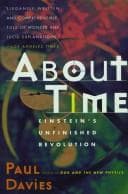
Book details and cover from Google Books.
Ready to read About time?
Get your copy on Amazon, or listen to it on Audible. We earn a commission if you buy through these links.