
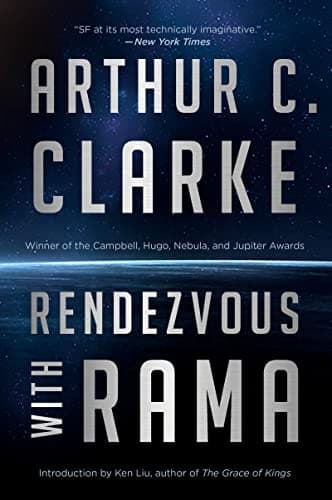
Rendezvous with Rama
Arthur C. Clarke
Like The Mote in God's Eye, it treats an alien presence as a scientific puzzle, with a crew methodically exploring something they cannot fully understand, grounded in careful physical detail.
Reader-supported: when you buy through links on our site, we may earn an affiliate commission. Learn more
We earn a commission if you buy through these links. Learn more
Find Similar Booksby Larry Niven, Jerry Pournelle
A 1974 first-contact classic that treats alien biology and politics with unusual rigor, following a human navy trying to understand a threat it barely comprehends.
The Mote in God's Eye, published in 1974 by Larry Niven and Jerry Pournelle, is a first-contact novel set in a human-settled galaxy where an interstellar navy stumbles onto an alien civilization. The story centers on the Moties, a species whose body and social structure are worked out in careful detail, and on the humans who must decide how to deal with them. The narrative moves between naval officers, scientific investigators, and political leaders, so the plot grows as much from institutional choices as from the aliens themselves.
The style is brisk and plainspoken, closer to a techno-thriller than a meditative literary work. Much of the pleasure comes from watching the authors reason through problems: how a species evolves under particular conditions, what that implies for its technology and politics, and where human assumptions about cooperation and conflict break down. The prose rarely lingers on inner emotional life, and many characters are defined by their jobs and loyalties.
The experience is that of a long, procedural puzzle with a good deal of hard-science texture and a wry edge. It rewards patient readers who enjoy seeing a problem worked out from first principles. It is less interested in lyrical description or tidy moral resolution, and it feels like a product of its moment, with a mid-century faith in engineering and command structures.
The Moties' physiology and evolutionary history shape their culture, their technology, and the way they reason. The authors take care to make these traits feel plausible, so the aliens' choices read as logical rather than arbitrary, which is what gives the first-contact problem its weight.
Early encounters are shaped by mismatched assumptions on both sides. The book is interested in how communication fails, how each side misreads the other's intentions, and what it would take to build trust between minds that do not share basic expectations.
Navy command, political oversight, and scientific advice pull in different directions. The novel shows how bureaucratic rivalry, deadlines, and incomplete information shape decisions, often more than any single person's judgment does.
The authors work through the practical physics of interstellar travel and military action with concrete arithmetic and engineering logic. That attention gives the setting a sense of realism and lets readers follow the consequences of each design choice.
Characterization is often functional, and the human cast can feel thin next to the alien society, which is the book's real strength. Gender roles and social attitudes reflect the 1970s and may feel dated to modern readers. Some technical exposition slows the pacing, and the political subplots can be dense. Readers who want a self-contained story should know that Niven and Pournelle later returned to this universe in The Gripping Hand (1993).
Reviews from readers on YouTube. Their opinions are their own.
Book details and cover from Google Books.
Ready to read The Mote in God's Eye?
Get your copy on Amazon, or listen to it on Audible. We earn a commission if you buy through these links.
Arthur C. Clarke
Like The Mote in God's Eye, it treats an alien presence as a scientific puzzle, with a crew methodically exploring something they cannot fully understand, grounded in careful physical detail.
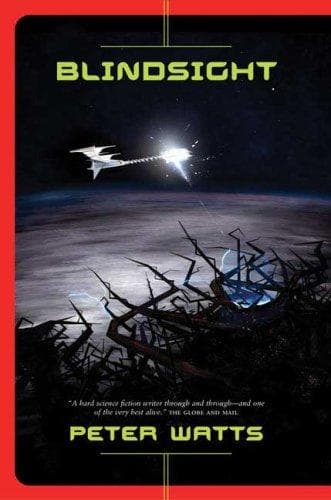
Peter Watts, Peter Watts
Its alien intelligences are unsettling and rigorously reasoned, much like the Moties, and the book asks hard questions about consciousness and what contact with a truly different mind would mean.

China Miéville, China Miville
It explores how an alien species thinks and communicates, and how humans struggle to bridge that gap, a theme that will appeal to readers fascinated by the Moties' strange biology and language.
Joe W. Haldeman
Its grounded, unglamorous view of military life during a long conflict with aliens echoes the Navy scenes in The Mote in God's Eye and its frank attention to strategy and cost.