
We earn a commission if you buy through these links. Learn more
Blindsight
Peter Watts's hard sci-fi first-contact novel asks whether intelligence needs consciousness at all, and it argues the point through a crew facing minds unlike their own, with dense ideas and a bleak tone that rewards close attention.
What It's About
Blindsight is a hard science fiction novel by Peter Watts about a crew sent to investigate a strange presence that has appeared near Earth. The narrator, Siri Keeton, is a synthesist, a person whose job is to assemble a coherent picture from fragmentary data, and whose own mind has been altered in ways that make him an unusual fit for the mission. Watts frames it as a first-contact story, but most of its energy goes to questions about perception, cognition, and selfhood.
The style is dense and clipped. Watts draws heavily on neuroscience, biology, and information theory, and he does not stop to make the material comfortable. The narrative moves between the expedition and Siri's fragmented memories, and it expects readers to keep up with technical vocabulary and unfamiliar concepts. The prose is cool and precise, with a steady undercurrent of dread rather than conventional action set pieces.
Reading it feels like working through a puzzle whose pieces keep changing shape. It rewards attention and rereading, and the payoff is an unsettling argument about what minds are for. It is less a comfortable adventure than a sustained thought experiment, and readers who want warmth or easy access to the characters may find the crew hard to get close to.
Read this if you…
- want hard science fiction where the ideas carry the story
- are curious whether consciousness is necessary for thinking
- enjoy bleak, cerebral first-contact stories like Stanislaw Lem's
Skip it if you…
- want warm characters or a clear emotional arc
- find dense technical prose tiring rather than stimulating
Key Ideas
- 1
Intelligence may not require consciousness
The central question is whether a mind can solve problems brilliantly while having no inner experience at all. Watts treats awareness as possibly an expensive evolutionary extra rather than a necessity, and he follows that premise into uncomfortable territory without offering reassurance.
- 2
The self as a reconstructed story
Siri's narration suggests that the sense of being a single, unified self may be an account the brain assembles after the fact. The book presses this idea through his damaged and rebuilt perception, asking how much of what we call a self is interpretation rather than fact.
- 3
Alien minds built on different principles
The encounter is less about communication than about the difficulty of understanding a mind that works by different rules. Watts asks what contact looks like when neither side can reliably model the other, and he does not let the human characters off the hook for their assumptions.
- 4
Vampires as a lens on cognition
Watts uses the vampire figure, reworked through biology, to explore what a predator with reduced self-awareness might be like. The choice is provocative and deliberately unsettling, and it turns a familiar monster into a serious question about how thinking works.
- 5
Speculative science as the engine
The novel's power comes from its ideas rather than from spectacle. Its notes on neuroscience and biology are part of the experience, and readers who enjoy following an argument through technical detail will find the book unusually sustained in its intellectual ambition.
Limitations
The book is bleak and cold, and its characters are often more functions of the argument than fully realized people, which many readers find alienating. Its science is speculative and some of its neurological framing reflects the state of research at the time it was written, so specialists may quibble with details. The ending is deliberately ambiguous and may frustrate readers who want resolution. Its density can also slow the pace, especially in the middle sections where ideas accumulate faster than events.
Questions Readers Ask
- Do I need a science background to read Blindsight?
- No specialist knowledge is required, but you will need patience and a willingness to look up unfamiliar terms. Watts does not explain every concept in detail, so readers who enjoy working things out as they go will get the most from it. General curiosity about the brain is enough to follow the core arguments.
- How does Blindsight compare to Solaris?
- Both books center on an alien intelligence that resists human understanding, and both are more interested in ideas than in action. Blindsight is colder, more technical, and more openly concerned with consciousness itself, while Solaris is more meditative and lyrical. Readers who liked the sense of unknowable otherness in Solaris will find much to appreciate here.
- Is Blindsight still relevant today?
- Yes. Its questions about whether intelligence requires awareness have become more pressing as artificial intelligence advances. Some of its neuroscience reflects the research of its time, but the central philosophical challenge remains sharp and worth engaging with.
- Published
- 2006
- ISBN
- 9787547739792
- Difficulty
- advanced
- Category
- Fiction
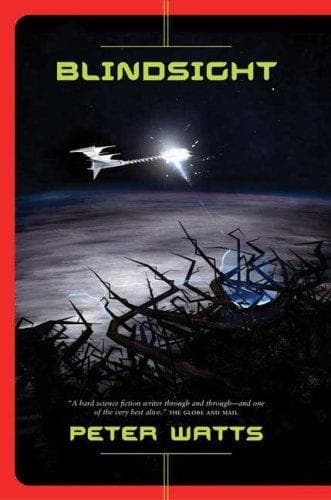
Book details and cover from Google Books.
Ready to read Blindsight?
Get your copy on Amazon, or listen to it on Audible. We earn a commission if you buy through these links.