
We earn a commission if you buy through these links. Learn more
Rendezvous with Rama
Clarke's 1973 Hugo and Nebula winner is a patient, awe-driven exploration of a giant alien cylinder, valued for its sense of scale and its refusal to explain itself too neatly.
What It's About
Rendezvous with Rama, published in 1973, is a science fiction novel about humanity's first close look at an object from somewhere else. A huge cylinder, later named Rama, drifts into the inner solar system, and a small crew is sent to meet it before it passes on. Much of the book takes place inside the object, which functions more like a built world than a conventional spaceship, with vast interior landscapes, seas, and machinery that the crew must examine piece by piece.
Clarke writes in a calm, almost documentary register. Scenes are built around observation, measurement, and inference rather than action set-pieces or villains. The drama comes from what the humans notice, what they guess, and how often they are forced to admit they do not understand. The sense of scale is the main pleasure: you feel the size of the thing through careful description and the crew's gradual realization of how much remains unknown. Characters are functional rather than rich, and emotional stakes stay modest.
The experience is closer to a guided tour through a puzzle than to a conventional plot. It rewards readers who enjoy speculative engineering, the wonder of discovery, and the feeling of being a small part of a very large universe. It is short for a novel and reads quickly, but it deliberately withholds many answers, so readers who want a tidy resolution may feel shortchanged.
Read this if you…
- enjoy speculative engineering and reasoning through how strange systems might work
- like stories about exploration and the feeling of an enormous, unexplained universe
- prefer a slow, observational pace to plot-driven tension
Skip it if you…
- need strong characters or emotional drama to stay engaged
- want a mystery that is fully solved and explained by the final page
Key Ideas
- 1
Scale as the central source of wonder
The book builds its awe through size, distance, and the sheer quantity of detail rather than through alien characters or dramatic confrontation. Clarke makes you feel how small the crew is against the object, and that feeling of insignificance is much of the point.
- 2
Discovery without guaranteed meaning
The crew learns a great deal about the object, but it never explains its purpose or its makers. The novel treats not-knowing as a permanent condition of contact with something truly alien, and it asks readers to accept that partial understanding is still valuable.
- 3
Humans as cautious observers, not conquerors
The crew's approach is procedural and restrained. Their curiosity is driven by a desire to understand rather than to dominate or extract, which gives the story a calm, scientific temperament that some readers find refreshing and others find emotionally distant.
- 4
Engineering logic as the story's engine
Much of the momentum comes from working out how the object's systems might function and what their design implies. If you enjoy reasoning through how a machine or environment must work, the book's puzzles will hold your attention even without strong plot twists.
- 5
Understated prose with a documentary feel
Clarke's style is plain and precise rather than lyrical. Descriptions are concrete and sometimes almost technical, which makes the setting feel credible but can also make the book read more like a report than a novel of character.
Limitations
The book's characters are thin, and their interpersonal dynamics feel dated. Women are almost absent from the crew's world, and some social assumptions reflect the early 1970s. Parts of its science and its projections of near-future space technology have aged, and some readers will find the procedural scenes slow. The deliberate lack of answers frustrates readers who expect a conclusive revelation. Its restraint is a strength for some and a limitation for others, and it is not a book that tries to be more than it is.
Questions Readers Ask
- Do I need to read the sequels before this book?
- No. Rendezvous with Rama works as a self-contained novel, and it ends in a way that makes sense on its own. Clarke later wrote sequels with collaborators that continue the story, but they are generally considered less focused. Most readers enjoy the first book fully without them and decide afterward whether to continue.
- Is Rendezvous with Rama still worth reading today?
- Yes, especially if you value sense of wonder and careful world-building over fast plotting. Some of its science, technology, and social details now look dated, and the characters are not as vivid as modern readers may expect. Its central sense of scale and mystery still works well, and it is short enough to read without a large time commitment.
- How does it compare to Clarke's 2001: A Space Odyssey?
- 2001 is more mythic and ambitious in its philosophical scope, and it pushes further into transformation and metaphor. Rendezvous with Rama is more grounded and procedural, focused on exploration and puzzle-solving rather than cosmic symbolism. If you liked 2001's sense of the unknown but want something more straightforward, this is a good next step.
- Published
- 1973
- ISBN
- 9781405073035
- Difficulty
- beginner
- Category
- Fiction
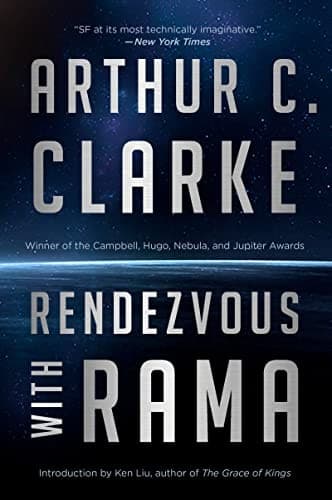
Book details and cover from Google Books.
Ready to read Rendezvous with Rama?
Get your copy on Amazon, or listen to it on Audible. We earn a commission if you buy through these links.