Reader-supported: when you buy through links on our site, we may earn an affiliate commission. Learn more

Cover of The Happiness Trap
Buy on AmazonBuy on Bookshop.orgListen on Audible

We earn a commission if you buy through these links. Learn more

Find Similar Books

The Happiness Trap

by Russ Harris

Self-Improvement
★★★☆☆3.0 (3)

A practical, exercise-driven introduction to ACT that shows how fighting uncomfortable feelings can keep you stuck, and offers a gentler way to build a life around what you value.

What It's About

The Happiness Trap is a self-help book built on Acceptance and Commitment Therapy, a cognitive behavioral approach that grew out of relational frame theory and has a growing research base. Harris's central claim is that many everyday strategies for feeling better, such as suppressing anxiety, arguing with our own thoughts, or chasing reassurance, often keep the very discomfort we want to escape. He calls this the trap, and the book walks you through how to notice it in your own life.

The writing is conversational and practical rather than academic. It leans on metaphors and short exercises you can do alone, such as clarifying what you actually care about, practicing noticing thoughts without obeying them, and planning small steps toward a direction you have chosen. Expect to do the work. The book is designed to be read slowly, with pauses to try things out, and it rewards readers who treat it more like a workbook than a novel.

The reading experience is gentle but direct. Harris repeatedly asks you to stop fighting feelings that are part of being human and to put your energy into how you want to live. Many readers find the tone encouraging, though some find the exercises repetitive. It works best as an accessible starting point for everyday stress, worry, and self-doubt, not as a replacement for professional treatment of severe depression or anxiety.

Read this if you…

  • feel stuck in cycles of worry, rumination, or self-criticism and want practical tools you can try right away
  • are curious about ACT or mindfulness-based approaches and want a self-guided starting point
  • prefer exercises and plain-language metaphors over dense research or theory-heavy reading

Skip it if you…

  • are looking for a quick mood boost, affirmations, or a formula for instant happiness
  • are dealing with severe depression, trauma, or thoughts of self-harm and need clinical support rather than a self-help book

Key Ideas

  1. 1

    Control strategies can backfire

    Harris argues that trying hard to get rid of anxiety, sadness, or self-doubt often strengthens it. Pushing feelings away, distracting yourself constantly, or demanding certainty can become a full-time job that drains energy and keeps the problem alive. The book asks you to examine whether your go-to fixes are actually working over the long run.

  2. 2

    Defusing from unhelpful thoughts

    Instead of arguing with a harsh inner voice or trying to replace it with positive statements, ACT teaches you to see thoughts as mental events rather than literal truths. The goal is not to stop thinking but to loosen the grip of thoughts so they have less power over what you do. Simple exercises help you practice this shift in perspective.

  3. 3

    Making room for painful feelings

    Acceptance in this book means willingly letting uncomfortable emotions be present while you act on what matters, rather than resigning yourself or liking the pain. Harris presents this as a skill you can build, not a passive surrender. The idea is that carrying difficult feelings is easier when you stop spending effort on fighting them.

  4. 4

    Values as a direction, not a finish line

    A central move in the book is separating values, which describe how you want to live, from goals, which can be achieved and checked off. Values work more like a compass you keep returning to. Clarifying them gives you a reason to take action even when your mood or confidence is low, which is why the book pairs them with committed action in small steps.

Limitations

Critics sometimes say the book leans more on exercises and metaphors than on detailed evidence, and that its research claims are presented in a simplified way. Some readers find the material repetitive, especially if they read it straight through. The book does not deal in depth with trauma, medication, or the biology of mood disorders, and it is not a substitute for working with a qualified therapist when symptoms are serious. Because it was first published in 2007, some later ACT developments and newer books on the subject go further.

Questions Readers Ask

Can The Happiness Trap replace therapy?
For mild or everyday struggles with worry, stress, or self-doubt, many readers find the book useful on its own. For severe depression, anxiety disorders, trauma, or thoughts of self-harm, it is better treated as a supplement to professional care. If you are unsure, talk to a doctor or qualified therapist before relying only on a self-help book.
How does it compare to a CBT workbook?
Both draw on cognitive behavioral traditions, but CBT workbooks usually focus on identifying and changing distorted thoughts. This book puts more weight on accepting difficult experiences, defusing from thoughts, and acting on personal values. Readers who want structured thought-record exercises may prefer a CBT workbook, while those who feel stuck arguing with their minds may find ACT a fresher angle.
Is the book still relevant?
The core ideas about avoidance, acceptance, and values remain widely discussed and practiced in ACT. Some of the surrounding research and terminology has moved on since the book appeared, so readers may want to check newer ACT resources for current evidence. The practical exercises still hold up as a way to start examining your own patterns.

What Creators Say About The Happiness Trap

Reviews from readers on YouTube. Their opinions are their own.

The Happiness Trap: Evolution of the Human MindDr. Russ Harris - Acceptance Commitment Therapy on YouTube
The Happiness Trap: Why You're Stuck in SufferingWizBuskOut on YouTube
Published
2008
ISBN
9780834821040
Difficulty
beginner
Category
Self-Improvement

Book details and cover from Google Books.

Ready to read The Happiness Trap?

Get your copy on Amazon, or listen to it on Audible. We earn a commission if you buy through these links.

Books Like The Happiness Trap

View all →
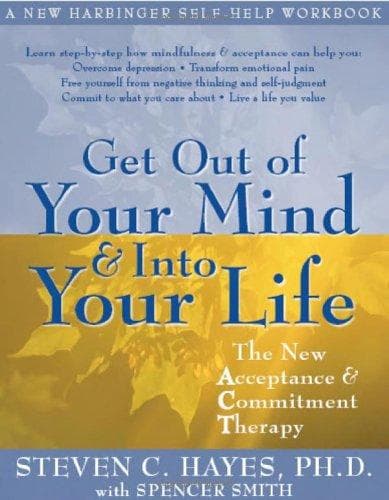
Cover of Get Out of Your Mind and Into Your Life

Get Out of Your Mind and Into Your Life

Steven C. Hayes

Written by one of ACT's founders, this book expands on the acceptance and defusion ideas Harris uses, offering the research-based foundations behind the techniques you met in The Happiness Trap.

Cover of Mindfulness in Plain English

Mindfulness in Plain English

Bhante Henepola Gunaratana

A clear, concise guide to meditation that suits readers who liked the book's mindfulness exercises. It explains how to observe difficult thoughts without being pulled along by them.

Cover of Wherever You Go, There You Are

Wherever You Go, There You Are

Jon Kabat-Zinn

A short, accessible introduction to everyday mindfulness, showing how to stay present with uncomfortable feelings rather than escaping them, much as The Happiness Trap encourages.

Cover of The Power of Now

The Power of Now

Eckhart Tolle

If the Happiness Trap's focus on living fully in the present moment appealed to you, this bestseller explores that idea in depth, with a spiritual rather than clinical framing.

Explore More