
We earn a commission if you buy through these links. Learn more
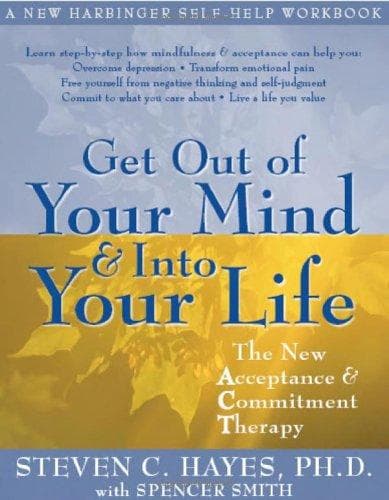
Get Out of Your Mind and Into Your Life
A clear, practical introduction to acceptance and commitment therapy that explains why fighting your own thoughts often keeps them alive, then offers exercises for loosening their grip and acting on what matters.
What It's About
Get Out of Your Mind and Into Your Life is a self-help introduction to acceptance and commitment therapy, the approach Steven C. Hayes helped develop. Its central claim is that much everyday suffering comes less from painful thoughts and feelings themselves than from the effort to push them away, argue with them, or control them. The book lays out the reasoning behind that idea and then offers practical methods for changing your relationship to inner experience instead of trying to win a battle with it.
The style is direct and workbook-like. It mixes explanation, metaphor, and exercises you can do on paper or in daily life. It reads more like a structured program than a memoir or a collection of case stories, and it asks you to try things rather than simply agree with them. Some exercises involve noticing thoughts as mental events, naming them, and tracking what you do to avoid discomfort.
Reading it is less a matter of quick fixes than gradual reorientation. Many readers find the early material the most eye-opening, because it makes the avoidance trap visible. Later sections shift toward choosing personal values and acting on them even while uncomfortable. The tone stays warm and nonjudgmental, though the material can feel repetitive to readers who want a conceptual argument rather than ongoing practice.
Read this if you…
- want a practical, exercise-based introduction to acceptance and commitment therapy
- keep getting stuck arguing with anxious or self-critical thoughts
- feel that avoiding discomfort has been quietly narrowing your choices
Skip it if you…
- want a purely academic account of ACT research or its clinical history
- are dealing with a serious mental health condition and need individualized treatment rather than a self-help book
Key Ideas
- 1
Experiential avoidance as the core problem
The book argues that trying to escape or suppress unwanted inner experiences often strengthens them and narrows your life. Anxiety, sadness, and self-criticism become more powerful when you spend energy fighting them, and the avoidance itself can quietly shape your choices for years.
- 2
Defusion: seeing thoughts as thoughts
Rather than trying to disprove a painful thought, you learn to observe it as a passing mental event with words attached. The aim is not to believe your thoughts less through argument but to notice them as language, so they stop dictating what you do.
- 3
Acceptance without resignation
Acceptance here means willingly making room for difficult feelings so you can move in a direction you care about. It is not giving up, approving of a situation, or waiting for discomfort to disappear first. The book treats it as a skill you practice rather than a mood you wait for.
- 4
Values and committed action
The second half of the approach asks you to clarify what you want your life to stand for, then take concrete steps toward it even when unpleasant thoughts show up. Values serve as a compass rather than a set of goals to be ticked off, and the emphasis is on sustained action.
Limitations
The book simplifies a clinical model for a general audience, so some of the nuance from full ACT training is lost. Its exercises can feel repetitive, and readers who want a tight argument may find the structure padded. The text is from 2005, and the ACT literature has since grown considerably. It is not a substitute for therapy for severe depression, trauma, or suicidal thinking, and its results vary from person to person.
Questions Readers Ask
- Is this book good for beginners to ACT?
- Yes, it is one of the more accessible entry points to acceptance and commitment therapy. It explains the core ideas in plain language and builds them through exercises. Readers who prefer a lighter, more narrative style may find a later, more introductory ACT book easier to start with, but this one works well for someone who wants to practice rather than only read.
- How does it compare to cognitive behavioral therapy self-help books?
- CBT books usually focus on challenging and restructuring thoughts, while this book asks you to change your relationship to them without necessarily arguing them away. If you have tried cognitive restructuring and found it exhausting or ineffective, this approach may feel like a fresh angle. Many readers use both ideas together rather than choosing one.
- Published
- 2005
- ISBN
- 9781572244252
- Difficulty
- intermediate
- Category
- Acceptance and commitment therapy
Book details and cover from Google Books.
Ready to read Get Out of Your Mind and Into Your Life?
Get your copy on Amazon, or listen to it on Audible. We earn a commission if you buy through these links.