
The Way of Kings
Brandon Sanderson
Sanderson finished The Wheel of Time, and this opener shares its huge scale, multiple viewpoints, rich history and slow-building sense of a world-ending threat returning.
Reader-supported: when you buy through links on our site, we may earn an affiliate commission. Learn more
We earn a commission if you buy through these links. Learn more
Find Similar BooksThe opening volume of one of fantasy's biggest series, with a slow-building, immersive world, a young cast pulled from farm life, and a sense of history far older than any character.
1 creator reviewed The Eye of the World on YouTube between 2017 and 2018, with 360.4K views between them. Their opinions are their own; we picked these reviews, we didn't write them.
The Eye of the World is the 1990 opening volume of Robert Jordan's The Wheel of Time, a long epic fantasy series that became one of the genre's best-selling. It follows a small group of young people from the Two Rivers, a rural region of farms and villages, after a sorceress named Moiraine arrives searching for a figure foretold to stand against the Dark One. Their quiet lives break apart when monstrous soldiers attack their homes.
Jordan's approach is patient and expansive. Much of the book is travel, conversation, and gradual worldbuilding, with cultures, politics, and magic revealed piece by piece. The cast is large and the point of view moves between several characters, so the story often feels like a journey across a country rather than a single plot. Early chapters establish the rules of the world slowly, which rewards readers who settle in and frustrates those who want quick action.
Reading it feels like stepping into a long, immersive tradition of epic fantasy. Its strengths are atmosphere, a cyclical view of history, and a sense that the world is far larger than any one character. Expect a slow first stretch, familiar archetypes, and an earnest tone. The experience is less about surprise than about gradually building a feeling of place and looming dread.
Jordan builds his setting around a repeating cosmic wheel, in which ages rise, fall, and return. Characters live with the sense that past ages left traces that are now mostly legend. This gives the story a feeling of deep history, and it explains why the book keeps hinting at events that happened long before anyone in the Two Rivers was born.
The central characters begin as farm folk with ordinary concerns, and the book spends real time on their fear, loyalty, and homesickness as they are drawn into a larger conflict. Their growth is slow and grounded, so the fantasy elements feel like pressure on real people rather than a backdrop for heroics.
Magic in this book is rare, partly hidden, and frightening to those who encounter it. Jordan avoids treating spellcasting as a tidy system, and instead presents it through its costs and uncertainties. Readers who like magic to feel uncanny rather than explained will find this one of the book's strongest qualities.
Much of the pleasure comes from moving through different regions, each with its own customs, dress, speech, and politics. The book shows only part of this map, and the sense that the world continues beyond the page is a major reason many readers keep going into the later volumes.
Many readers find the opening slow, especially the long stretches of travel and early setup, and the pacing can feel uneven. The prose has been criticized for repetition, with recurring physical details and dialogue habits that some find tiresome. Its debts to earlier fantasy, particularly Tolkien, are obvious, and the characters and conflict follow familiar patterns. The book is also the first of a long series, so it does not resolve its main story and leaves many threads open.
Book details and cover from Google Books.
Ready to read The Eye of the World?
Get your copy on Amazon, or listen to it on Audible. We earn a commission if you buy through these links.
Brandon Sanderson
Sanderson finished The Wheel of Time, and this opener shares its huge scale, multiple viewpoints, rich history and slow-building sense of a world-ending threat returning.
George R. R. Martin
Another doorstop series opener with a vast map, many point-of-view characters and an ancient danger stirring, though grittier and more political than Jordan's farm-boy quest.
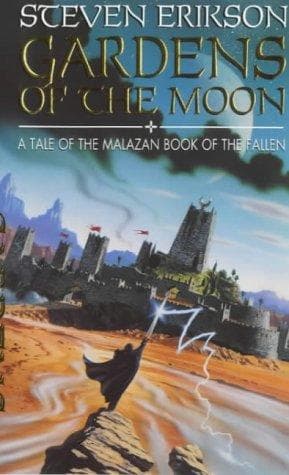
Steven Erikson
For readers who loved the depth of Jordan's history and magic, Malazan offers an even denser world, with armies, gods and sorcery on an enormous canvas.
J. R. R. Tolkien
Jordan openly echoes Tolkien: humble villagers flee pursuing dark creatures with a wise guide. Go back to the source of the quiet-home-to-perilous-road structure.