
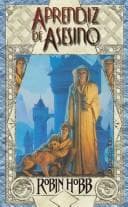
Assassin's Apprentice
Robin Hobb
Like Gardens of the Moon, it draws you into a deeply personal story while hinting at a much larger political and magical world beyond the protagonist's view.
Reader-supported: when you buy through links on our site, we may earn an affiliate commission. Learn more
We earn a commission if you buy through these links. Learn more
Find Similar BooksGuide by the Books of the Day editors · Updated · How we write our guides
Erikson's opening Malazan volume drops you into an empire's siege with no glossary and a crowd of soldiers, sorcerers, and gods, and it rewards patience with one of fantasy's most ambitious worlds.
2 creators reviewed Gardens of the Moon on YouTube between 2019 and 2024, with 171.8K views between them. Their opinions are their own; we picked these reviews, we didn't write them.
Gardens of the Moon is the first book of the Malazan Book of the Fallen, a sprawling epic fantasy published in 1999. It centers on the Malazan Empire's campaign against the city of Pale, seen through a rotating cast of point-of-view characters: imperial soldiers, mages, a sorcerer-thief, and beings who were once mortal and now walk among the living with their own agendas. Rather than following one chosen hero, the book keeps its attention spread across a crowd, and many of those characters are working toward goals they only partly understand.
The style is the first thing readers notice. Erikson drops you into a world that is already old and complicated, uses unfamiliar names and institutions without explaining them, and expects you to infer meaning from context. Scenes are often short and cut abruptly, and the military material has the texture of a soldier's memoir rather than a quest. The humor is dry and frequent, and the violence is ugly rather than glamorous.
Reading it feels less like following a story than like piecing together a history already in motion. The early chapters can be disorienting, and the payoff arrives gradually as threads that seemed incidental begin to connect. It rewards patience and rereading more than speed.
Gods, ascended mortals, and ancient sorcerous institutions shape events in the background, often for reasons that have nothing to do with the human characters. The book treats divine and magical power less as a gift and more as a force with its own history and politics, which makes ordinary people feel small in a way that is central to the story.
Much of the emotional weight sits with soldiers rather than generals. Erikson pays attention to logistics, loyalty among units, bureaucratic indifference, and the dark humor soldiers use to survive. The empire is not presented as simply good or evil; it is a machine that the people inside it both serve and resent.
Rather than stopping to explain its setting, the book lets history, religions, and factions surface through dialogue and action. This can be frustrating at first, but it gives the world a sense of depth that most fantasy only gestures at. Readers who enjoy working things out for themselves will find this a large part of the pleasure.
Because the point of view shifts constantly, no single character holds the moral center for long. Villains get moments of sympathy, heroes make compromised choices, and the reader is asked to hold several perspectives at once. The effect is closer to watching a conflict from many sides than to following one protagonist's arc.
The most common criticism is the opening. The sheer number of characters, factions, and unexplained terms can make the first several chapters hard going, and some readers give up before the story settles. The prose is also uneven at times, with rough edges and an occasional sense of excess. Some readers find the violence and bleak tone wearying, and the book's ambition sometimes outruns its control of pacing. It is also the first volume of a very long series, so it does not resolve its larger questions and works best as an entry point to a much bigger story.
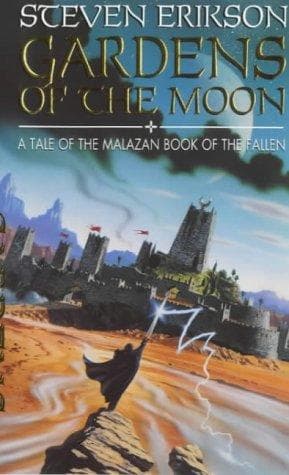
Book details and cover from Google Books.
Ready to read Gardens of the Moon?
Get your copy on Amazon, or listen to it on Audible. We earn a commission if you buy through these links.
Robin Hobb
Like Gardens of the Moon, it draws you into a deeply personal story while hinting at a much larger political and magical world beyond the protagonist's view.
Scott Lynch
A crew of con artists, sharp banter and a city full of intrigue give the same grounded, morally grey feel that Erikson's mercenaries and schemers offer.
Patrick Rothfuss
Its layered history, magic system and richly built world reward the same kind of attentive reading that Gardens of the Moon demands.
Glen Cook
Told by a company clerk chronicling a mercenary unit, it shares Gardens of the Moon's focus on soldiers' loyalty, dark humour and the cost of war.