
A Brief History of Time
Stephen Hawking
The classic popular account of black holes, the Big Bang and the search for unification, covering the background Greene builds on in a short, conversational book.
Reader-supported: when you buy through links on our site, we may earn an affiliate commission. Learn more
We earn a commission if you buy through these links. Learn more
Find Similar Booksby Brian Greene
Guide by the Books of the Day editors · Updated · How we write our guides
A clear, energetic guide to the idea that tiny vibrating strings and extra hidden dimensions could reconcile gravity with quantum mechanics, written for curious non-physicists.
2 creators reviewed The Elegant Universe: Superstrings, Hidden Dimensions, and the Quest for the Ultimate Theory on YouTube between 2021 and 2023, with 2.3K views between them. Their opinions are their own; we picked these reviews, we didn't write them.
The Elegant Universe is a tour of the search for a single theory that explains both the very large and the very small. Greene starts from the two great physics frameworks of the twentieth century, Einstein's account of gravity as curved space and the quantum rules that govern atoms, and shows why they clash when applied to extreme conditions such as the interior of a black hole or the first instants after the Big Bang. From there he traces how string theory grew from a niche idea into a field that many physicists took seriously.
Greene's approach is part history, part explainer, and part analogy. He builds intuition with everyday images, such as a violin string producing different notes, and uses them to convey the claim that fundamental particles might be vibrations of one-dimensional filaments. He also makes room for the strange consequences: space that may have extra dimensions curled too small to see, and the surprising discovery that theories that looked different were really faces of the same underlying framework. The writing is brisk and upbeat, with the pace of a detective story.
Reading it feels like sitting in on a lecture from a patient, enthusiastic teacher who is clearly excited about the material. You will come away understanding the vocabulary and the reasoning behind the bet, though not the mathematics. The book is most rewarding when you treat it as an invitation to think about what a theory of everything would have to do, rather than as a settled account of what is true.
General relativity describes smooth curved spacetime, while quantum mechanics describes a world of discrete, probabilistic events. Each works well alone, but combining them produces breakdowns in situations like black holes and the early universe. Greene uses this tension as the motivation for the whole book, arguing that a deeper theory must resolve it before physicists can claim a complete picture of nature.
The core proposal of string theory is that the basic building blocks of matter are not points but tiny one-dimensional loops or filaments. Different vibration patterns would appear as different particles, much as a single string on an instrument produces different notes. Greene explains this with simple analogies, and the idea becomes the foundation for everything that follows.
For the mathematics to work, string theory requires more spatial dimensions than the three we experience. Greene argues that these extra dimensions could be folded into shapes too small to detect with current instruments. He explains how the geometry of these hidden spaces could determine the properties of particles and forces, which makes the abstract idea feel concrete.
For years physicists had several distinct versions of string theory that seemed unrelated. Greene describes how discoveries of hidden symmetries and duality relationships suggested these were different views of one larger structure. This convergence, which he presents as a turning point, is the reason the book is often read as a snapshot of a field that believed it was closing in on a unified answer.
A central theme is that string theory makes its predictions at energies and scales far beyond current experiments. Greene is candid that the theory has not yet been confirmed, and he discusses what kinds of observations might eventually test it. Readers who care about how science decides between speculative ideas will find this honest framing one of the book's most useful features.
The book was written in 1999, before several major developments in string theory, including later debates over the vast number of possible string vacua and the rise of new approaches to quantum gravity. Some of its optimism about how quickly the theory would be confirmed has not been borne out, and experimental evidence remains absent. Critics also note that Greene's enthusiasm can make a contested research program sound closer to established fact than it is. Readers should treat the book as a well-informed view of a particular moment rather than a final verdict.
Book details and cover from Google Books.
Ready to read The Elegant Universe: Superstrings, Hidden Dimensions, and the Quest for the Ultimate Theory?
Get your copy on Amazon, or listen to it on Audible. We earn a commission if you buy through these links.
Stephen Hawking
The classic popular account of black holes, the Big Bang and the search for unification, covering the background Greene builds on in a short, conversational book.
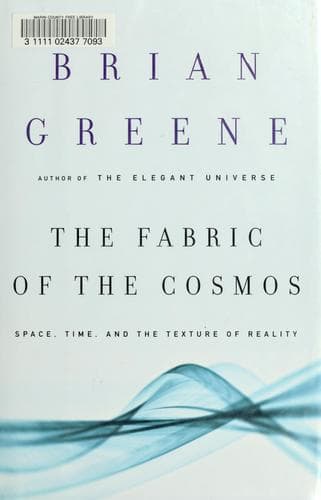
Brian Greene
Greene's follow-up turns to space, time and entropy with the same patient analogies, ideal if you want more of his voice beyond string theory itself.
Carlo Rovelli
A lyrical, compact tour of relativity, quantum mechanics and quantum gravity that captures the wonder of The Elegant Universe in a fraction of the pages.
Lee Smolin
A pointed critique of string theory's dominance, offering a valuable counterweight to Greene's enthusiasm and introducing alternative approaches.