
A Brief History of Time
Stephen Hawking
Like Rovelli's book, it introduces relativity, black holes and the origins of the cosmos in plain language for general readers, with a clear sense of the big questions behind each idea.
Reader-supported: when you buy through links on our site, we may earn an affiliate commission. Learn more
We earn a commission if you buy through these links. Learn more
Find Similar BooksA short, lyrical tour of modern physics, from curved spacetime to quantum strangeness, that rewards readers who want wonder and big-picture thinking more than equations.
2 creators reviewed Seven Brief Lessons on Physics on YouTube in 2016, with 33.3K views between them. Their opinions are their own; we picked these reviews, we didn't write them.
Seven Brief Lessons on Physics is a small book that covers a lot of ground: Einstein's general relativity, quantum mechanics, elementary particles, gravity, black holes, the large-scale structure of the universe, and the place of human minds in all of it. Rovelli, a theoretical physicist who helped develop loop quantum gravity, writes in short, self-contained sections that move quickly from one idea to the next. He mostly avoids heavy mathematics and relies on analogies, historical anecdotes, and plain-language reasoning.
The tone is closer to an essay collection than a textbook. Rovelli is openly enthusiastic and willing to be philosophical, asking what it means for space to bend, for events to be probabilistic, or for time to seem to point in one direction. He often steps back to reflect on what physics has revealed about how little our everyday intuitions can be trusted.
Reading it feels like a guided walk along the edge of current knowledge. You finish with a sense of the major ideas and a clearer picture of where the open questions lie, but not with the tools to calculate anything. It works best as a first serious encounter with the subject or as a refresher for someone who once studied it and wants the big picture back.
Rovelli explains general relativity as the idea that gravity is not a force pulling through empty space but the curvature of space and time themselves. The consequences are strange: clocks run at different rates, space can stretch and ripple, and the whole cosmos becomes a dynamic, changing structure rather than a fixed stage.
The book presents quantum theory as a challenge to the idea that nature has definite properties at all times. Measurements yield probabilities, and the act of observation seems to matter. Rovelli shows why these results are so hard to reconcile with everyday intuition and why physicists still disagree about what they mean.
One of Rovelli's signature themes is that the fundamental picture of reality may be better described by interactions between things than by the things themselves. He treats properties as relative to other systems, a view that reframes familiar concepts like position and state and that he presents as a serious option rather than settled fact.
Most fundamental equations work the same forwards and backwards, yet we experience a clear difference between past and future. The book connects this puzzle to thermodynamics and the early universe, arguing that the direction of time is tied to how the cosmos began rather than to something built into the basic laws.
The closing lessons turn to the observer. Rovelli reminds readers that we are made of the same matter and governed by the same laws we study, and he suggests that thinking about minds and knowledge is part of the same project. The effect is less a conclusion than an invitation to wonder at how much remains unknown.
The brevity that makes the book readable also means many ideas are sketched rather than developed, so readers may finish with questions the book does not answer. Some of the material, especially on quantum gravity and relational interpretations, reflects Rovelli's own well-known positions, which are not shared by all physicists. Critics sometimes find the enthusiasm and poetic style overwrought, and the book does not cover experimental details or the history of the field in depth. Readers wanting a more complete account should pair it with a longer work.
Book details and cover from Google Books.
Ready to read Seven Brief Lessons on Physics?
Get your copy on Amazon, or listen to it on Audible. We earn a commission if you buy through these links.
Stephen Hawking
Like Rovelli's book, it introduces relativity, black holes and the origins of the cosmos in plain language for general readers, with a clear sense of the big questions behind each idea.
Brian Greene
It explains spacetime, quantum ideas and the search for a unifying theory with the same enthusiasm and clarity that make Seven Brief Lessons so easy to follow.
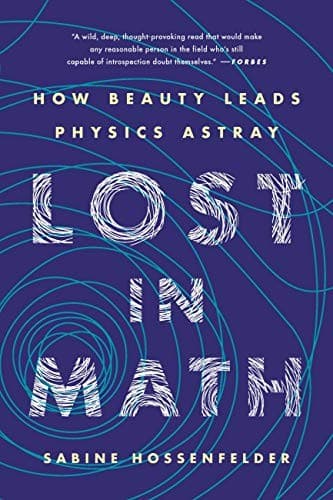
Sabine Hossenfelder
A sharper, more skeptical look at how physicists chase beauty and elegance, which suits readers who enjoyed Rovelli's reflections on what physics really tells us.
Carl Sagan
Sagan blends science and wonder across the universe in the same spirit as Rovelli, turning cosmic scale into something personal and moving.