
We earn a commission if you buy through these links. Learn more
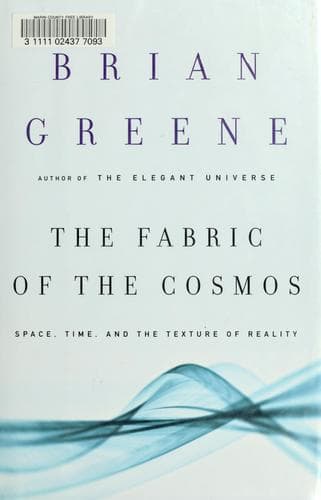
The Fabric of the Cosmos
by Brian Greene
Guide by the Books of the Day editors · Updated · How we write our guides
A clear, ambitious tour of how relativity, quantum physics, and string theory each reshape our idea of space and time, written for curious readers rather than specialists.
What Creators Say About The Fabric of the Cosmos
2 creators reviewed The Fabric of the Cosmos on YouTube in 2011, with 28.4K views between them. Their opinions are their own; we picked these reviews, we didn't write them.
What It's About
The Fabric of the Cosmos is nonfiction, a popular science book, even though it is filed here as fiction. Brian Greene, a theoretical physicist, asks what space and time actually are and whether they have a structure of their own. He starts from intuitions most people hold without thinking, then shows how Newton, Einstein, and quantum physicists each overturned parts of them.
The approach is patient and built on analogies and thought experiments. Greene usually moves from a familiar picture toward a stranger claim, and he keeps the mathematics mostly out of sight, though some passages still ask for concentration. He is open about which ideas are well tested and which are speculative, and he gives the speculative ones real room.
Reading it feels like being guided through a run of surprises by an enthusiastic and candid expert. The book's second half moves into more uncertain territory, including extra dimensions, the possibility of many universes, and the puzzle of why time seems to run in one direction. Expect to read slowly and to reread some sections.
Read this if you…
- want a serious, readable introduction to modern physics of space and time
- enjoyed popular science about relativity or quantum theory and want the next step
- are comfortable with abstract reasoning and don't need every equation spelled out
Skip it if you…
- want a story, a memoir, or anything resembling a novel
- are looking for settled, experimentally confirmed answers, since much of the second half is speculative
Key Ideas
- 1
Space and time as a single, flexible fabric
Einstein's general relativity treats space and time as one connected structure that bends and stretches in response to matter and energy. Gravity is then less a force pulling things together than the shape of that structure, which changes how clocks tick and how distances measure.
- 2
Simultaneity depends on the observer
Two events that look simultaneous to one observer may not be simultaneous to another moving at a different speed. Greene uses this to show that the everyday notion of a universal present moment does not survive close scrutiny in physics.
- 3
Quantum mechanics undermines a fixed, definite reality
At small scales, particles behave in ways described only by probabilities until measured, and distant particles can be linked so that their states are correlated. Greene explains why these results are so hard to reconcile with ordinary intuitions about cause and location.
- 4
Why time seems to have a direction
The past-to-future direction of time is traced to entropy and to the unusually ordered state of the early universe. The argument connects a basic feature of daily life to the large-scale history of the cosmos, though the deepest explanation remains open.
- 5
String theory as an attempt at unification
String theory proposes that fundamental particles are tiny vibrating strings in extra spatial dimensions, offering a route to combine gravity with quantum physics. Greene presents it as a serious but unconfirmed program, and that distinction matters for how the reader should weigh it.
Limitations
Parts of the book, especially the discussions of string theory and the multiverse, describe ideas that have not been experimentally confirmed, and critics argue they are presented with more confidence than the evidence supports. Greene also writes from the vantage point of 2004, so it predates later observational milestones such as the direct detection of gravitational waves and later progress in cosmology. It is an overview rather than a rigorous textbook, so readers wanting technical depth will need further study.
Questions Readers Ask
- Do I need a physics background to read The Fabric of the Cosmos?
- No formal background is required. Greene introduces his ideas through everyday analogies and avoids most mathematics. Some sections, particularly on quantum mechanics and string theory, are dense, so a willingness to reread and go slowly will help a great deal.
- How does it compare to The Elegant Universe?
- Both are by Greene and cover similar territory, but The Fabric of the Cosmos is broader and more philosophical, asking what space and time fundamentally are. The Elegant Universe focuses more narrowly on string theory and its development, so it suits readers who want that topic in depth.
- Published
- 2004
- ISBN
- 9780375727207
- Difficulty
- intermediate
- Category
- Fiction
Book details and cover from Google Books.
Ready to read The Fabric of the Cosmos?
Get your copy on Amazon, or listen to it on Audible. We earn a commission if you buy through these links.