
The Road
Cormac McCarthy
Like Station Eleven, it imagines a world after collapse and focuses on a small, devoted human bond. Its spare, haunting prose will suit readers who valued the mood more than the disaster itself.
Reader-supported: when you buy through links on our site, we may earn an affiliate commission. Learn more
We earn a commission if you buy through these links. Learn more
Find Similar BooksGuide by the Books of the Day editors · Updated · How we write our guides
A quiet, humane post-pandemic novel that braids together a famous actor's death, a traveling Shakespeare troupe, and the strangers whose lives touch in the years around a collapse.
2 creators reviewed Station Eleven on YouTube between 2014 and 2019, with 115.7K views between them. Their opinions are their own; we picked these reviews, we didn't write them.
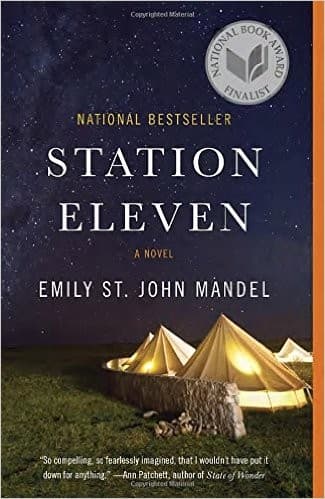
Station Eleven opens on a night in Toronto when an aging actor collapses during a production of King Lear. Within days, a devastating flu has spread across the world, and civilization as its readers know it begins to fall apart. The novel then jumps between that night and a time roughly twenty years later, when the surviving world has settled into small, fragile communities across the Great Lakes region.
Mandel's method is to follow a web of people rather than a single hero. Some of them were on that stage or in the audience, some knew the actor well, and some are connected through a single comic book whose meaning changes as the story goes on. The shifting timelines reward attention, because a detail in one chapter often gains weight decades later in another. The tone is calm and observational, with more interest in what people remember, make, and mourn than in spectacle or violence.
Reading it feels like watching a mosaic assemble. It is melancholy but not bleak, and the sections set among the traveling performers carry a steady warmth. You will finish with a clear sense of what the book cares about, which is what survives a catastrophe besides bare life.
The Traveling Symphony performs Shakespeare and orchestral music for scattered settlements. The novel treats this as a deliberate choice rather than a pastime. Mandel asks what a society needs beyond food and safety, and her answer, argued through characters rather than lectures, is that beauty and memory are part of survival too.
The book is built on coincidence and linkage. Characters who never meet on the page turn out to share history, and objects travel from one life to another. Mandel rewards close reading by letting small details accumulate meaning, so the structure itself becomes part of the emotional payoff.
The actor at the center of the opening is a famous man, but the novel is far more interested in the people orbiting him: the child actor, the ex-wives, the friends, the stagehands. It quietly questions how much a public life matters once the systems that sustain celebrity disappear.
Settlements, trade routes, and travel between towns depend on fragile agreements. Mandel shows how people decide whom to trust and what to preserve, and how quickly ordinary cooperation can be turned into something dangerous when a self-appointed leader gains followers.
Some readers find the coincidences and interlocking connections a little neat, and the emotional register is restrained enough that a few characters can feel more like vehicles for ideas than fully inhabited people. The logistics of how the world functions after the collapse are sketched rather than explored, so readers who want practical detail about rebuilding may be disappointed. Because the pandemic is central, the novel can also feel too close to recent experience for some readers, even though it was written before that period.
Book details and cover from Google Books.
Ready to read Station Eleven?
Get your copy on Amazon, or listen to it on Audible. We earn a commission if you buy through these links.
Cormac McCarthy
Like Station Eleven, it imagines a world after collapse and focuses on a small, devoted human bond. Its spare, haunting prose will suit readers who valued the mood more than the disaster itself.
Peter Heller
A pandemic-era survivor lives in a small community and reflects on what is worth keeping. Its lyrical narration and tenderness toward the natural world echo the reflective tone of Mandel's novel.
Margaret Atwood
A lone survivor pieces together how the world ended, moving between past and present. Readers who liked Station Eleven's fractured timeline will appreciate its sharp, unsettling vision of a collapsed future.
David Mitchell
Several stories spread across centuries are linked by objects and echoes, much like the connected lives in Station Eleven. Its nested structure rewards the same attentive reading.