
We earn a commission if you buy through these links. Learn more
Cloud Atlas
On screen: Cloud Atlas (film, 2012)
Guide by the Books of the Day editors · Updated · How we write our guides
Cloud Atlas links six stories across centuries and genres into one ambitious puzzle, rewarding readers who enjoy structure, voice and big ideas more than a conventional plot.
What Creators Say About Cloud Atlas
2 creators reviewed Cloud Atlas on YouTube between 2018 and 2025, with 12.5K views between them. Their opinions are their own; we picked these reviews, we didn't write them.
What It's About
Cloud Atlas is six stories set at very different moments, from a 19th-century Pacific sea voyage to a far-future society where people are manufactured for labor. Mitchell starts each tale in its own voice and register, then stops it abruptly mid-scene, and only after the sixth story does the book unwind, returning through the earlier tales in reverse order.
The form is the point. Each section is a pastiche of a different genre: a colonial adventure journal, a set of letters from the 1930s, a 1970s conspiracy thriller, a comic farce about an aging publisher trapped in a nursing home, a dystopian interview transcript, and a post-collapse oral narrative in a dialect of invented English. Mitchell moves between these modes with real command, so the reading experience is more like sampling several novels than following one.
Its connective thread is a set of recurring marks and a notion that the same souls recur across lifetimes, which Mitchell handles with a light touch rather than mysticism; you can read it as a puzzle or simply as a sequence of linked moods. The first half asks for patience, since each story but the last is cut off just as it gets going, and the second half rewards it by giving every story its ending in reverse, which deepens what came before.
Read this if you…
- want a novel that rewards close attention to language and structure
- enjoy stitching together a book's larger design across many voices
- like big-picture speculation about history, power and the future
Skip it if you…
- want a single continuous narrative with one protagonist and steady momentum
- find shifting dialects and deliberate hops between eras tiring rather than engaging
Key Ideas
- 1
Nested structure as the book's main argument
The book's shape carries much of its meaning. Stories are interrupted at their most suspenseful moments and resumed only after the central tale, so the reader carries unfinished threads through the whole book. Reading it becomes an exercise in noticing how each voice echoes or inverts the others.
- 2
Voice as the main source of variety
Each story is written in a distinct register: archaic journal prose, letters from the 1930s, hardboiled reportage, brisk comic British English, a formal interview transcript, and a rough future dialect. The variety is not just decoration. Mitchell uses voice to show how power, class and memory shape who gets to tell a story, and how a narrator's idiom can be a form of survival.
- 3
Recurring marks and the idea of return
Characters across eras share a birthmark and a sense of being bound together, and the book hints that souls or acts recur across lifetimes. Mitchell keeps this suggestive rather than explanatory. Readers who want a clear metaphysics may find it frustrating; readers who enjoy patterns will find each reappearance a small pleasure.
- 4
Pastiche as homage and critique
Each section borrows a genre's conventions, from adventure and thriller to satire and science fiction, and plays with them knowingly. The imitations are often affectionate, but Mitchell also tests how far those conventions can carry serious moral weight. Some readers will admire the range; others will feel the cleverness sometimes outruns the feeling.
Limitations
Common criticisms are that the stories vary unevenly in strength, and that the futuristic and post-collapse sections are more inventive than emotionally convincing for some readers. The connective idea of recurring souls is easy to find sentimental. Some readers feel the central thread is thinner than the scaffolding around it, and the characters in the earlier sections are sketched more than fully drawn. The book is also long and demanding in its middle stretch, and its dialect writing can slow reading for some.
Questions Readers Ask
- Is Cloud Atlas a good first David Mitchell novel?
- It can be a strong entry point if you like ambitious structure, but it is not his simplest book. The shifting voices and reverse-order second half ask for patience. Readers who prefer a conventional, single-narrative novel may find it a hard start. Going in expecting a set of linked novellas, rather than one story, helps a great deal.
- Is the film worth watching instead of reading the book?
- The 2012 film, directed by the Wachowskis and Tom Tykwer, adapts the six stories by having actors play multiple roles across them, which many viewers found striking and others found confusing. It can give you a sense of the design, but it flattens much of the prose and the voice-by-voice texture that makes the novel distinctive. Reading the book is the fuller experience.
- Published
- 2004
- ISBN
- 9785699595174
- Difficulty
- intermediate
- Category
- Fiction
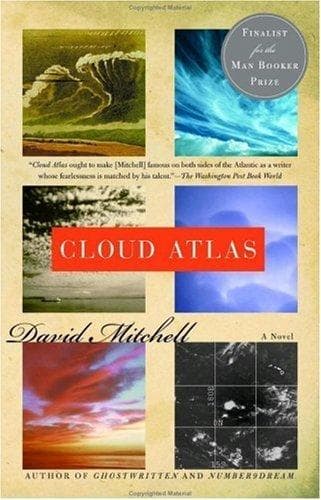
Book details and cover from Google Books.
Ready to read Cloud Atlas?
Get your copy on Amazon, or listen to it on Audible. We earn a commission if you buy through these links.