
We earn a commission if you buy through these links. Learn more
Oryx and Crake
Atwood's near-future novel about genetic engineering, corporate science, and a survivor who is not quite alone asks hard questions about what we owe the future and who gets to shape it.
What It's About
Oryx and Crake follows Snowman, a man who may be the last human being left in a ruined world. He scavenges for food, keeps his distance from the Crakers, a gentle, bioengineered people created by his old friend Crake, and tries to make sense of how everything came apart. The story moves between this bleak present and the years before the collapse, when Snowman, then called Jimmy, grew up in a walled corporate enclave with Crake and a girl named Oryx.
Atwood's approach is patient and deliberate. She withholds the full picture, letting the reader assemble the disaster piece by piece from scraps of childhood, school, and adult life. The near future she builds feels uncomfortably close: genetic labs sell products under invented brands, entertainment is engineered for appetite, and nearly everything, including people, has a price. Her prose is precise and often darkly funny, with a dry eye for the absurdity of consumer culture.
Reading it is less a thriller than an unsettling conversation about what science owes the future and who gets to decide what humanity should become. You will likely finish feeling uneasy, and that is part of the point. The book asks you to sit with guilt, loyalty, and the stories we tell ourselves to get through the day.
Read this if you…
- want speculative fiction that treats science as a moral question rather than a gadget
- like slow-burn stories that reward patience with a gradually assembled picture
- enjoy dark satire with a dry, sharp sense of humour
Skip it if you…
- need a fast plot or a clear, tidy resolution
- find graphic sex and violence hard to read, even when they serve the story
Key Ideas
- 1
Science without a conscience
Atwood shows how a market that rewards genetic work for profit can drift away from any real concern for consequences. The corporations are not cartoon villains. They are indifferent, and that indifference is what makes them frightening. The novel asks who is accountable when scientific ambition outruns moral thinking.
- 2
Who counts as human
The Crakers are designed to be calm, cooperative, and free of the appetites and anxieties that drove their makers. The book uses them to ask what would be gained and lost by a people built to be better behaved than we are. Snowman's uneasy relationship with them keeps the question personal rather than abstract.
- 3
Memory, guilt, and reckoning
Snowman's present is shaped by the childhood years he keeps returning to. Atwood treats remembering as a form of reckoning, where the reader gradually understands what he saw, what he chose not to see, and how much of the disaster was built from ordinary decisions. The emotional weight comes from this slow accumulation.
- 4
Satire of consumer culture
Brands, entertainments, and products in this world are sharp, funny, and deeply cynical. Atwood's satire targets a culture where almost everything is for sale, including bodies and desire. The humour is dry and often uncomfortable, so the jokes tend to land a second later as something more troubling.
Limitations
Some readers find the satire heavy-handed, and the constant brand names and product jokes can feel like a list at times. The graphic content is frequent and not always easy to justify, which bothers some reviewers. The science is loose by design, and the Crakers work better as a thought experiment than as fully realised characters. The book was published in 2003, so some of its predictions now look prescient and others look dated. It is also the first part of the MaddAddam trilogy, so its world feels partly open-ended.
Questions Readers Ask
- Do I need to read the MaddAddam trilogy first?
- No. Oryx and Crake is the first book and stands alone as a complete novel. The two sequels, The Year of the Flood and MaddAddam, widen the world and retell events from other viewpoints. Many readers enjoy them, but you do not need them to understand this book.
- How does it compare to The Handmaid's Tale?
- The Handmaid's Tale is tighter, narrower in focus, and centred on a single political system. Oryx and Crake is wider in scope, more driven by science and commerce, and more openly sardonic. Both use dystopia to examine power over bodies, but this one feels closer to a warning about where current technology might lead.
- Is it still relevant today?
- Yes. Gene editing, biotech companies with large commercial ambitions, and debates about the ethics of engineering living things are all live issues. Readers often find the book more pointed now than when it first appeared, though its tech details reflect the early 2000s.
- Published
- 2002
- ISBN
- 9780747562597
- Difficulty
- intermediate
- Category
- Fiction
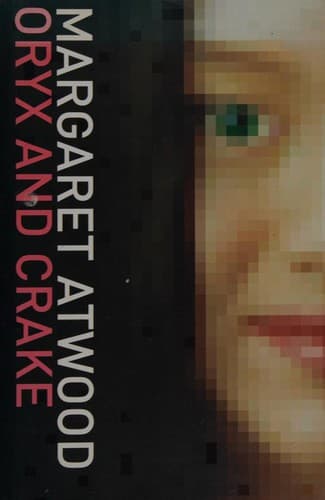
Book details and cover from Google Books.
Ready to read Oryx and Crake?
Get your copy on Amazon, or listen to it on Audible. We earn a commission if you buy through these links.