

One Hundred Years of Solitude
Gabriel Garcia Marquez
Like Homegoing, it traces a family across many generations, letting the weight of history settle on ordinary lives. Its sweep of time and inherited patterns will feel familiar.
Reader-supported: when you buy through links on our site, we may earn an affiliate commission. Learn more
We earn a commission if you buy through these links. Learn more
Find Similar Booksby Yaa Gyasi
Guide by the Books of the Day editors · Updated · How we write our guides
Gyasi's debut follows two half-sisters' bloodlines across three centuries, turning one family's history of captivity and survival into a relay of linked stories that accumulates real force.
2 creators reviewed Homegoing on YouTube between 2016 and 2017, with 93.5K views between them. Their opinions are their own; we picked these reviews, we didn't write them.
Homegoing opens in eighteenth-century Gold Coast, now Ghana, with two half-sisters who grow up in the same village without knowing each other. One is married into the British fort at Cape Coast. The other is taken from the same village and held in the fort's dungeons before being shipped across the Atlantic. Yaa Gyasi then follows each sister's descendants, one chapter per generation, alternating between the Ghanaian line and the American line. The story moves through the Asante wars, the slave trade, plantation life in Mississippi, Harlem in the early twentieth century, the coal mines of Alabama, and into the present day.
Each chapter works like a self-contained short story with its own central character, and characters often appear briefly and then vanish. Gyasi's prose is spare and concrete. She rarely indulges in sentiment and trusts the reader to make connections across generations. Much of the pleasure comes from recognition: a name returning, a scar or habit passed down, an object or phrase that surfaces again after a long gap.
Reading Homegoing feels more like running a relay than following a single novel. Each chapter lands hard, and then you are abruptly in a different life, a different century, and often a different country. The reading is quick and ambitious, and its emotional weight builds as the family tree fills in. The final chapters gather the threads, and the design of the whole book becomes clear.
The book begins with a single split: two women in one village whose lives go in opposite directions, one into comfort inside the colonial fort and one into captivity. Their separate descendants then become the two strands the novel follows. Keeping the sisters' link in mind as you read makes each later chapter feel like part of a larger pattern rather than an isolated episode.
Gyasi shows captivity less as a single event than as something that reshapes families for generations on both sides of the Atlantic. Trauma, poverty, and forced migration appear in different forms in each era, from the slave trade to convict leasing and industrial labor. The book suggests that the consequences of the trade are visible in ordinary lives long after its formal end.
Alternating generations means the reader holds the whole family in mind at once, which the characters themselves cannot do. History shows up as repetition: similar choices, similar violence, and similar hopes recurring under new conditions. The form asks you to notice patterns that no single character could see from inside their own life.
The novel covers the Asante kingdom's conflicts, British coastal forts, the Great Migration, Jim Crow, and the struggles of the civil rights era. Gyasi moves between these settings without much lecturing, so the historical context arrives through what characters need, fear, and lose. The result is a broad sweep of history told mostly at the level of individual lives.
The writing is restrained and clear, with short scenes and few long digressions. Gyasi does not explain every connection or explicitly moralize about injustice. That restraint can make emotional moments hit harder, because the reader supplies the feeling. It also means some characters stay sketched rather than fully drawn, which is part of the book's compact design.
Because the book covers roughly seven generations in a few hundred pages, many characters get only one chapter, and some readers find that they never fully inhabit anyone. Critics have said the episodic structure can flatten emotional investment, and that some chapters feel more like sketches of a historical moment than complete stories. The Ghanaian sections, particularly the precolonial and Asante material, are compressed, so readers wanting deep historical detail may want to read further. The novel also relies on broad moral contrasts that some find schematic.
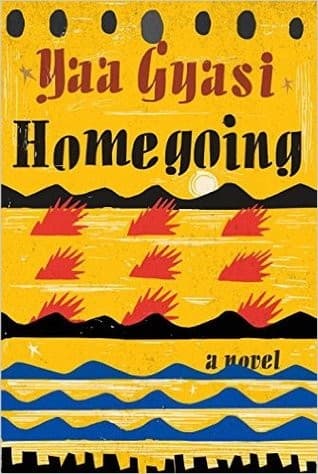
Book details and cover from Google Books.
Ready to read Homegoing?
Get your copy on Amazon, or listen to it on Audible. We earn a commission if you buy through these links.
Gabriel Garcia Marquez
Like Homegoing, it traces a family across many generations, letting the weight of history settle on ordinary lives. Its sweep of time and inherited patterns will feel familiar.

Min Jin Lee
A Korean family saga spanning generations and continents, following migration and hardship with the same patient attention to individual choices that Homegoing gives its branching lineage.

Edward P. Jones
A novel of slavery and freedom in antebellum Virginia, portraying a community with the moral seriousness and humane detail that readers value in Gyasi's account of slavery's afterlives.

Elizabeth Strout, Rosa Perez Perez
Its interlinked chapters build a full portrait of a community through separate episodes, much like Homegoing's chapters that pass the story from one character to the next.