
Hyperion
Dan Simmons
Like Dune, it follows a group of travellers across a richly built future universe, with a mix of religious intrigue, political danger and a slowly revealed mythic core that rewards patient reading.
Reader-supported: when you buy through links on our site, we may earn an affiliate commission. Learn more
We earn a commission if you buy through these links. Learn more
Find Similar BooksOn screen: Dune (film, 2021) · Dune (film, 1984) · Dune: Part Two (film, 2024)
Guide by the Books of the Day editors · Updated · How we write our guides
A 1965 epic of politics, ecology, and religion on a desert planet, valued for its dense worldbuilding and a protagonist whose rise is more troubling than heroic.
2 creators reviewed Dune on YouTube between 2019 and 2026, with 10.3M views between them. Their opinions are their own; we picked these reviews, we didn't write them.
Dune follows Paul Atreides, the son of a noble family given control of Arrakis, a harsh desert planet that is the only source of the spice, a rare substance essential to interstellar travel and valuable beyond measure. The move is far from a simple promotion, and the novel spends most of its length on the fallout: betrayal, shifting alliances, and an outsider's attempt to survive among the planet's native people.
Herbert's style is the first thing that surprises readers. He moves between characters' points of view, sometimes within a single scene, and explains ideas through conversation, internal reflection, and an invented vocabulary the book never fully stops using. Much of the pace comes from scheming and long stretches on ecology, religion, and the economics of water and spice, so the opening can feel slow. Action arrives in bursts rather than as a steady drumbeat.
The experience is closer to reading a political chronicle set in another age than to a typical space adventure. The rewards build gradually: a world that feels lived-in, with its own customs, myths, and economy, and ideas that reward a second reading. Patience matters more than speed here, and readers who give the book that patience often find it richer than its reputation as a blockbuster suggests.
Arrakis shapes everything that happens on it. Water is currency, survival depends on understanding the land, and the native people's customs grow directly out of their environment. Herbert treats the planet as an active force in the story rather than a backdrop, which is one of the book's most original qualities and a reason its ecological themes still resonate with readers today.
Religion in the novel is a tool as much as a faith. Myths about a chosen figure can be cultivated, exploited, and spread for political ends, and the book asks how much of a movement's power comes from genuine belief and how much from people who know how to use it. This skepticism toward messiah stories runs through the whole narrative.
The spice gives the great houses a reason to fight over a single hostile world. The novel lays out a feudal, interstellar system of obligations, rival dynasties, and imperial oversight, and it shows how economic dependence turns into political pressure. Readers who enjoy intrigue will find the court maneuvering as absorbing as any battle.
Several characters can see possible futures, but knowing what might happen does not give them control over it. Herbert explores the tension between fate and choice, and what it costs to carry the burden of foresight. These passages are often more reflective than dramatic, and they give the book much of its philosophical weight.
The shifting point of view, the invented terminology, and the embedded explanations make Dune feel more like a chronicle than a conventional novel. The style is not always smooth, but it creates a sense of a deep history and an unfamiliar culture, and many readers consider this texture the book's central pleasure.
Critics often point to the prose, which can be stiff, and to dialogue that sometimes feels more like exposition than speech. The portrayal of women is limited by the norms of the 1960s, and the narrative's treatment of the Fremen and the hero's arc has drawn sustained criticism for colonialist undertones. Some readers find the later sequels uneven or the glossary a distraction. The book also takes its time, and its interest in politics and religion may not appeal to everyone.
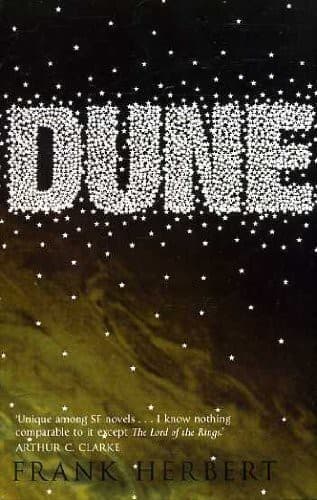
Book details and cover from Google Books.
Ready to read Dune?
Get your copy on Amazon, or listen to it on Audible. We earn a commission if you buy through these links.
Dan Simmons
Like Dune, it follows a group of travellers across a richly built future universe, with a mix of religious intrigue, political danger and a slowly revealed mythic core that rewards patient reading.
George R. R. Martin
It shares Dune's web of great houses vying for control of a vital resource, with alliances and betrayals driving every chapter and no character entirely safe.
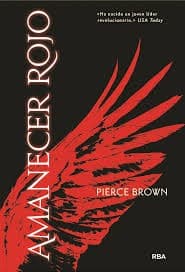
Pierce Brown
Its rigid class hierarchy and rebellion against a ruling elite echo Dune's imperial power struggles, while its pace and sense of a vast, dangerous society will feel familiar.
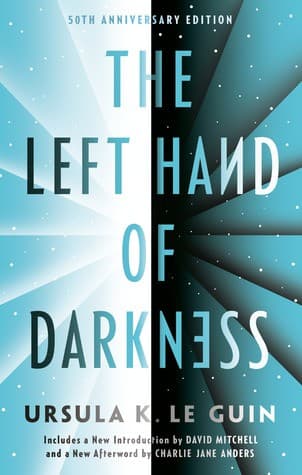
Ursula K. Le Guin
Le Guin shares Dune's careful anthropology of an alien world, where culture, climate and politics shape everything, and her quiet, thoughtful tone suits readers who enjoy Herbert's ideas.