
A Short History of Nearly Everything
Bill Bryson
Bryson brings the same humour and curiosity to the whole of science, from the Big Bang to cells, ideal if you enjoyed Tyson's light touch and sweeping scope.
Reader-supported: when you buy through links on our site, we may earn an affiliate commission. Learn more
We earn a commission if you buy through these links. Learn more
Find Similar BooksGuide by the Books of the Day editors · Updated · How we write our guides
A brisk, witty survey of modern astronomy and physics that gives you the vocabulary and big picture to follow science headlines, in bite-sized sections you can read anywhere.
2 creators reviewed Astrophysics for People in a Hurry on YouTube in 2018, with 44.1K views between them. Their opinions are their own; we picked these reviews, we didn't write them.
Astrophysics for People in a Hurry is a short popular-science survey of the universe, written by a well-known astrophysicist and organized as brief, self-contained sections meant to be read in a few minutes. It moves across a wide range of topics: how we think about scale and distance, the expansion of the universe and the Big Bang, stars and black holes, the strange behavior of matter at the smallest scales, and the search for planets and life beyond Earth. It is a survey rather than a deep dive, so you come away oriented rather than expert.
The tone is conversational and quick, with jokes, analogies, and a clear enthusiasm for the subject. Tyson often ties a concept back to human experience or to the everyday world so that huge numbers and odd ideas feel graspable. The book uses almost no equations, so you will not learn to calculate anything. What you get is a working sense of the main ideas and the terms that come up in news coverage.
Reading it feels like working through a well-stocked sampler. Each piece is easy to finish, and the cumulative effect is a decent mental map of the cosmos. It suits readers who want orientation first and mastery later, and it works well as a starting point before moving on to longer books.
Much of the book's early work is about making the universe's size and age feel real. Tyson stresses how far apart things are and how long events take, and he shows how thinking in scales, from human-sized to cosmic, helps you place every other topic. If you take one habit from the book, it is to ask how big a thing is before asking what it does.
The book presents the cosmos as something that changes over time rather than a fixed backdrop. Expansion, the Big Bang, and the gradual formation of galaxies and stars are explained as parts of one story. The aim is to show why astronomers treat the universe as an evolving system, and why evidence from light and motion carries so much weight in that story.
Gravity is the force that shapes most large-scale structure, and the book uses it to explain how stars live and die and what black holes are. Tyson treats these objects as places where ordinary intuition breaks down, which makes them a good way into thinking about physics in general. The explanations are qualitative, so expect concepts rather than the mathematics behind them.
Quarks, particles, and quantum mechanics get a compact treatment that aims to show why the smallest scales behave so differently from everyday objects. Tyson is candid that these ideas can feel counterintuitive, and he presents them as part of the same picture as the largest structures. Readers new to quantum physics will get a useful outline, though not a full understanding.
The closing themes address exoplanets, the search for life, and the question of Earth's place in the cosmos. Tyson connects discoveries about distant planets to bigger questions about our origins and our significance. This section tends to be the most engaging for general readers, because it turns abstract physics into questions people care about directly.
Because the book covers so much in so little space, many topics are sketched rather than explained, and readers who want to understand the reasoning behind a claim will need to look further. Some critics find the wit and self-promotion more prominent than the substance, and others feel the breezy tone can flatten difficult ideas. The book was published in 2017, so fast-moving areas such as exoplanet discovery and dark matter and energy research have since advanced beyond what it describes.
Book details and cover from Google Books.
Ready to read Astrophysics for People in a Hurry?
Get your copy on Amazon, or listen to it on Audible. We earn a commission if you buy through these links.
Bill Bryson
Bryson brings the same humour and curiosity to the whole of science, from the Big Bang to cells, ideal if you enjoyed Tyson's light touch and sweeping scope.
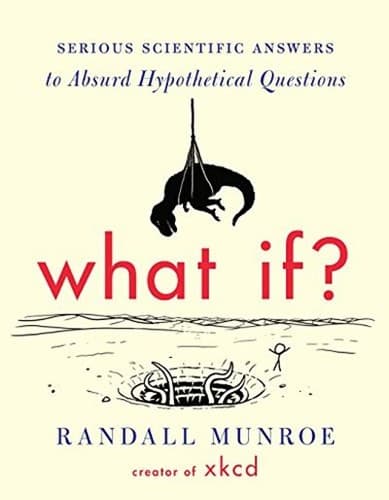
Randall Munroe
Absurd hypothetical questions answered with real physics and stick-figure humour; a playful companion for readers who liked Tyson's wit and quick, digestible sections.
Carl Sagan
Tyson's mentor wrote the classic that inspired his closing chapter's sense of wonder; Sagan blends astronomy, history and philosophy about our place in the universe.
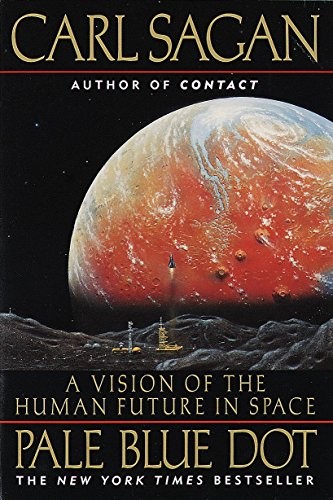
Carl Sagan
A meditation on humanity's future in space, it deepens the reflective, humbling tone that readers found so moving at the end of Tyson's book.