
We earn a commission if you buy through these links. Learn more
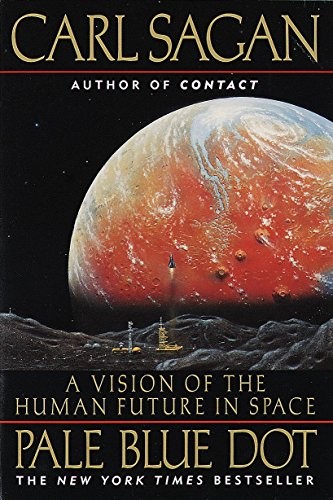
Pale Blue Dot
by Carl Sagan
Guide by the Books of the Day editors · Updated · How we write our guides
Sagan's 1994 book uses the famous Voyager photo of Earth as a starting point for a clear, warm case that exploring other worlds helps us understand and protect our own.
What Creators Say About Pale Blue Dot
2 creators reviewed Pale Blue Dot on YouTube between 2009 and 2012, with 9M views between them. Their opinions are their own; we picked these reviews, we didn't write them.
What It's About
Pale Blue Dot, published in 1994, takes its title from the 1990 photograph of Earth taken by Voyager 1 from billions of kilometers away, an image Sagan had championed. The book is part memoir, part survey of planetary science, and part policy argument. It moves between Venus and its runaway greenhouse climate, Mars and the evidence that it once had water, and the moons of the outer planets, always asking what those worlds teach us about Earth and about our place in the universe.
Sagan's style is expansive and conversational. He explains complicated ideas without talking down to readers, and he is openly persuasive. Much of the book is an argument rather than a neutral report: he wants readers to see space science as an investment in human survival, and he makes his case with enthusiasm and a fair amount of moral urgency.
Reading it feels like listening to a passionate teacher who wants you to care as much as he does. It works best as a big-picture experience. If you want a tight, technical account of any single mission, this will feel more like a sermon than a manual.
Read this if you…
- Want a big-picture view of why planetary science matters for life on Earth
- Enjoy Sagan's warm, persuasive, and literary style of science writing
- Are curious about Venus, Mars, and the outer planets without wanting heavy math
Skip it if you…
- Want current findings on exoplanets, astrobiology, or recent Mars missions
- Prefer technical detail, data tables, or a neutral, non-persuasive account
Key Ideas
- 1
Earth seen from a great distance
Sagan uses the image of a small speck of light to argue that our planet's fragility and isolation should change how we think about conflict, resources, and responsibility. The argument is emotional as much as scientific, and it is the thread that ties the book together. He presents perspective as something people can actually choose to adopt, not just a feeling a photograph produces.
- 2
Other planets as cautionary comparisons
Venus, Mars, and Earth started with similar materials but ended up with very different climates. Sagan uses these contrasts to show how atmospheres can change, and why understanding those changes matters for our own planet. The comparisons are the most useful part for readers who want to understand climate as a planetary system rather than a set of isolated environmental issues.
- 3
Exploration as an investment, not escapism
Sagan pushes back on the idea that space programs distract from problems on Earth. He argues that the knowledge, technology, and habits of inquiry they produce are practical and worth funding. Readers who have heard the same debate in modern budget discussions will find his reasoning familiar, though his tone is more idealistic than most policy writing.
- 4
Robots versus people in space
Sagan weighs the strengths of robotic probes against the case for sending humans to other worlds. He is candid about the costs and risks of crewed missions, but he also argues that human presence can inspire and extend what machines do. This section shows his willingness to consider trade-offs rather than simply cheer for spaceflight.
Limitations
Because the book was written in the early 1990s, much of its planetary science is out of date. Discoveries about exoplanets, the subsurface oceans of icy moons, and the many later Mars missions came after it was published. Some of Sagan's optimism about future crewed exploration and terraforming has not been borne out. Critics also find the tone preachy at times, and the policy arguments reflect the debates of their era, so readers should weigh them as period writing rather than settled conclusions.
Questions Readers Ask
- Is Pale Blue Dot still worth reading today?
- Yes, especially for its perspective and its argument about why space matters. The specific science and forecasts are dated, so pair it with newer sources on Mars or exoplanets if you want current facts. Sagan's core point about Earth's fragility still lands well.
- How does it compare to Sagan's Cosmos?
- Cosmos is a broader, more visual tour of the universe and its history. Pale Blue Dot is narrower and more argumentative, focused on our planetary neighborhood and on why exploration matters. Readers who liked Cosmos will enjoy the same voice here, but with a sharper political and moral edge.
- Do I need a science background to read it?
- No. Sagan writes for general readers and explains concepts as he goes. Some passages about atmospheres and planetary geology require some attention, but none assume prior training. Curiosity matters more than background knowledge.
- Published
- 1994
- ISBN
- 9781531888121
- Difficulty
- beginner
- Category
- Science
Book details and cover from Google Books.
Ready to read Pale Blue Dot?
Get your copy on Amazon, or listen to it on Audible. We earn a commission if you buy through these links.