
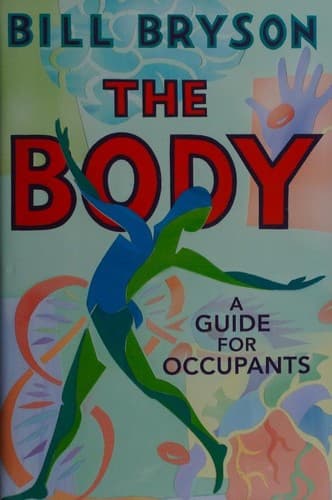
The Body
Bill Bryson
Bryson turns the same curious, joke-studded approach inward, touring the human body organ by organ with the strange facts and quirky scientist stories that made A Short History such a pleasure.
Reader-supported: when you buy through links on our site, we may earn an affiliate commission. Learn more
We earn a commission if you buy through these links. Learn more
Find Similar Booksby Bill Bryson
Bryson turns a sprawling tour of cosmology, geology, and biology into a funny, curious crash course in how scientists know what they know, without requiring any prior training.
A Short History of Nearly Everything is Bill Bryson's attempt to tell the story of the universe, the planet, and the living things on it in a single readable volume. He ranges from the first moments after the Big Bang through the formation of the Earth, the appearance of life, and the slow emergence of human beings, pausing at each stage to ask how anyone could possibly know what happened so long ago. The book is less a list of settled facts than a tour of the people who work out those facts.
Bryson's method is the one he uses in his travel books: he goes to see things, visits working scientists in their labs and field sites, asks blunt questions, and reports back in plain, conversational prose. Expect many short digressions, vivid anecdotes about eccentric researchers, and an unusual number of numbers translated into human scale. The tone is affable and self-deprecating, with frequent jokes, but the explanations are careful and he is candid about what remains unclear.
The experience is closer to being walked through a museum by an enthusiastic, slightly bewildered guide than to reading a textbook. You will rarely feel lost, and you will often find yourself reading passages aloud to whoever is nearby. It is a book to dip into or to read in a few long sittings, and it rewards curiosity more than prior knowledge.
Much of the book is an effort to make billions of years graspable. Bryson keeps returning to the gap between a human lifetime and geological time, and to how hard it was for scientists to accept that the Earth is as old as it is. The sense of scale is the book's organizing feeling, and it is what makes the early chapters feel so striking.
The people in the book are not infallible. Many of them were rivals, many were wrong for years, and several made their breakthroughs by persisting against prevailing opinion or by sheer luck. Bryson uses these stories to show that knowledge arrives through argument, mistakes, and personality as much as through clean experiments.
The book repeatedly stresses how contingent the course of life has been. Mass extinctions, chance events, and long stretches of slow change appear again and again, leaving the emergence of humans looking like a recent and fragile outcome rather than the planned destination of evolution. This perspective is one of the book's most memorable lessons.
Bryson's later chapters turn toward biology and medicine, where he points out how much we still do not understand about the living systems we inhabit, including microbes and the mechanics of our own cells. The contrast between confident knowledge of distant galaxies and shaky knowledge of ourselves gives the book a reflective closing note.
The book was published in 2003, so parts of it are dated, including some planetary classifications, fast-moving areas of genetics, and the state of cosmology. Critics also point out that Bryson's cast of characters skews heavily toward white men and that the emphasis on eccentric personalities sometimes crowds out the science itself. Because the book aims for accessibility, it can smooth over real scientific disagreements and simplify complicated mechanisms. It is a starting point, not a substitute for the specialist literature.
Reviews from readers on YouTube. Their opinions are their own.
Book details and cover from Google Books.
Ready to read A Short History of Nearly Everything?
Get your copy on Amazon, or listen to it on Audible. We earn a commission if you buy through these links.
Bill Bryson
Bryson turns the same curious, joke-studded approach inward, touring the human body organ by organ with the strange facts and quirky scientist stories that made A Short History such a pleasure.
Carl Sagan
The classic sweeping tour of the universe and of how we came to understand it. Sagan shares Bryson's sense of wonder and his gift for making vast scales feel personal.
Neil deGrasse Tyson
A brisk, witty primer on the cosmos for readers who loved Bryson's opening chapters on the Big Bang and the universe and want that material in compact, entertaining form.
Yuval Noah Harari
It picks up roughly where Bryson's book ends, tracing humanity from early hominins to the modern world with the same big-question ambition and accessible style.