
We earn a commission if you buy through these links. Learn more
What If?
Guide by the Books of the Day editors · Updated · How we write our guides
Randall Munroe answers odd reader questions with real physics, careful estimates, and jokes that land because the math holds up, making hard science feel playful rather than intimidating.
What Creators Say About What If?
2 creators reviewed What If? on YouTube between 2014 and 2022, with 1.1M views between them. Their opinions are their own; we picked these reviews, we didn't write them.
What It's About
What If? is a collection of answers to strange hypothetical questions that Munroe, the cartoonist behind xkcd, received from readers and took seriously. The premises are often absurd: what would happen under particular extreme conditions, how something would really behave if the rules were pushed far enough. Munroe treats each one as a real problem. He works out the physics, estimates the numbers, and shows his reasoning, so the reader sees how a scientist would approach a question no one has ever asked a lab.
The approach is what makes the book distinctive. Munroe leans on rough, back-of-the-envelope calculation, the habit of getting a sensible answer within an order of magnitude using simple assumptions. Nothing is hidden behind jargon. Many chapters move from a plain question to a surprising conclusion, with the middle steps laid out clearly enough that you could redo them yourself. His drawings and dry asides keep the tone light, and the best answers end with a fact about the world that you did not expect.
Reading it feels like sitting with a clever friend who finds everything interesting and refuses to skip the arithmetic. It works well in short sessions, since each answer stands alone, and it rewards readers who enjoy following a line of reasoning to its absurd end.
Read this if you…
- enjoy seeing a rigorous answer to a ridiculous question
- want a friendly, practical introduction to estimation and basic physics
- like xkcd and its mix of curiosity, precision, and dry humor
Skip it if you…
- want a systematic textbook with exercises and full derivations
- need reliable, up-to-date data for a professional project
Key Ideas
- 1
Estimation as a way of thinking
The book's central skill is the rough estimate. Munroe repeatedly shows that you do not need precise data to reach a useful answer. Pick sensible sizes, speeds, and masses, multiply them out, and check whether the result is plausible. The method is transferable well beyond these questions, and the book teaches it by example rather than by lecture.
- 2
Taking absurd premises literally
The humor comes from refusing to wave away a silly question. Munroe asks what the rules of physics actually imply when a premise is pushed to an extreme. Often the answer reveals something real about scale, energy, or materials, and the joke becomes a window into how the world works.
- 3
Showing the physics behind everyday intuition
Many answers overturn common assumptions about speed, heat, weight, or damage. Munroe connects the odd scenario to familiar ideas, so readers come away with a better feel for forces and energies they already encounter. The science is accurate at the level of a good introductory course.
- 4
Humor and illustration as a teaching tool
Drawings, captions, and self-aware asides keep long calculations readable. The jokes are not decoration; they signal when an assumption is silly, when a number is absurd, and when the reader should pause and check the logic. This makes the book more inviting than a standard science text while keeping its rigor intact.
Limitations
Munroe's answers are estimates built on simplifying assumptions, and some conclusions depend heavily on choices he makes about materials or conditions. Readers looking for exhaustive treatment of any single topic will find the coverage broad but shallow. The format is episodic, so the book has no overarching argument, and some readers will tire of the repeated pattern of joke, assumption, calculation, and punchline. Because it is built on established physics rather than cutting-edge research, it adds little for specialists.
Questions Readers Ask
- Do I need a physics background to enjoy What If??
- No. Munroe explains each step in plain language and uses basic arithmetic and common sense. Some answers involve more numbers than others, but you can follow the reasoning even if you skip the details. A high school level of science is enough to get the main points, and the humor carries you through the heavier passages.
- How does it compare to a more traditional popular science book?
- It is less about a single theme and more about demonstrating a way of thinking through many small problems. A traditional popular science book usually builds one argument across chapters. What If? instead gives you dozens of self-contained answers, which makes it easier to dip into and more fun for readers who like puzzles and surprises.
- Published
- 1980
- ISBN
- 9786053436157
- Difficulty
- beginner
- Category
- Science
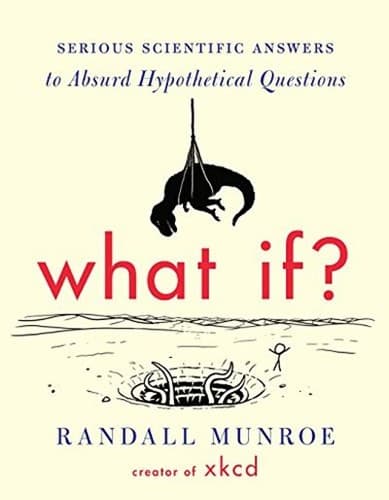
Book details and cover from Google Books.
Ready to read What If??
Get your copy on Amazon, or listen to it on Audible. We earn a commission if you buy through these links.