
Consider Phlebas
Iain Banks
Banks shares Vinge's love of huge galactic canvases, advanced machine minds and morally complicated war. Like A Fire upon the Deep, it treats a far-future civilization with wit and grim realism.
Reader-supported: when you buy through links on our site, we may earn an affiliate commission. Learn more
We earn a commission if you buy through these links. Learn more
Find Similar Booksby Vernor Vinge
Guide by the Books of the Day editors · Updated · How we write our guides
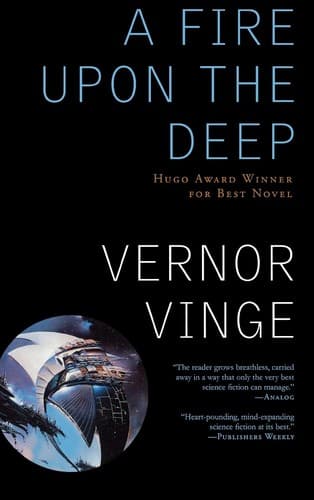
Vinge's Hugo-winning space opera makes the limits of intelligence a physical fact, sending its characters across a galaxy where thinking power depends on distance from the core.
2 creators reviewed A Fire upon the Deep on YouTube between 2023 and 2025, with 49.6K views between them. Their opinions are their own; we picked these reviews, we didn't write them.
A Fire Upon the Deep is a big space opera by Vernor Vinge, first published in 1992, built on one unusual premise: how smart a mind can be depends on where it lives in the galaxy. The galaxy is divided into concentric zones of thought. Far out, in the Unthinking Depths, physics allows only simple machines and minds. Closer in, intelligence can be stronger, and at the center lie regions where superintelligent beings operate. Vinge uses this structure to make the setting feel strange and internally logical rather than merely decorative.
The story follows several groups who are swept across these zones after a dangerous discovery sets off a chain of disasters. The narrative alternates between human characters, alien creatures, and their pursuit of a powerful and malevolent force. The pace is brisk, with long stretches of adventure, political maneuvering, and close calls. Vinge explains his technology in practical terms, and his aliens are written with real care, especially the Tines, whose group-minded bodies make dialogue and point of view unusual.
Reading it feels like a long, generous adventure with serious ideas underneath. The early chapters can take some patience while the cast and the zone rules settle in, but the book rewards commitment with momentum and a sense of scale that few space operas match.
The central conceit is that the physical laws governing computation vary by region, so the same kind of mind can be brilliant in one zone and nearly helpless in another. Vinge treats this as a practical constraint that affects travel, communication, and what characters can build or understand. It gives the book its distinctive sense of cosmic geography.
The Tines are a pack-like species whose individual bodies together form a single mind, and the book explores what identity, loyalty, and decision-making mean under those conditions. Their perspective challenges the human assumption that a thinking being is one body with one voice. Their scenes are some of the most original writing in the novel.
Vinge asks what happens when minds far beyond human capacity pursue goals that ordinary beings cannot easily predict or resist. The book treats superintelligence less as a fantasy of wonder than as a source of real risk and moral complexity. Characters must weigh survival against the cost of getting involved with forces they barely understand.
Beneath the chases and battles, the novel is interested in civilizations separated by vast distances and immense spans of time. Vinge keeps returning to how small and fragile individual lives look against that backdrop. This sense of scale is what gives the action its weight and makes the stakes feel larger than any single ship or world.
Some readers find the human characters less vivid than the aliens, and the early chapters can feel crowded with names, factions, and zone rules before the story gains speed. The prose is uneven in places, with dialogue that sometimes leans on exposition. Some of the technology and social assumptions reflect early 1990s attitudes, and the book does not explore its ideas about minds and power as deeply as some later work in the genre. It is also the first part of a larger universe, so it leaves some threads open.
Book details and cover from Google Books.
Ready to read A Fire upon the Deep?
Get your copy on Amazon, or listen to it on Audible. We earn a commission if you buy through these links.
Iain Banks
Banks shares Vinge's love of huge galactic canvases, advanced machine minds and morally complicated war. Like A Fire upon the Deep, it treats a far-future civilization with wit and grim realism.
Dan Simmons
Hyperion pairs a sweeping far-future setting with a band of travelers and a series of connected tales. Readers who enjoyed the layered storylines and dread of Vinge's galaxy will find the same ambition here.
Alastair Reynolds, John Lee
Reynolds builds a hard-science galaxy of ancient alien mysteries and dangerous posthuman factions. Fans of Vinge's Transcend-style far future will appreciate its scale and the sense of deep time.
Adrian Tchaikovsky
Tchaikovsky imagines evolved spider societies and a human crew trying to communicate across vast gulfs. Like Vinge's Tines and Skroderiders, the non-human minds feel truly alien and cleverly designed.