
We earn a commission if you buy through these links. Learn more
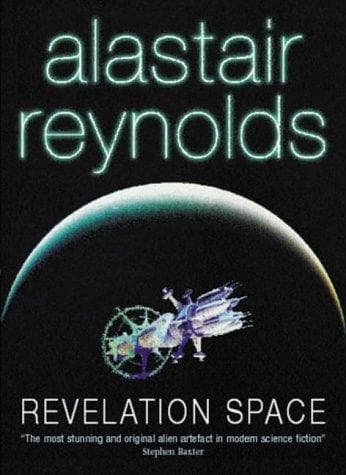
Revelation Space
by Alastair Reynolds, John Lee
A dense, patient hard science fiction novel where relativity, dead alien ruins, and a galaxy-wide machine threat combine into a slow-building mystery that rewards close attention.
What It's About
Revelation Space is a long, dense science fiction novel by Alastair Reynolds, first published in 2000 and the opening book of a loosely connected series. It is set in the far future, when humanity has spread across several star systems, and much of the action takes place aboard ships and on remote worlds where people live in the long shadow of a vanished alien civilization and a galactic menace. The story moves between several characters and several eras, so the reader assembles the picture piece by piece rather than being handed it up front.
Reynolds writes in the tradition of hard science fiction. Relativity, the cost of travel at near light speed, and the physical conditions of ships and planets shape the plot as much as the people do. Time dilation is not a gimmick here; it is what makes the characters' lives feel stretched and disconnected from the people they left behind. The prose is careful rather than flashy, and the pacing is deliberate, with long stretches of investigation, argument, and technical detail alternating with sudden bursts of danger.
Reading it feels like working through a mystery across a huge canvas. The payoff comes from patience and from noticing how small details connect across distance and decades. Expect a book that rewards attention more than it offers immediate pleasure, and plan for a few slow sections before the larger pattern becomes clear.
Read this if you…
- enjoy hard science fiction where physics and engineering drive the plot
- like slow-burn mysteries that span centuries and several characters
- are interested in posthuman futures and what identity means when minds can be copied or altered
Skip it if you…
- want fast action and tight, self-contained plots that finish cleanly
- find long passages of technical detail or exposition tiring
Key Ideas
- 1
Deep time and the cost of distance
Relativistic travel means that a voyage can take years for the traveller while decades pass at home. Reynolds uses this to make isolation physical. Characters carry old loyalties into worlds that have moved on without them, and the sense of being out of step with your own past is one of the book's most affecting threads.
- 2
A dead civilization that still matters
The Amarantin, an extinct alien people, left ruins and traces that humans keep trying to understand. The book treats them less as a tidy puzzle than as a warning about how much a lost culture can shape the present. Archaeology here is patient, uncertain work, and the answers are never simple.
- 3
Posthuman factions and what humanity becomes
Some people in the novel have altered their bodies, minds, or memories beyond recognition. Reynolds asks what identity means when a person can be copied, merged, or extended indefinitely. The ideas are presented through competing factions with different values, so the reader sees several answers rather than one lecture.
- 4
Machines as a galaxy-scale threat
The Inhibitors are a vast, impersonal machine presence whose motives are hard to read. Their menace is less about spectacle than about scale and indifference. The fear of something that can wipe out whole civilizations without malice gives the background of the book a steady sense of dread.
- 5
Hard science fiction in a literary register
Reynolds grounds his ideas in physics and engineering while keeping the emotional stakes personal. The science is not decoration; it limits what characters can do and how quickly they can act. This combination of rigorous detail and character-driven unease is what sets the book apart from more action-driven space opera.
Limitations
The book has a slow opening, and its large cast and several factions can be hard to keep track of in the early chapters. Some readers find the characters less vivid than the ideas around them, and the exposition sometimes arrives in dense blocks. The story ends with many threads still open, which frustrates readers who want resolution. The 2000 publication date shows in some of the technology and assumptions, though the core themes about distance, memory, and identity still hold up well.
Questions Readers Ask
- Do I need to read the rest of the Revelation Space series?
- No, the novel works on its own as a complete reading experience, though it leaves several threads unresolved. Reynolds's later books in the same universe pick up those threads and expand the setting, often with different characters. If you enjoy this one, the sequels are the natural next step, but you will not be lost if you stop here.
- How does it compare to Dan Simmons's Hyperion?
- Both are large space operas built around multiple viewpoints and a sense of a vast, mysterious universe. Revelation Space is more firmly grounded in hard science, with relativity and engineering shaping the plot. Hyperion has a more mythic, literary tone and a clearer structure of linked stories. Readers who want rigour may prefer Reynolds, while those who like a richer structure may prefer Simmons.
- Does the book still feel relevant?
- Yes, mostly. The specific technology reflects its era, but the book's core concerns about distance, memory, the limits of human identity, and the danger of indifferent powers remain current. Its slower pace may feel unfamiliar to readers used to modern space thrillers, but the ideas age better than many of its gadgets.
- Published
- 2000
- ISBN
- 9780316462433
- Difficulty
- intermediate
- Category
- Science Fiction
Book details and cover from Google Books.
Ready to read Revelation Space?
Get your copy on Amazon, or listen to it on Audible. We earn a commission if you buy through these links.