
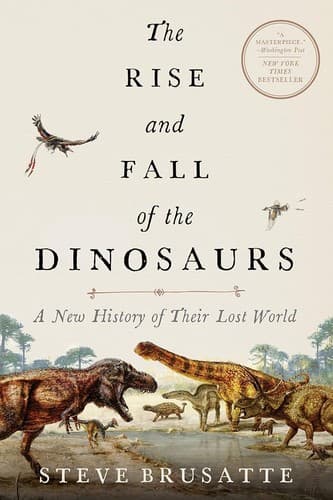
The rise and fall of the dinosaurs
Stephen Brusatte
A working paleontologist mixes field stories with clear explanations, much as Shubin does with Tiktaalik, tracing how dinosaurs arose, diversified and gave rise to birds.
Reader-supported: when you buy through links on our site, we may earn an affiliate commission. Learn more
We earn a commission if you buy through these links. Learn more
Find Similar Booksby Neil Shubin
Guide by the Books of the Day editors · Updated · How we write our guides
A paleontologist who helped find Tiktaalik walks you through how fossils and genes reveal that your hands, skull, and even some genes descend from ancient fish and simple animals.
2 creators reviewed Your Inner Fish on YouTube between 2020 and 2023, with 3.6K views between them. Their opinions are their own; we picked these reviews, we didn't write them.
Your Inner Fish is Neil Shubin's account of how the human body makes sense only when you read it as a record of its past. Shubin, a paleontologist who co-discovered Tiktaalik, a fossil animal with fin-like limbs and a neck that was not fully locked to its shoulders, uses that find as a starting point for a larger argument about shared ancestry. The book moves between the rock record and modern laboratories, where genes that organize development in flies, worms, and mice turn out to resemble the ones that build our own bodies.
The style is conversational and personal. Shubin describes the fieldwork in the Canadian Arctic, the long stretches of hard digging and the occasional luck that turns up a key specimen, and the way his lab work changed what he thought he knew. Explanations are anchored in everyday body parts such as the hand, the skull, and the nerves that take odd detours through the body, so readers can test each idea against their own anatomy.
Reading it feels less like studying a textbook and more like being led through a series of surprises by a guide who clearly enjoys the puzzle. It is short, brisk, and light on equations, though it assumes you can follow a basic idea of evolution and inheritance. The result rewards curiosity more than prior expertise, and it tends to change how readers look at their own bodies.
Shubin's central idea is that the same basic structures keep showing up in very different animals, sometimes in altered form. A bone or nerve in your body can be traced back to a job it once did in an ancestor that looked nothing like you. Seeing anatomy this way turns a list of body parts into a history of reuse and modification, which explains many features that otherwise seem like poor design.
The book builds its best-known argument around the bones of fish fins and the bones of our arms and hands, which follow a similar arrangement. Fossils such as Tiktaalik show the transition in progress, with a fin that also carried a proto-wrist and limb-like joints. The lesson is not that a fish turned into a person, but that our limbs grew from structures already present in fish.
Shubin argues that the human skull carries the organization of ancient jawless fish, and that the supports for the gills in early vertebrates were later repurposed into jaws and parts of the middle ear. This reframing makes the head read like a set of parts recycled over hundreds of millions of years. It is one of the book's most vivid demonstrations of how evolution works with what it already has.
In the later sections, Shubin turns to genetics to show that many of the genes controlling body plans are shared across animals, from insects to vertebrates. Some of the same regulatory systems also appear in much simpler organisms. This suggests that the instructions for building bodies were largely inherited and then elaborated, rather than invented from scratch in each lineage.
Because the book was written in 2008, its genetics material reflects an earlier stage of research, and the field has moved considerably since then. Shubin simplifies some ideas to keep the narrative moving, and critics sometimes feel the 'fish to human' framing encourages a ladder picture of evolution that the science does not support. Readers looking for mechanisms in depth, or for the wider debate over developmental genes, will need to look elsewhere. Some passages lean on the author's own work, which gives the book energy but also a narrower view than a survey would offer.
Book details and cover from Google Books.
Ready to read Your Inner Fish?
Get your copy on Amazon, or listen to it on Audible. We earn a commission if you buy through these links.
Stephen Brusatte
A working paleontologist mixes field stories with clear explanations, much as Shubin does with Tiktaalik, tracing how dinosaurs arose, diversified and gave rise to birds.

Thomas Halliday
Vivid snapshots of ancient ecosystems built from fossil evidence. It suits readers who enjoyed picturing the shallow streams where Shubin's fishapod lived.
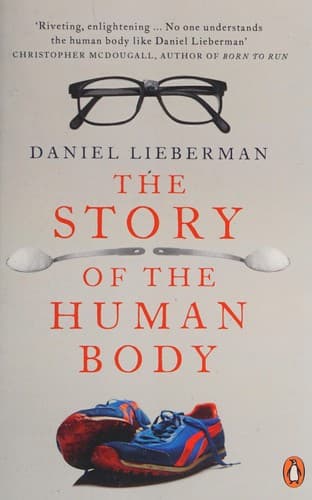
Daniel E. Lieberman
Lieberman explains how our evolutionary past shapes modern health. It extends Shubin's idea that ancient ancestry explains everyday bodily quirks and ailments.
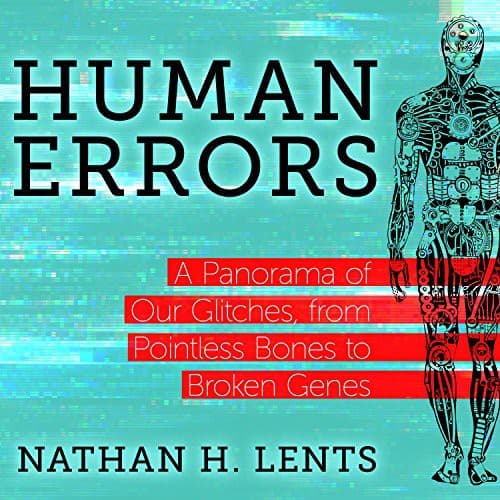
Nathan H. Lents
A witty catalogue of our body's design flaws, from sinuses to knees, rooted in evolutionary history. It has the same playful, anatomy-first spirit as Shubin.