
We earn a commission if you buy through these links. Learn more
Story of the Human Body
Guide by the Books of the Day editors · Updated · How we write our guides
A Harvard evolutionary biologist explains why bodies shaped for ancient life struggle with modern food, chairs, and sleep, and makes a clear case for evolutionary medicine.
What Creators Say About Story of the Human Body
2 creators reviewed Story of the Human Body on YouTube between 2017 and 2018, with 36.9K views between them. Their opinions are their own; we picked these reviews, we didn't write them.
What It's About
Daniel Lieberman, an evolutionary biologist at Harvard, asks a practical question: why does a body built over millions of years for hunting, gathering, and walking so often break down in modern life? He follows the human lineage through the traits that define us, including upright walking, the feet and knees that support it, the teeth and jaws that process food, and the large brain that depends on energy and sleep. Each trait is then set against contemporary conditions such as sedentary work, cushioned shoes, refined diets, and long lives that outlast the body's original design.
The approach is evolutionary medicine. Lieberman's central tool is the idea of mismatch: many common complaints, from back pain to dental crowding, may reflect a gap between the environment our bodies expect and the one we actually live in. He leans on anatomy, fossils, and comparisons with other primates, and he explains technical points in plain language. He also separates well-supported claims from educated guesses, which helps a general reader see where the science is firm and where it is still being argued.
Reading the book feels like listening to a knowledgeable, opinionated professor who likes to connect everyday experience to deep history. It is brisk and readable rather than dense, and it rewards anyone curious about why the body works the way it does. Its advice about movement and daily habits is pointed, which some readers will find motivating and others may find preachy, but the underlying reasoning stays visible throughout.
Read this if you…
- are curious about why the body has quirks like bad backs, wisdom teeth, and difficult childbirth
- want a clear introduction to evolutionary thinking applied to health
- enjoy popular science that connects everyday aches to deep human history
Skip it if you…
- want a definitive, step-by-step health or diet plan you can follow without debate
- are looking for a detailed guide to a specific medical condition or treatment
Key Ideas
- 1
The mismatch between ancient bodies and modern life
Lieberman's core argument is that human bodies were tuned by natural selection for conditions that have changed quickly in the last few thousand years. Many chronic problems, he suggests, come from the gap between those inherited expectations and modern routines like constant sitting, processed food, and artificial light. The idea is less about nostalgia than about understanding why certain conditions are so common.
- 2
Built to walk and run
A large share of the book is about locomotion. Feet, knees, hips, and the spine are presented as structures shaped by long-distance walking and, possibly, running. Lieberman discusses how supportive footwear and inactivity may change how these structures work, which makes the chapters on feet and posture especially useful for anyone with aches they cannot explain.
- 3
Evolution as trade-offs, not perfect design
The book repeatedly stresses that natural selection produces workable compromises, not flawless machines. Childbirth, wisdom teeth, and the spine's upright load are examples of features that carry real costs. Seeing the body as a set of trade-offs helps explain why it can be impressive and fragile at the same time, and it discourages the idea that any single fix will make it perfect.
- 4
Diet and teeth as evidence of our past
Teeth, jaws, and digestion offer clues about what early humans ate and how their bodies adapted to it. Lieberman uses this evidence to question some popular nutrition claims. Readers should note that dietary reconstructions from the past are uncertain and debated, so the book is best read as a set of plausible hypotheses rather than settled dietary rules.
Limitations
Some of the book's conclusions about ancestral diet, exercise, and footwear are contested among researchers, and Lieberman's personal views sometimes come through more strongly than the evidence alone would support. Reconstructions of early human life rely on incomplete fossil and archaeological records, and fast-moving work in ancient DNA has since added detail that the book does not fully reflect. Its lifestyle advice can also read as prescriptive. It is best treated as a well-argued framework rather than a complete account of human health.
Questions Readers Ask
- Is this a good first book on human evolution?
- Yes, for most general readers. Lieberman explains anatomy and evolutionary reasoning without assuming prior training, and he keeps the focus on the body rather than the full history of hominins. Readers who want a broader survey of human origins may want to pair it with a book that covers fossils and migration in more depth.
- How does it compare to Why We Get Sick by Nesse and Williams?
- Both books apply evolutionary thinking to health. Nesse and Williams focus more on why natural selection leaves us vulnerable to disease, while Lieberman spends more time on anatomy, movement, and the body's everyday mismatches with modern life. If you want the disease-focused argument, read Nesse and Williams. If you want to understand your feet, spine, and diet, Lieberman is the better fit.
- Is the book still worth reading given newer research?
- Yes, as an introduction to the ideas, though some specifics have aged. Advances in ancient DNA and fossil studies have revised parts of the human story, and debates about diet and footwear have moved on. Use the book for its framework and questions, then check newer sources for the details.
- Published
- 2013
- ISBN
- 9780141399959
- Difficulty
- beginner
- Category
- Science
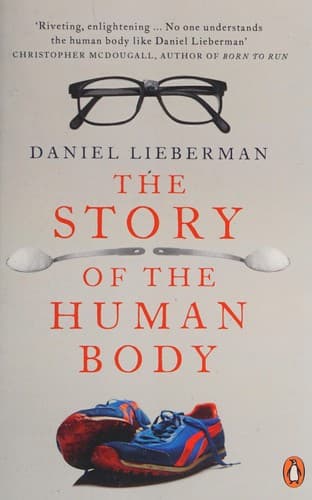
Book details and cover from Google Books.
Ready to read Story of the Human Body?
Get your copy on Amazon, or listen to it on Audible. We earn a commission if you buy through these links.