
We earn a commission if you buy through these links. Learn more
Human errors
Guide by the Books of the Day editors · Updated · How we write our guides
A friendly, wry tour of the body's awkward design compromises, explaining why evolution leaves us with a bad back, a throat that can choke us, and a dependence on vitamin C, without requiring any biology background.
What Creators Say About Human errors
2 creators reviewed Human errors on YouTube between 2018 and 2024, with 3.9K views between them. Their opinions are their own; we picked these reviews, we didn't write them.
What It's About
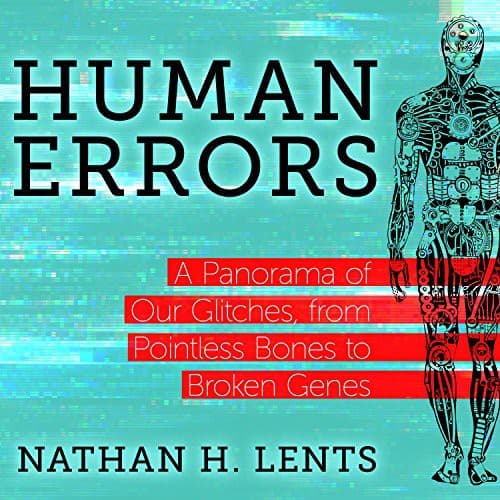
Human Errors is a popular science book about the body's design flaws, the parts that work badly or make little obvious sense. Lents, a biochemist and college professor, builds on the idea that evolution modifies what already exists rather than designing from scratch. Each example is a case where an older solution got stuck in place and now causes problems, from backaches and tight childbirth to choking and the way we rely on vitamin C from our diet.
The approach is conversational and anecdotal. He explains the biology in plain language, walks through why a structure ended up the way it did, and keeps returning to a simple question: what would a sensible engineer have done differently? The tone is wry rather than alarmed, and the chapters are short enough to dip into. You get a steady stream of "I never knew that" moments about your own body.
Reading it feels like a guided tour of your own anatomy with a friend who enjoys the awkward parts. It is less a textbook than a set of well-chosen case studies, so you come away with vivid examples rather than a detailed mechanism for each one. It works best as a light but informed read for anyone curious about how bodies came to be the way they are, and it leaves you more interested in the subject than when you started.
Read this if you…
- are curious why the body has so many quirks and enjoy learning the reasons behind them
- want a light, accessible introduction to evolutionary thinking without equations or jargon
- like learning about your own anatomy through funny, slightly awkward examples
Skip it if you…
- want a rigorous, citation-heavy account of evolutionary theory or the research behind it
- are looking for practical advice on treating back pain, diet, or other health concerns
Key Ideas
- 1
Evolution works with what already exists
Natural selection cannot start over. It reshapes existing structures, so a body part built for one job often gets reused for another. The book shows how this produces routes and arrangements that look inefficient once you see the historical starting point. The central insight is that the body is a patchwork of inherited solutions rather than a clean blueprint.
- 2
Many flaws come from unavoidable trade-offs
Shared pathways create risk. The throat carries both air and food, and an upright posture places heavy demands on the spine and pelvis. Lents argues that these compromises were often acceptable for survival and reproduction, even when they cause pain or danger later. Seeing the trade-off makes many oddities feel less like mistakes and more like bargains.
- 3
Some problems are lost abilities, not bad design
Not every flaw is a structure that went wrong. Humans cannot make their own vitamin C because a gene for that process has broken down over time. The book treats such losses as a different kind of error, one where a capacity was dropped and our diets must now supply what our bodies no longer produce.
- 4
Good enough is the standard evolution uses
Selection does not aim for perfection, only for traits that help an organism survive and reproduce well enough. That is why flawed systems persist for millions of years. The idea helps explain why the book's examples feel so stubborn: they do not need to be optimal to keep being passed along.
Limitations
The title's word "errors" can mislead, since evolution does not make mistakes; it only produces what happens to work well enough. Some readers may find the framing more dramatic than the science warrants. The examples are selected for entertainment value, so the coverage is broad and the depth on any single topic is limited. Because the field moves quickly, some specific claims may have been refined by later research, and the book is not a guide to clinical care.
Questions Readers Ask
- Is Human Errors a good first book on evolution?
- It can be. The writing is clear and the examples are concrete, so you do not need a biology background. It gives a feel for how evolution produces odd results, but it does not teach the theory systematically. Pair it with a more structured introduction if you want the full framework.
- How does Human Errors compare to Bill Bryson's The Body?
- Both are accessible and witty, but they differ in scope. Bryson covers the whole body with history and anecdote across many topics. Lents is narrower and more focused on one argument: that many features are imperfect because evolution works with what already exists. If you want a broad overview, Bryson fits better; for a sharper case about design flaws, Lents does.
- Published
- 2018
- ISBN
- 9781684413324
- Difficulty
- beginner
- Category
- Science
Book details and cover from Google Books.
Ready to read Human errors?
Get your copy on Amazon, or listen to it on Audible. We earn a commission if you buy through these links.