
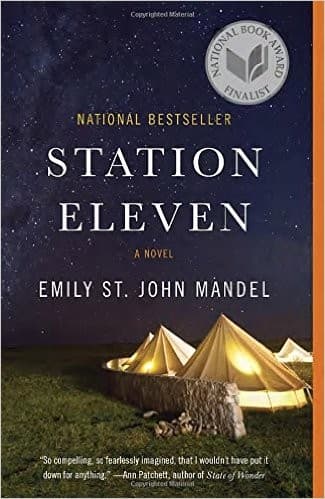
Station Eleven
Emily St. John Mandel
Like The Stand, it follows a scattered cast of survivors after a pandemic wipes out most of the world, and it cares as much about what people carry forward as about the disaster itself.
Reader-supported: when you buy through links on our site, we may earn an affiliate commission. Learn more
We earn a commission if you buy through these links. Learn more
Find Similar Booksby Stephen King
Guide by the Books of the Day editors · Updated · How we write our guides
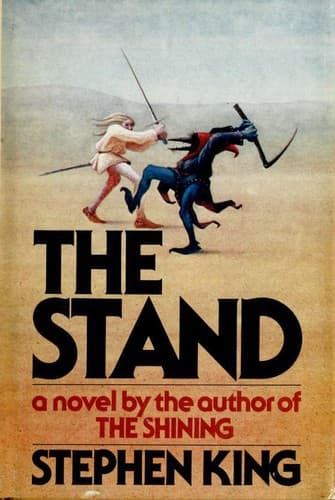
Stephen King's sprawling post-apocalyptic novel follows survivors of a plague that kills most of America and the good-versus-evil struggle that follows, a story that rewards readers who enjoy a large cast.
2 creators reviewed The Stand on YouTube between 2018 and 2025, with 143.4K views between them. Their opinions are their own; we picked these reviews, we didn't write them.
The Stand opens with a lab accident that lets a fast, nearly unstoppable influenza escape into the world. Within weeks, the vast majority of people are dead, and the first part of the novel is about what remains: scattered individuals drifting across a hollowed-out country, trying to find each other and learning to live without power, pharmacies, or anyone to call for help. King spends real time on the practical texture of that collapse, which is what makes it feel plausible rather than merely frightening.
Gradually the survivors begin to dream, and those dreams pull them toward two opposing figures: an elderly woman in Boulder, Colorado, and a charismatic stranger gathering followers in Las Vegas. The book then becomes a long moral argument staged across a continent, with ordinary people forced to choose sides. Expect a sprawling cast, many shifting points of view, and digressions into backstory that some readers will love and others will find slow.
Reading it is less like following a single thriller than like spending weeks in a large, talkative community. The prose is conversational and often funny, with a strong feel for small-town life and 1970s American road culture. The horror is real but arrives in bursts; much of the pleasure lies in the characters' friendships, arguments, and small acts of decency. It rewards patience and tends to stay with readers long after the final pages.
Much of the novel's warmth comes from watching unremarkable people choose kindness, loyalty, and cooperation when no authority is left to enforce it. King treats everyday competence, like cooking, repairing things, and keeping watch, as a quiet form of heroism. The collapse is less interesting as spectacle than as a test of what people still owe one another.
The book frames its conflict in openly moral terms, with a clear pull between a figure of goodness and a figure of cold, seductive malice. Readers who expect moral ambiguity may find this blunt, but it gives the story a mythic clarity. The question driving the plot is less whether the sides exist than which side each survivor will join.
Dreams act as the book's supernatural engine, steering characters toward one camp or the other and linking people who have never met. King uses them to bind a scattered cast into a single story. This device is what turns a disaster novel into a fable about destiny and free will.
Alongside the fantasy, the novel is a detailed study of how small groups organize themselves: who leads, who decides, how rules form, and where power starts to concentrate again. The contrast between a community built on consent and one built on fear gives the second half much of its tension.
The book is long, and its middle stretches can feel repetitive, with many characters introduced and revisited at length. Its good-versus-evil framing is heavy-handed by modern taste, and some readers find the supernatural turn abrupt after a grounded first half. Women characters are often sketched in narrower terms than the men, and the dated pop culture and attitudes show their age. The 1978 original was later expanded in 1990 with restored material, so editions differ noticeably.
Book details and cover from Google Books.
Ready to read The Stand?
Get your copy on Amazon, or listen to it on Audible. We earn a commission if you buy through these links.
Emily St. John Mandel
Like The Stand, it follows a scattered cast of survivors after a pandemic wipes out most of the world, and it cares as much about what people carry forward as about the disaster itself.
Max Brooks
Told as a series of interviews with survivors, it shares The Stand's sense of a whole society being tested across many places and voices, with grim practicality throughout.
M. R. Carey
A fungal outbreak has upended civilisation, and the bleak, tense journey through a ruined Britain echoes The Stand's mix of pandemic horror and hard moral choices.
J.R.R. Tolkien
Its fellowship of ordinary people facing a dark, seductive power on a long quest mirrors the moral scale and mythic tone that make The Stand's struggle feel so large.