
The Psychology of Money
Morgan Housel
Like Stanley and Danko, Housel argues that behaviour beats intelligence or income, using short, vivid stories about saving, humility and why staying wealthy differs from getting wealthy.
Reader-supported: when you buy through links on our site, we may earn an affiliate commission. Learn more
We earn a commission if you buy through these links. Learn more
Find Similar Booksby Thomas J. Stanley, William D. Danko
A readable, data-driven look at how many Americans with real wealth live well below their means, and why the habits behind that wealth matter more than income.
The Millionaire Next Door is built on the authors' research into affluent American households, mostly people who were self-made rather than inheriting money. Thomas Stanley and William Danko gathered survey data on how these households earned, spent, saved, and lived, and they use it to challenge the common image of a millionaire as a big earner with a flashy lifestyle. Much of the book is a description of who these people actually are: often business owners or professionals in unglamorous fields, driving modest cars, and buying their homes at modest prices.
The writing is plain and conversational rather than academic. Each chapter pairs a claim with profiles and tables, and the authors repeatedly contrast the frugal accumulators with what they call the 'economic outpatients', people who earn well but look wealthy and stay broke. The tone is encouraging and a little preachy at times, with a clear message that discipline, budgeting, and living below your means are the real engines of net worth.
Reading it feels like sitting down with a pair of researchers who have clearly enjoyed their interviews. It is short, quick, and easy to finish in an evening. The main payoff is a shift in perspective: you will likely look at your own spending and at the people around you differently afterward.
The book separates what you earn from what you keep and accumulate. Many high earners have little net worth because their spending absorbs everything. The authors argue that the gap between income and wealth is largely a matter of behavior, and they treat net worth as the measure that counts.
The affluent households described tend to buy used or moderately priced cars, live in homes well below their means, and avoid conspicuous consumption. The authors present this as a choice that compounds over time, not as deprivation. Their examples make the case that spending restraint is a skill people can practice.
A recurring theme is that many millionaires work in or run ordinary businesses, such as trades, sales, and professional practices, rather than in high-status fields. The authors suggest that owning a business or working in an area with steady demand can build wealth more reliably than a prestigious job that pays well but leaves little to save.
The book offers simple benchmarks for comparing your net worth with what your age and income would predict. This gives readers a rough way to check their progress and spot whether their spending is out of line with their earnings, without requiring any financial software or expertise.
The sample is drawn from surveys of affluent households, so the findings describe what those people did rather than proving cause and effect. Critics point out that self-selection and survivorship can flatter the frugal profile, and that the book says little about luck, inheritance, or the disadvantages that keep many people from saving at all. It is also dated: it was written in the 1990s and its examples of jobs, prices, and lifestyles reflect that era. The advice can read as moralizing toward people with low incomes, and it offers limited detail on how to invest what you save.
Reviews from readers on YouTube. Their opinions are their own.
Book details and cover from Google Books.
Ready to read The Millionaire Next Door?
Get your copy on Amazon, or listen to it on Audible. We earn a commission if you buy through these links.
Morgan Housel
Like Stanley and Danko, Housel argues that behaviour beats intelligence or income, using short, vivid stories about saving, humility and why staying wealthy differs from getting wealthy.
Vicki Robin, Joe Dominguez
Takes the frugality of the millionaires next door further, asking you to measure purchases in hours of life energy and build financial independence through mindful spending.
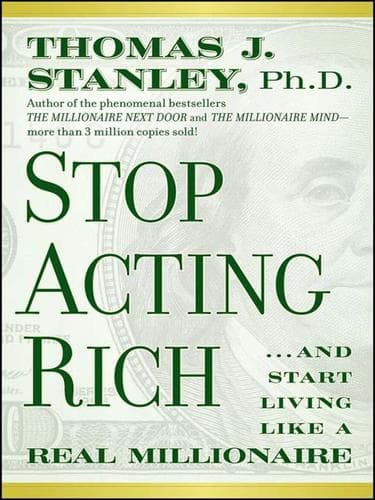
Thomas J. Stanley
Stanley returns with fresh survey data focused squarely on the status trap, showing how imitating the rich keeps people from actually becoming wealthy.
Dave Ramsey
Turns the book's anti-debt, live-below-your-means message into a concrete step-by-step plan for clearing debt and building savings, delivered with blunt motivation.