
We earn a commission if you buy through these links. Learn more
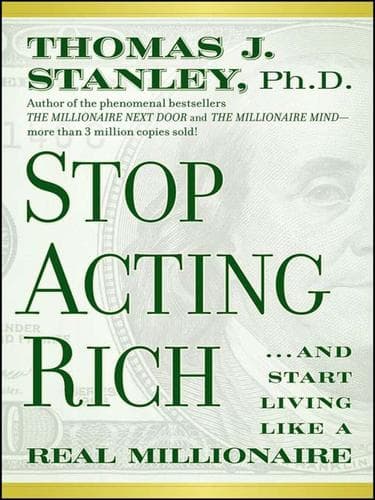
Stop acting rich
Guide by the Books of the Day editors · Updated · How we write our guides
Thomas J. Stanley's follow-up to The Millionaire Next Door argues that looking wealthy often blocks building wealth, and it gives a sharp, uncomfortable mirror for anyone whose spending is driven by image.
What Creators Say About Stop acting rich
2 creators reviewed Stop acting rich on YouTube between 2018 and 2023, with 7.4K views between them. Their opinions are their own; we picked these reviews, we didn't write them.
What It's About
Stop Acting Rich is Thomas J. Stanley's follow-up to The Millionaire Next Door, and it picks up a gap the earlier book had exposed: the difference between looking wealthy and actually being wealthy. Stanley's central figure is the "Aspirational," someone who spends heavily on cars, clothing, homes, and social signals while accumulating little real net worth. The book sets this against the habits of people who quietly build assets and often look far less impressive from the outside.
The approach is plain and observational rather than theoretical. Stanley draws on his research into affluent households and uses portraits of typical spending decisions to show what separates the two groups. The book tends to move between diagnosis, why image spending feels necessary, and prescription, how to redirect money toward savings, ownership, or financial independence. The tone is direct and sometimes lecturing, with frequent side-by-side comparisons that make the contrast easy to follow.
Reading it feels less like studying investing and more like a candid conversation about status and self-deception. It is quick to get through, and its real value lies in a mindset shift: judging money decisions by what they build rather than what they display. Specific investment mechanics are thin, so treat it as a behavioral companion to a fuller financial plan rather than a complete guide.
Read this if you…
- Notice that your spending is driven more by appearances than by your savings goals
- Want a short, practical push toward living below your means
- Are curious how Stanley's earlier research on millionaires looks in a more personal, behavioral form
Skip it if you…
- Want detailed guidance on investing, taxes, or retirement accounts
- Find moralizing about spending habits tiresome or condescending
Key Ideas
- 1
Aspirationals versus real wealth builders
The core distinction is between people who spend to signal success and people who spend to accumulate. Stanley argues that the first group often earns well but keeps little, while the second group may look modest yet steadily grows net worth. The book uses this contrast as the lens for nearly everything else.
- 2
Image spending as a financial trap
Stanley examines how purchases like luxury vehicles, designer goods, and prestige addresses can quietly consume income that could have been saved or invested. The problem is less any single purchase than the pattern of spending to meet perceived expectations from peers and neighbors.
- 3
Frugality as a deliberate strategy
Rather than treating thrift as deprivation, the book presents it as a choice that buys flexibility and independence. Living below one's means, Stanley suggests, is what creates the margin needed to save, take risks, or stop working when one chooses.
- 4
Measuring success by net worth
A recurring theme is that income is a poor proxy for wealth. The book encourages readers to track what they own minus what they owe and to ask whether their habits are moving that number upward or merely keeping up appearances.
Limitations
The book leans heavily on observational research and illustrative profiles, so some readers will find its categories too broad or its conclusions more confident than the evidence allows. Its tone can feel judgmental toward people who spend on status, and it offers little on market investing or tax strategy. Some examples and assumptions reflect the American context and the period of its publication, so readers in other countries or economic conditions should adjust accordingly.
Questions Readers Ask
- Is Stop Acting Rich a sequel to The Millionaire Next Door?
- It is best understood as a companion or follow-up. Both books use Stanley's research into affluent households, but Stop Acting Rich focuses on the gap between looking wealthy and building wealth. If you have read the earlier book, you will recognize the themes, though this one is more about behavior and mindset than about describing who the millionaires are.
- Who will benefit most from reading it?
- It suits readers who already earn a reasonable income but feel their money disappears without building much. It is also useful for people who recognize status spending in themselves. Readers looking for a technical investing manual should look elsewhere, since the book stays focused on habits and attitudes rather than specific financial products.
- Published
- 2009
- ISBN
- 9780470552513
- Difficulty
- beginner
- Category
- Business
Book details and cover from Google Books.
Ready to read Stop acting rich?
Get your copy on Amazon, or listen to it on Audible. We earn a commission if you buy through these links.