
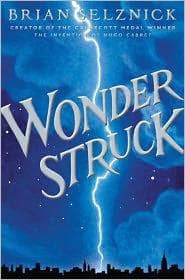
Wonderstruck
Brian Selznick
Selznick's follow-up uses the same alternating structure, with one story told entirely in drawings and another in prose, so readers who loved Hugo's cinematic page-turning will recognise the magic immediately.
Reader-supported: when you buy through links on our site, we may earn an affiliate commission. Learn more
We earn a commission if you buy through these links. Learn more
Find Similar BooksOn screen: Hugo (film, 2011)
A boy secretly keeping a Paris train station's clocks, a broken automaton, and a hidden family secret, told through drawings that make reading feel close to watching a film.
2 creators reviewed The Invention of Hugo Cabret on YouTube between 2013 and 2016, with 17.3K views between them. Their opinions are their own; we picked these reviews, we didn't write them.
The Invention of Hugo Cabret follows a boy who lives hidden inside the walls of a busy Paris train station in the early 1930s. He keeps the station clocks running and tries to finish a repair his late father started, while staying out of sight of the officials who would send him to an orphanage. A chance encounter with a girl and a grumpy toy-shop owner pulls him into a mystery that connects the machine he is fixing to a larger story about the past.
What makes the book unusual is its form. Selznick mixes a novel with hundreds of pages of pencil drawings, and the pictures often carry the action that prose would normally handle. Sequences of images zoom, pan, and cut like a film, so turning pages can feel like watching a movie unfold. The written sections are short and plain, and the two halves work together rather than one simply illustrating the other.
Most readers will get through it in an afternoon or two, though the drawings reward slowing down and studying small details. The tone is tender and a little melancholy, more concerned with craft, loneliness, and the pull of old stories than with fast thrills. It is an experience that rewards patience and a willingness to read with your eyes as much as your head.
Much of the story is told through drawings rather than sentences. Selznick uses the images to show time passing, emotion, and movement, so the reader has to follow the visual storytelling as closely as the text. The result feels closer to a flip-book or a silent film than to a conventional novel.
Clocks and automata appear throughout as objects that must be understood, repaired, and kept running. The book treats mechanisms as a model for care and attention: a broken part can be fixed if you understand how it fits with the rest. That idea gives the mystery its emotional logic as well as its plot.
Hugo survives by avoiding notice, and the other characters are also outsiders in different ways. The book explores what it means to lose family, to be treated as a problem by institutions, and to find people who see you. Its sympathy for lonely, overlooked figures gives the story much of its warmth.
The book draws on real history of early film and the people who invented its tricks. It suggests that making images and stories can be a way of keeping hope and memory alive. Readers curious about the history behind the plot will find the book a gentle entry point, though it is more an invitation than a lesson.
Some readers find the plot's coincidences convenient and the resolution a little too neat. The adventure is gentle, and adults looking for complex characterization or sharp prose may find it slight. The historical material is simplified for younger readers and should not be treated as a full account of early film. The book is also long for its story, since many of its pages are illustrations, which can make the pacing feel uneven to people who want the text to carry more.
Book details and cover from Google Books.
Ready to read The Invention of Hugo Cabret?
Get your copy on Amazon, or listen to it on Audible. We earn a commission if you buy through these links.
Brian Selznick
Selznick's follow-up uses the same alternating structure, with one story told entirely in drawings and another in prose, so readers who loved Hugo's cinematic page-turning will recognise the magic immediately.
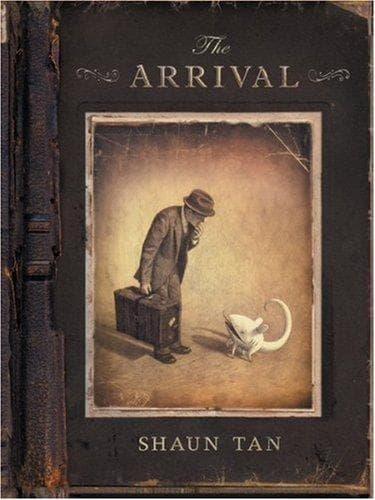
Shaun Tan
A wordless illustrated novel about an immigrant in a strange city, it shows how much feeling pictures alone can carry, just as Hugo's long drawn sequences do.
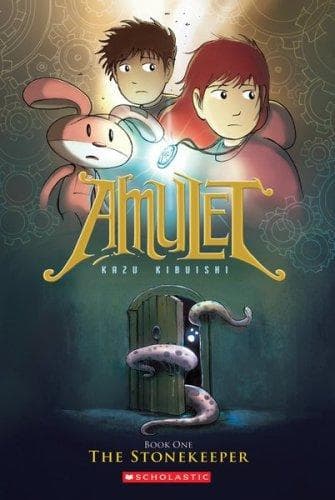
Kazu Kibuishi
A richly drawn graphic novel with mechanical creatures, a mysterious inheritance and a grieving family, it suits readers who loved Hugo's mix of visual storytelling and loss.
Peter Brown
Illustrated by its author, this gentle story about a robot learning to live on a wild island shares Hugo's fascination with machines that seem to have a heart.