
We earn a commission if you buy through these links. Learn more
The Arrival
by Shaun Tan
Guide by the Books of the Day editors · Updated · How we write our guides
A wordless graphic novel that makes the bewildering experience of arriving in an unfamiliar country feel immediate, using only pictures to tell its story.
What Creators Say About The Arrival
2 creators reviewed The Arrival on YouTube between 2015 and 2022, with 17.5K views between them. Their opinions are their own; we picked these reviews, we didn't write them.
What It's About
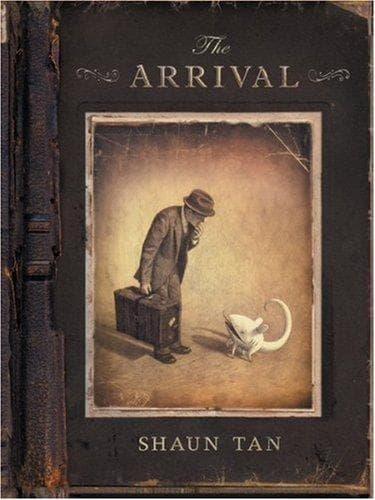
The Arrival is a wordless graphic novel by Australian illustrator Shaun Tan, first published in 2006. It follows a man who leaves his wife and young daughter to find work in a distant country, and it tracks his first unsettling months there. Tan draws the story in a sequence of sepia-toned, pencil-textured panels, with a layout that feels part old family album and part bureaucratic file.
The city he lands in is built from invented details: strange animals kept as pets or workers, unreadable signs, machines whose purpose is unclear. Tan never explains these. Meaning comes from faces, gestures, and small domestic moments, so the reader does the interpreting. Because there is no text, the pace is slow and deliberate, and you find yourself going back over pages to notice things you missed.
A first read can be done in one sitting, but the book lingers. It works well as something adults and children read together and talk through, and it rewards grown readers who give it time. The experience is less like following a plot and more like being handed someone else's memories and asked to make sense of them.
Read this if you…
- want a short book that opens a serious conversation about immigration with a child or teenager
- are curious how much a story can carry through pictures alone
- enjoy dreamlike, detailed worlds and want something for adults that still feels like a picture book
Skip it if you…
- want a fast plot with clear cause and effect and a lot of dialogue
- need concrete explanations of the setting, its history, or the politics behind the journey
Key Ideas
- 1
Migration seen from the inside
The book shows the disorientation of arriving somewhere you cannot read, speak, or navigate. It treats displacement as an ordinary human experience rather than a headline, asking the reader to feel the daily confusion of someone whose new surroundings offer no clear instructions.
- 2
Meaning built from images alone
With no words to anchor it, Tan makes the reader the interpreter. The gaps are deliberate, and each reader fills them differently. That puts the work of understanding on you, so the book feels more like an active puzzle than a passive story.
- 3
Small kindnesses among strangers
Other newcomers share help, stories, and practical tips. These quiet moments of solidarity inside an indifferent system are some of the book's most affecting material, and they suggest that community is built from ordinary gestures.
- 4
Strangeness as a lens on the familiar
The invented creatures and objects make everyday customs and border procedures look odd. Seeing them through an outsider's eyes makes the reader notice how arbitrary many of our own routines and rules can appear to someone new.
Limitations
The invented world is deliberately vague, so readers who want specific history, real places, or the political reasons people migrate may find it abstract. Some reviewers find the tone sentimental in places, and the journey shown is one generalized story rather than a range of real experiences. The slow, detailed pencil style also asks for patience, and readers used to quick panels may tire of it before the book's emotional payoff.
Questions Readers Ask
- Is The Arrival suitable for children?
- Yes. Many libraries shelve it in children's sections, and it is often used with older children and teenagers. Younger readers usually do better with an adult alongside them to talk through the scenes. Adults tend to find it moving as well, often more so on a second reading.
- How does it compare to Maus?
- Art Spiegelman's Maus anchors its story in text, interviews, and a specific historical period. The Arrival leaves almost everything to the image and invents its setting, so it feels more universal and less tied to one history. If you want the historical grounding, Maus is the better choice; for a wordless, open-ended experience, read Tan.
- Is the book still relevant today?
- Migration remains one of the most debated issues in the world, and the book's focus on ordinary daily experience keeps it relevant. Because the setting is invented, it does not address current policies or specific events, so pair it with reporting or nonfiction if you want that context.
- Published
- 2006
- ISBN
- 9780734415868
- Difficulty
- beginner
- Category
- Children's Books
Book details and cover from Google Books.
Ready to read The Arrival?
Get your copy on Amazon, or listen to it on Audible. We earn a commission if you buy through these links.