
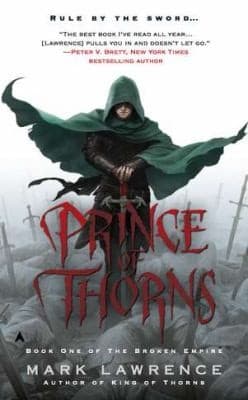
Prince of Thorns
Mark Lawrence
A ruthless young prince narrates his bloody climb to power with a cold, cutting voice that will appeal to anyone who relished Glokta's chapters and Abercrombie's refusal to make heroes likeable.
Reader-supported: when you buy through links on our site, we may earn an affiliate commission. Learn more
We earn a commission if you buy through these links. Learn more
Find Similar BooksGuide by the Books of the Day editors · Updated · How we write our guides
Joe Abercrombie's opening volume is a grimy, funny, morally murky fantasy built on sharp character studies, and it rewards readers who enjoy flawed people more than heroic quests.
2 creators reviewed The Blade Itself on YouTube between 2018 and 2022, with 99.2K views between them. Their opinions are their own; we picked these reviews, we didn't write them.
The Blade Itself is the first volume of Joe Abercrombie's First Law trilogy, a fantasy novel that follows three point-of-view characters whose paths only gradually converge: an embittered inquisitor working for a state that has grown rotten, a vain young officer more interested in cards and comfort than in soldiering, and a northern fighter who would rather be anywhere else than where his past has dragged him. A fourth thread involving an old man of uncertain power adds a sense that something larger is moving underneath.
Abercrombie's approach is closer to a sardonic character study than a quest. Chapters rotate between viewpoints, and each voice is distinct: the inquisitor's is caustic and self-aware, the officer's is petty and vain, and the northerner's is weary and blunt. The prose is brisk, the dialogue is sharp, and the humor is frequently black. Violence is present and unflinching, but it is usually used to reveal character rather than to shock for its own sake.
Reading it feels like settling into a world that is dirty, politically compromised, and only partly explained. Much of the pleasure comes from watching flawed people make small, self-serving choices and noticing how little separates the heroes from the villains. It is a book that rewards patience. The opening stretch can feel slow to readers expecting momentum, and the larger picture arrives in pieces rather than through exposition.
None of the three main characters is admirable at the start. Their goals are selfish, cowardly, or compromised, and the book is more interested in how they rationalize themselves than in whether they become good. That makes them more believable, though it also means you spend long stretches with people you would not necessarily want to befriend.
The plots run in parallel for much of the book, each with its own stakes and tone. The connections between them build gradually, so the early chapters can feel like separate stories. Readers who like ensemble fantasy will enjoy the slow fit of the pieces, while others may find the switching disruptive before the payoff arrives.
The Inquisition, the army, and the aristocracy all show how institutions reward cruelty, vanity, and bureaucratic loyalty. Abercrombie treats political machinery as a set of human habits rather than as grand ideology, which gives the setting a grounded, weary realism that many readers find more convincing than typical epic fantasy.
Much of the book's bite comes from its jokes, which tend to be cynical and cutting. The humor often arrives at the worst possible moment, and it lets the narrative stay readable even when it is describing cruelty or failure. Some readers will find the wit the highlight; others may tire of the constant undercut.
Some readers find the opening slow, since the three storylines take time to connect and the magic system and history are left deliberately vague. The cynicism can feel repetitive to readers who expected a shift in tone by the end. Female characters have less room than the men, a criticism many readers raise. Violence is frequent and sometimes gratuitous. As the first part of a trilogy, the book ends without resolving its main conflicts, so it is best judged alongside the rest of the series.
Book details and cover from Google Books.
Ready to read The Blade Itself?
Get your copy on Amazon, or listen to it on Audible. We earn a commission if you buy through these links.
Mark Lawrence
A ruthless young prince narrates his bloody climb to power with a cold, cutting voice that will appeal to anyone who relished Glokta's chapters and Abercrombie's refusal to make heroes likeable.
Scott Lynch
Con artists, foul-mouthed banter and sudden brutality in a richly built city. It shares The Blade Itself's mix of laugh-out-loud dialogue and genuine menace.
Glen Cook
A foundational grimdark novel about mercenaries serving a dark power, told with dry soldierly humour. Fans of Logen and the Northmen will find the same unglamorous view of war.
George R. R. Martin
Multiple viewpoints, scheming nobles and warfare in the north. If you enjoyed how Abercrombie juggles Glokta, Jezal and Logen, Martin's sprawling cast offers the same political tension on a bigger canvas.