
Leaders Eat Last
Simon Sinek
Sinek's follow-up expands on the idea that great organizations are built on trust and purpose. It explores why people commit to a cause, which is the core question Start with Why raises.
Reader-supported: when you buy through links on our site, we may earn an affiliate commission. Learn more
We earn a commission if you buy through these links. Learn more
Find Similar Booksby Simon Sinek
A short, influential argument that great organizations and leaders succeed by communicating purpose before products, with a simple model you can apply to your own work.
Simon Sinek's book argues that the most influential people and companies communicate from the inside out, starting with the reason they exist rather than with what they sell or how they sell it. He builds this around a three-ring model he calls the Golden Circle: why, how, and what. The book is brief and anecdotal, drawing on examples from businesses, political movements, and inventors, so it reads more like a long essay than a manual.
The experience is persuasive and quick. Sinek leans on stories, including a comparison of two early aviation pioneers and a famous civil rights speech, to make his case feel vivid. He also draws loosely on neuroscience about the brain's emotional and decision-making layers, which gives his claims a physical grounding even though he is not writing a scientific study. You finish with a clear vocabulary and a set of questions to test your own organization or project.
It works best as a framing book. Readers looking for step-by-step tactics, rigorous research, or a detailed marketing playbook will need to look elsewhere, but as a lens for thinking about purpose, it is hard to forget.
Sinek proposes three nested layers: what an organization does, how it does it, and why it exists. Most companies describe the outer layers in detail and rarely articulate the core. His argument is that the why, meaning the belief or cause behind the work, is the foundation that makes everything else persuasive. The model is simple enough to sketch on a whiteboard, which is a large part of its appeal.
Sinek contends that feelings and loyalty drive most decisions, while language and logic are added on top. Messages that open with the purpose speak to the parts of our thinking that decide whether we trust someone. Messages that open with features ask people to reason their way to a choice they may not care about. The claim is more intuitive than rigorously tested, but it is a useful check on how you pitch ideas.
A recurring theme is the difference between earning commitment and buying it. Discounts, incentives, and fear can produce short-term behavior, but Sinek argues that people who believe in a cause stay loyal and defend it. This distinction pushes readers to ask whether their customers and employees are actually aligned with the organization or just responding to pressure.
The book offers an implicit test: can a team state its why in a sentence, and do its decisions line up with that statement? Sinek's examples suggest that consistency between stated purpose and daily choices is what separates lasting organizations from those that chase trends. This idea is the most usable part of the book for managers and founders.
The book's evidence is mostly anecdotal. Sinek selects well-known success stories, and critics point out that this invites survivorship bias: plenty of companies with a strong sense of purpose still fail, and the book does not show how often the Golden Circle is the deciding factor. The neuroscience is simplified, and the causal claims are hard to verify. The idea of why is also somewhat abstract, so readers may struggle to turn it into concrete changes. Some examples feel dated, and the book does not address how purpose plays out in digital businesses or large, regulated organizations.
Reviews from readers on YouTube. Their opinions are their own.
Book details and cover from Google Books.
Ready to read Start with Why?
Get your copy on Amazon, or listen to it on Audible. We earn a commission if you buy through these links.
Simon Sinek
Sinek's follow-up expands on the idea that great organizations are built on trust and purpose. It explores why people commit to a cause, which is the core question Start with Why raises.
Daniel H. Pink
Pink argues that autonomy, mastery and purpose motivate people more than rewards. Readers who found Sinek's emphasis on why compelling will find the same case made with research.
Jim Collins
Collins studies companies that moved from good results to lasting excellence. Like Start with Why, it looks at the habits of leaders whose organizations outlasted their peers.
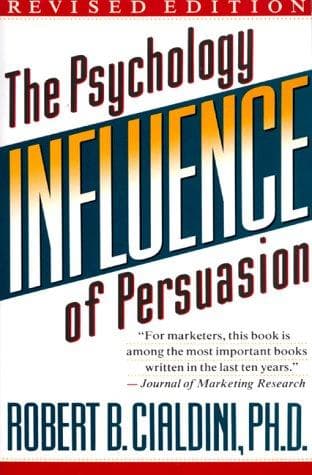
Robert B. Cialdini
Cialdini explains the psychology of persuasion, including why people say yes. It suits readers curious about how the Golden Circle changes what customers and staff respond to.