
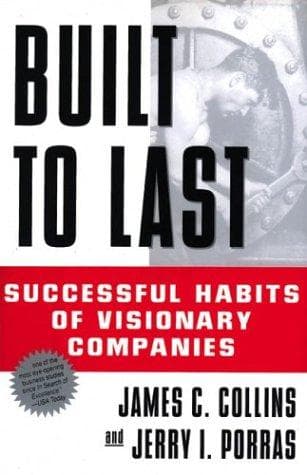
Built to Last
Collins, James C., Jim Collins
The prequel study by Collins and Jerry Porras uses the same paired-comparison method to show how visionary companies endure, pairing naturally with Good to Great's frameworks.
Reader-supported: when you buy through links on our site, we may earn an affiliate commission. Learn more
We earn a commission if you buy through these links. Learn more
Find Similar Booksby Jim Collins
A rare business book that asks whether ordinary companies can become lasting top performers, and answers with a careful comparison study rather than hype about charismatic CEOs.
Good to Great asks a question most business books skip: if a company's record is merely decent, or even poor, can it turn itself into a lasting top performer? Jim Collins and his research team picked companies that moved from ordinary results to sustained, market-beating returns, then matched each one against a comparison firm in the same industry that never made the leap. The method is slow, data-heavy, and comparative, so the book reads more like an investigation than a motivational manual.
Most chapters are built around a few named concepts, each illustrated with company stories drawn from the research. The writing is plain and disciplined, with frequent contrasts and short summaries that make the argument easy to follow. You will spend most of your time on the differences between the winners and their peers, and on how often the obvious explanation, such as a famous chief executive or a fashionable technology, turned out not to be the decisive factor.
Reading it feels like sitting in on a long strategy seminar where the presenter keeps checking his own assumptions. It is confident without being breezy, and it rewards slow reading and a pencil. Expect a book of ideas to test against your own organization rather than a playbook with steps to copy on Monday.
The leaders at the good-to-great companies combined intense personal humility with fierce professional resolve. They tended to deflect credit and accept blame, and they were often not the celebrity executives the business press favored. The book argues that this quiet combination mattered more than charisma or a grand personal vision.
Leaders in these companies settled people questions before strategy questions. They got the right people on board and moved the wrong ones off before deciding where to take the organization. Collins argues that with the right talent a company can adapt to changing markets, while with the wrong talent no strategy will rescue it.
Companies that made the leap found a focus at the intersection of three questions: what they could be best in the world at, what drove their economic engine, and what they cared about deeply. Simplicity here means refusing many tempting opportunities, and the idea challenges the habit of trying to be good at everything.
Instead of relying on one dramatic breakthrough, the winners built momentum through consistent, disciplined action, with each push adding to the last. The contrast is the doom loop, where companies lurched from one radical program or restructuring to the next and tended to stall.
The good-to-great companies used technology to speed up a business model they already understood, rather than treating a new tool as the reason for their success. The point is that technology amplifies a sound strategy but does not create one.
The most common criticism is that the study chose successful companies and then looked backward at what they did, which makes it hard to tell which traits caused success and which merely coincided with it. Phil Rosenzweig's The Halo Effect made this case in detail. Several featured companies also faded after the book appeared, and Fannie Mae, one of the eleven, later collapsed during the 2008 financial crisis. The sample is also mostly American and mostly from a particular era, which limits how far the lessons travel.
Reviews from readers on YouTube. Their opinions are their own.
Book details and cover from Google Books.
Ready to read Good to Great?
Get your copy on Amazon, or listen to it on Audible. We earn a commission if you buy through these links.
Collins, James C., Jim Collins
The prequel study by Collins and Jerry Porras uses the same paired-comparison method to show how visionary companies endure, pairing naturally with Good to Great's frameworks.
Thomas Peters
The classic study of what well-run companies share. If you enjoyed Collins's search for common traits among top performers, this is the book that started the genre.
Clayton M. Christensen
A research-based look at why strong, well-managed companies still fail when disruptive technologies arrive, complementing Collins's thinking on technology and decline.
Simon Sinek
Explores why trust-building, self-sacrificing leaders create loyal teams, echoing the modest, organisation-first spirit of Collins's Level 5 leaders.