
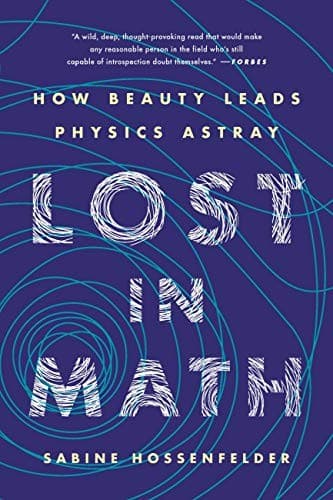
We earn a commission if you buy through these links. Learn more
Lost in math
Hossenfelder argues that theoretical physics has stalled because theorists trust elegance and beauty as guides to truth, and she makes that case in plain, pointed prose that a general reader can follow.
What It's About
Lost in Math is a short, opinionated book by Sabine Hossenfelder, a theoretical physicist who works on the same kind of problems she writes about. Her central claim is that fundamental physics has made little real progress since the mid-twentieth century, and that a major reason is a habit of treating mathematical beauty, simplicity, and symmetry as evidence that a theory is correct. The book is an argument rather than a survey, so it takes sides and expects you to follow the reasoning.
She builds the case through specific episodes: the search for supersymmetric particles, the expectations behind the Higgs mass, the proliferating options in string theory, and speculation about a multiverse. She also looks at historical cases where aesthetic judgment did help, which keeps the argument from being a simple rejection of beauty. Her explanations use everyday analogies and avoid heavy equations, so the ideas are accessible without much background.
Reading it feels like listening to a frustrated insider talk candidly about her field. Much of the book concerns how careers, funding, publication pressure, and group consensus shape which questions get asked. You come away with a sharper sense of why experimental data matters so much, though the book is stronger as a diagnosis than as a detailed plan for what physicists should do next.
Read this if you…
- are curious how scientists decide which theories are worth pursuing
- want a clear, opinionated look at the state of particle physics and cosmology
- enjoy critical writing about how research communities work
Skip it if you…
- want a balanced survey that gives equal weight to every major research program
- are looking for a step-by-step introduction to the physics itself
- prefer popular science that is mainly wonder and storytelling
Key Ideas
- 1
Beauty as a misleading guide to truth
Hossenfelder argues that physicists have increasingly chosen theories because they look elegant, symmetric, or economical. Nature is not obliged to share our sense of aesthetics, so a theory that feels right can still be wrong. She shows how this expectation has repeatedly failed to deliver the discoveries it promised.
- 2
The problem with naturalness arguments
Many theorists expected new particles at energies reachable by the Large Hadron Collider, based on the idea that the Higgs mass should not need fine-tuning. Hossenfelder explains why this reasoning seemed compelling and why its failure to predict anything new has been so damaging to confidence in it.
- 3
Why experiments must lead theory
A recurring theme is that physics is an empirical science, and the only reliable test of an idea is whether it matches observation. She argues that theorists should be more willing to accept the absence of confirming data and to let measurements, rather than mathematical taste, decide which directions to pursue.
- 4
Incentives, hype, and groupthink in physics
The book looks beyond ideas to the social system that produces them. Funding priorities, the pressure to publish, and the comfort of working on popular programs can keep a field pursuing approaches long after the evidence has weakened. Hossenfelder treats these as structural problems rather than personal failings.
Limitations
Critics argue that the book overstates its case. Beauty has guided physicists to real successes, such as general relativity and the prediction of antimatter, and some readers feel Hossenfelder moves too quickly from failed predictions to broad conclusions about the whole field. The sociological sections are less developed than the scientific ones, and her proposed remedies are more general than specific. Because the book is written by a participant with strong opinions, it is best read alongside other physicists who see the situation differently.
Questions Readers Ask
- Do I need a physics background to read Lost in Math?
- No, but it helps to be comfortable with basic ideas like particles, forces, and the Higgs boson. Hossenfelder keeps equations to a minimum and uses analogies, so a motivated general reader can follow the argument. The book assumes you care about how science is actually done.
- Is Lost in Math still relevant?
- Yes, largely because its main argument concerns how physicists choose theories, which has not changed much. Subsequent experimental results have continued to show no sign of the new particles many theories predicted, so the critique has aged in a way that supports its core point. Readers should still check recent developments for specifics.
- How does it compare to The Trouble with Physics by Lee Smolin?
- Both books criticize string theory and the direction of theoretical physics. Smolin's book is longer and more focused on the history and sociology of string theory, while Hossenfelder's is shorter and broader, concentrating on the role of beauty and aesthetic judgment across the field.
- Published
- 2018
- ISBN
- 9781541646766
- Difficulty
- intermediate
- Category
- Science
Book details and cover from Google Books.
Ready to read Lost in math?
Get your copy on Amazon, or listen to it on Audible. We earn a commission if you buy through these links.