
Sapiens
Yuval Noah Harari
Like Diamond, Harari traces the whole human story from ancient foragers to the present, asking how large-scale societies formed and why one species came to dominate the planet.
Reader-supported: when you buy through links on our site, we may earn an affiliate commission. Learn more

We earn a commission if you buy through these links. Learn more
Find Similar BooksGuide by the Books of the Day editors · Updated · How we write our guides
Diamond's 1997 attempt to explain why some societies came to dominate others, tracing the roles of geography, crops, animals, and disease. It is a sweeping argument that rewards readers who like big explanations of history.
2 creators reviewed Guns, Germs, and Steel on YouTube between 2019 and 2026, with 692.9K views between them. Their opinions are their own; we picked these reviews, we didn't write them.
Guns, Germs, and Steel asks a question that sounds simple and is not: why did wealth, technology, and political power end up concentrated in certain parts of the world rather than others? Diamond, a physiologist turned biogeographer, rejects the idea that some peoples were simply more capable or intelligent. He builds the case that the starting conditions of human societies, especially which wild plants and animals were available to them, shaped everything that followed.
The book moves across thousands of years and nearly every inhabited continent. Much of its length goes to mechanics: which wild species could be domesticated, why the long east-west axis of Eurasia helped crops and ideas spread, and how dense livestock-keeping populations gave rise to epidemic diseases. The voice is that of a curious lecturer with a wide-angle lens. A conversation with a New Guinean politician named Yali frames the central question, and the tone stays confident and engaged rather than dry.
Reading it feels like being walked through a long chain of cause and effect, with each link checked against evidence from archaeology, linguistics, and ecology. It is an argument more than a narrative, so expect the core thesis to recur and occasional detours along the way. Readers who want a tight, single-thread history will find it sprawling, but those who enjoy ambitious explanations of the human past will find it hard to put down.
Diamond argues that the number of wild plants and animals suitable for domestication varied enormously between regions. The Fertile Crescent had many such species, which allowed farming and surplus food to develop earlier. Surplus, in turn, supported larger populations, specialization, and eventually states, so geography shaped the timing of everything else.
Because Eurasia stretches east to west, crops and livestock could travel across lands sharing similar day length and climate. Diamond contrasts this with the north-south orientation of the Americas and Africa, where climate zones blocked easy movement. The idea that spreading innovations depended on latitude is one of the book's most discussed claims.
Living closely with livestock exposed early farming peoples to diseases that jumped from animals to humans. Over generations, survivors built partial immunity, and these pathogens later devastated populations with no such history. Diamond presents this as a major, underappreciated reason for the collapse of Indigenous societies after contact with Europeans.
A recurring theme is that disparities in technology and power are not evidence of innate differences between peoples. Diamond insists the explanation lies in environment, history, and chance. This position is central to the book's purpose and is argued repeatedly across its chapters, making it a useful counterweight to older racialized accounts of the past.
The book's broad strokes are its strength and its weakness. Critics argue that Diamond leans toward environmental determinism and gives too little weight to culture, institutions, individual choices, and contingency. Several historians and archaeologists have said that his case studies are simplified or drawn largely from secondary sources. Since 1997, research in archaeology and genetics has advanced considerably, so some specific claims now look dated. Readers should treat the framework as a provocative hypothesis rather than settled history.
Book details and cover from Google Books.
Ready to read Guns, Germs, and Steel?
Get your copy on Amazon, or listen to it on Audible. We earn a commission if you buy through these links.
Yuval Noah Harari
Like Diamond, Harari traces the whole human story from ancient foragers to the present, asking how large-scale societies formed and why one species came to dominate the planet.

Francis Fukuyama
Fukuyama continues the Diamond habit of explaining history through long causal chains, here focusing on how states, rule of law and accountable government developed over millennia.
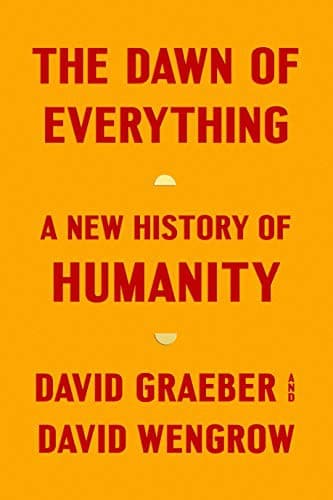
David Graeber, David Wengrow
This book challenges the simple stage-by-stage story of human progress, offering a fresh, evidence-heavy look at early societies that will appeal to readers who enjoyed Diamond's rethinking of the past.

Daron Acemoglu, James A. Robinson
Acemoglu and Robinson take up the same puzzle of why some countries prosper and others stagnate, arguing that political and economic institutions matter more than geography alone.