
We earn a commission if you buy through these links. Learn more
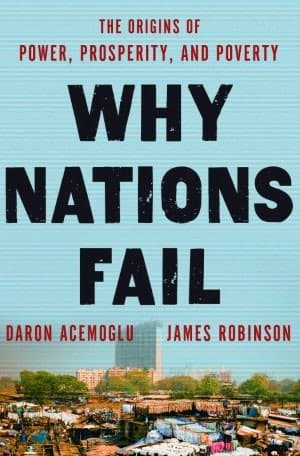
Why Nations Fail
by Daron Acemoglu, James A. Robinson
Acemoglu and Robinson make a sweeping, history-driven case that political and economic institutions, not geography or culture, explain why some nations prosper and others stay poor.
What It's About
Why Nations Fail takes on a question that sounds simple and isn't: why are some countries rich and others poor, and why does that gap persist for generations? Daron Acemoglu and James Robinson, economists who study political economy, answer that the decisive factor is institutions, meaning the rules that determine who holds power, how property is protected, and who gets to share in the gains from economic activity. They argue that countries with inclusive institutions tend to grow, while those run by narrow elites who extract wealth from everyone else tend to stagnate, even when they have natural resources, good geography, or capable people.
The book's style is that of a long, argumentative tour rather than a single theory built from equations. The authors move through a wide run of historical episodes, from medieval and early modern Europe to the Americas, Africa, Asia, and the divided Korean peninsula. Many chapters hinge on what they call critical junctures, moments when a shift in power or a lucky accident pushes institutions onto different tracks. Some of the examples are vivid and memorable, and the authors are good at showing why a border, a revolution, or an epidemic might have mattered.
Reading it feels like being walked through a persuasive case by two authors who want to win you over. It is accessible for a general reader, with few technical passages, and it rewards patience with its recurring framework. Expect to be convinced in places and to keep a skeptical pencil handy in others.
Read this if you…
- Want a big-picture explanation of why living standards differ so much between countries
- Enjoy history told to make an argument, with many examples from different centuries and continents
- Are interested in how politics and economics shape each other
Skip it if you…
- Want a rigorous, data-first analysis with formal models and detailed statistical tests
- Are looking for a balanced survey of all the major theories of economic development
Key Ideas
- 1
Inclusive versus extractive institutions
The core distinction in the book is between institutions that spread political power and economic opportunity widely and those that concentrate both in a small group. Inclusive systems encourage people to invest, innovate, and take risks because they can keep the rewards. Extractive systems take resources from the many to benefit the few, which may bring short-term gains but discourages long-term growth.
- 2
Why geography and culture fall short
The authors spend real effort rejecting the common alternatives: that hot climates, disease, or cultural traits doom a country to poverty. They point to places with similar geography and very different outcomes, such as cities or regions divided by a border, to argue that the rules a society lives under matter more than the land it sits on.
- 3
Critical junctures and path dependence
Institutions are rarely the product of a steady plan. The book argues that moments of upheaval, such as wars, revolts, plagues, or sudden shifts in trade, can set a country on a path that becomes very hard to leave. Once a ruling group has built its advantages into the system, those advantages tend to reproduce themselves.
- 4
Vicious and virtuous circles
The authors describe how institutions reinforce themselves. Extractive rulers who fear losing power resist reforms that would strengthen citizens, which keeps the economy stuck. Inclusive arrangements can likewise build momentum, as broader participation supports more reform. The framework helps explain why some countries escape poverty while others fall back into it.
Limitations
Critics have argued that the book leans heavily on one explanatory factor and can make the concept of inclusive institutions stretch to fit whatever case is being discussed. Its treatment of China, where rapid growth has occurred under a highly centralized state, has drawn particular skepticism. Some historians and economists have also questioned the selection and simplification of individual case studies. The book is more persuasive as an argument than as a complete account, and readers should check its claims against specialist sources.
Questions Readers Ask
- Is Why Nations Fail hard to read?
- No. It is written for a general audience and avoids heavy mathematics. The historical chapters are engaging and the central argument is easy to follow. Some sections repeat the same framework, which can feel slow, but the book is generally approachable for anyone comfortable with popular nonfiction about history or economics.
- How does it compare to Jared Diamond's Guns, Germs, and Steel?
- Both books ask why some societies came to dominate others. Diamond emphasizes geography, environment, and technology, while Acemoglu and Robinson focus on political and economic institutions. If you found Diamond's explanations too deterministic, this book offers a different framework. Readers who want a more historical, less environmental account will likely prefer it.
- Published
- 2012
- ISBN
- 9789584232830
- Difficulty
- intermediate
- Category
- Science
Book details and cover from Google Books.
Ready to read Why Nations Fail?
Get your copy on Amazon, or listen to it on Audible. We earn a commission if you buy through these links.